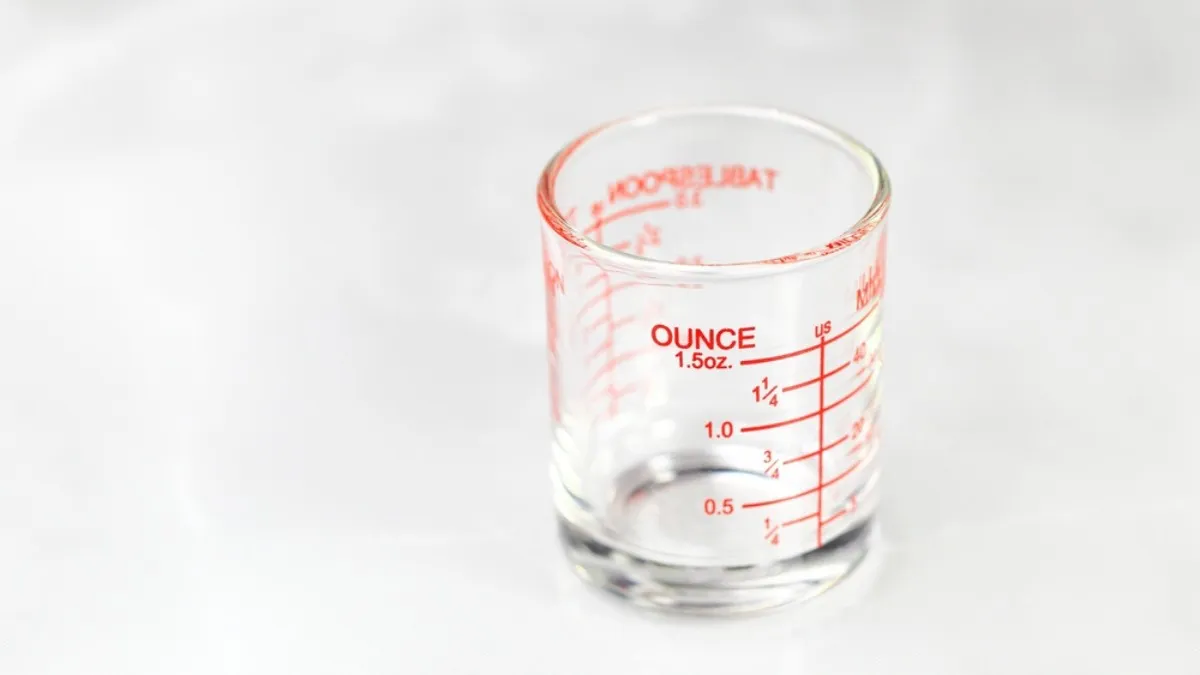
Have you ever wondered how many ounces are in a cup? Well, if you did, you are not alone. Most of us have found ourselves confused when converting between ounces and cups, and that is what we will address in this article. Knowing how to convert ounces to cups is an invaluable skill, with applications in various areas of life, not just cooking as it's generally perceived, but also in school projects, storage, science experiments, etc.
Let’s dive in!
How Many Ounces in a Cup? The Ultimate Conversion Guide
The American standard measurement system considers one liquid cup as 8 fluid ounces. To determine how many ounces are in a cup; simply multiply the number of cups by 8. Half a cup is an example of an item which is 4 fluid ounces and 2 cups equals to 16 fluid ounces.
Making the wrong measurements is a simple error you can commit whether you are doubling a recipe of a soup or you are attempting to bake something. This confusion is normally attributed to the distinction between the process of measuring solids and liquids.
Before we get into the conversions, we must first understand that not all ounce measurements are equal; in other words, the measurements vary across countries. Also, please note that liquid and solid measurements are not the same. While liquid measurements are straightforward, solid measurements are complex.
We will discuss three major measurement systems in use: the US, the UK, and the metric system.
Ounces to Cups (US)
In the United States of America (US), the standard conversion from cups to ounces is 1 cup equals 8 fluid ounces (8 fl oz) for liquids. It is equivalent to 236.58 ml of liquid in a cup. This conversion is uniform across all the liquid measurements.
Some other essential conversions are listed below.
1/2 cup = 4 fl oz
1/4 cup = 2 fl oz
1/8 cup = 1 fl oz
Ounces to Cups (UK)
In the UK, the conversion from ounces to cups is higher than in the US. In the UK, cups to ounces is officially recognised: 1 cup equals 10 imperial fluid ounces (fl oz).
It is also called imperial cup measurement, and is equivalent to 284.1 ml of fluid.
Ounces to Cups (Metric System)
The metric system is a global standard of measurement, mainly because of its simplicity and precision. Its advantage is that it does not require decimals, unlike the US and UK measurement systems discussed above. It is the gold standard which is followed worldwide.
According to metric conversion, 1 cup equals 250 ml.
Liquid vs. Dry Measurements: What is the Difference?
The domestic volume measures are regulated by the customary approach of the United States that puts the standard cup of liquid at eight fluid ounces (fl oz). The mistake that is most frequently made with the kitchen is the conflation between fluid ounces (volume or space) and dry ounces (weight or mass).
Fluid Ounces (Volume): 1 cup will always be 8 fluid ounces in case of water, milk, or oil.
Weight (Dry): When using dry products, such as flour, oats, sugar, etc., 1 cup of that specific product may weigh differently when weighed in it’s state (dry). An example of that is 1 cup of granulated sugar has a weight of approximately 7.1 dry ounces whereas 1 cup of all-purpose flour has a weight of 4.25 dry ounces.
When a recipe asks for "ounces" of a dry ingredient, it requires a kitchen scale, not a liquid measuring cup.
The US Customary System vs. The Imperial System
When using a United Kingdom, Australian, or American recipe, watch out for regional variations. The imperial system of British Empire refers to a cup as 10 imperial fluid ounces (theoretically around 284 milliliters). This is approximately 20 percent bigger than a typical US cup (236.588 milliliters). You should never measure without checking the origin of your recipe.
Quick Conversion Chart: Cups to Fluid Ounces
Use this standardized US customary conversion table for all liquid ingredients:
| Cups | Fluid Ounces (fl oz) | Tablespoons (tbsp) |
| 1/4 Cup | 2 fl oz | 4 tbsp |
| 1/3 Cup | 2.66 fl oz | 5 tbsp + 1 tsp |
| 1/2 Cup | 4 fl oz | 8 tbsp |
| 3/4 Cup | 6 fl oz | 12 tbsp |
| 1 Cup | 8 fl oz | 16 tbsp |
| 2 Cups (1 Pint) | 16 fl oz | 32 tbsp |
| 4 Cups (1 Quart) | 32 fl oz | 64 tbsp |
As we mentioned above, measuring solid items is complex because the weight of a cup filled with dry materials depends on the material, environmental conditions like humidity, and the way it's packed.
For tasks that require precise measurements, it is recommended to use a scale that measures in both ounces and grams, thereby ensuring greater accuracy.
Check out some more interesting articles from the general knowledge section to boost your knowledge of national and international topics. Stay connected with Jagran Josh for more topics like this.
Also Read:



Comments
All Comments (0)
Join the conversation