Birds Can See The Earth's Invisible Magnetic Field – But How? Here's What You Need To Know
Ever look up and wonder how birds manage those epic cross-continental journeys? Spoiler: they are not checking Google Maps. Turns out, these feathered travellers have a built-in quantum compass, right in their eyeballs. Yep, special proteins let them actually see the Earth's magnetic field, which is basically their secret navigation superpower.

Key Points
- Birds use Cryptochrome-4a protein in their eyes to detect Earth's magnetic field.
- Earth's magnetic field provides a constant, reliable navigation tool for birds.
- A 2004 study proved birds rely on eye-based chemical sensors for direction.
Did you ever look up at the sky and wonder about the amazing world of birds? Our planet is full of different kinds of birds. Some of them, like the Ruppell's griffon vulture, can take the highest flights, soaring up to 11,300 meters in the sky! On the other hand, some birds like penguins and ostriches are completely flightless.
But the most esoteric thing happens when seasons change. Every year, as winter comes closer, millions of migratory birds start a long journey. They leave their cold homes and fly to warmer places.
Take the tiny Bar-tailed Godwit, for example. According to wildlife studies, this incredible bird departs from Alaska at the end of summer and flies nonstop for 11,000 kilometres over the Pacific Ocean to reach New Zealand.
It does not stop for food or water even once! But how do they know the exact directions? How do they decide where to fly and where their destination will be?
There is an invisible force around us that helps them. It is called the Earth's magnetic field. In this article, we'll take a look at the secret superpower birds use to read this invisible force and find their way without any Google Maps!
How Do Birds Detect The Earth's Magnetic Field?
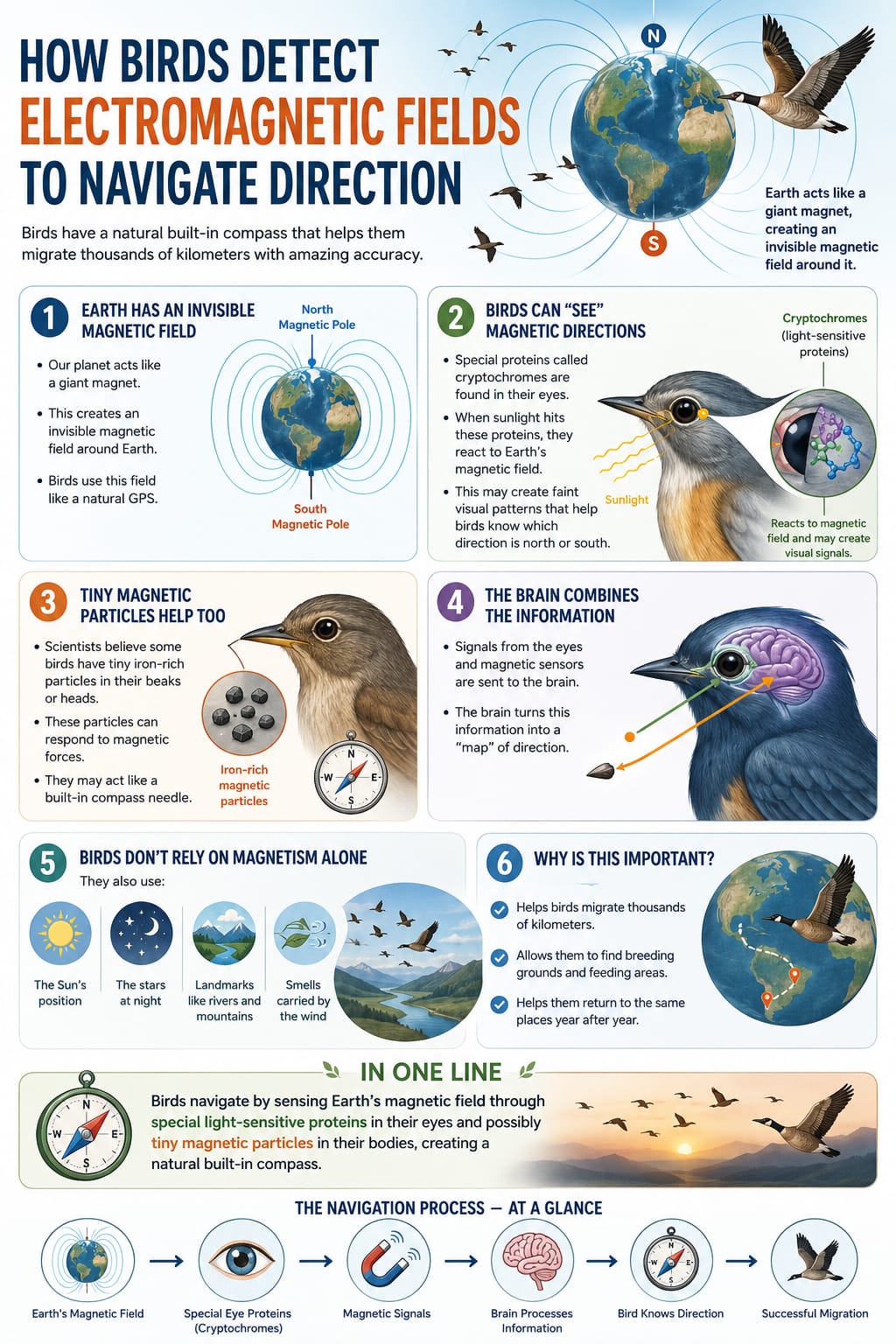
Birds can actually "see" the Earth's magnetic field using a special protein inside their eyes. The Earth is like a giant magnet, and it creates an invisible shield of magnetic lines stretching from the South Pole to the North Pole.
While humans need a mechanical compass with a metal needle to find north, birds have a built-in quantum compass.
Scientists have found out that migratory birds use a special light-sensitive protein called Cryptochrome-4a (Cry4a) in their retinas. When blue light enters the bird's eye, it hits this protein and triggers a super-fast chemical reaction.
This reaction creates a pair of molecules that are highly sensitive to the angle of the Earth's magnetic field. This allows the bird to perceive light and dark patterns overlaid on their vision, showing them exactly where the magnetic lines are pointing.
What Is The Earth's Magnetic Field?
To understand how this works, we first need to know what a magnetic field is. The centre of our Earth is filled with hot, liquid iron that is constantly moving. This moving iron works like a giant electric generator. It creates an invisible force field around the planet. You cannot feel it, but it is always there.
A standard magnetic field lines up from the south to the north. For humans, we have used metal compasses for over 1,000 years to read these lines. But for birds, this field is an everyday highway guide.
The strength of this field on the surface is very weak—only about 30 to 50 microteslas. That is thousands of times weaker than a simple fridge magnet! Yet, birds can sense it easily.
Why Is It Important For Birds?
Migration is a very risky journey. In fact, data show that only about 30 per cent of small songbirds survive their very first migration journey to their wintering grounds and back. The remaining 70 per cent often get lost or face bad weather.
Because the stakes are so high, having a reliable compass is a matter of life and death. The magnetic field is the only navigation tool that never changes. The sun can hide behind dark clouds, and the stars can be blocked on a foggy night.
But the magnetic field is always available, 24 hours a day. It helps the birds stay perfectly on track so that around 50 per cent of adult songbirds manage to return to the exact same nesting box every single year.
How Does the Eye Compass Actually Work?
This is where the real science magic happens. Inside the eyes of migratory birds, the Cryptochrome-4a protein acts like a quantum sensor.
When blue light activates this protein, it creates two free radicals. The electrons in these radicals start a quantum dance, switching between two states called singlet and triplet. The weak magnetic field of the Earth shifts this balance.
Depending on which way the bird turns its head, the chemical reaction changes. This change tells the bird's brain whether they are flying toward the equator or toward the poles.
A famous study published in the year 2004 by scientist Thorsten Ritz showed that if you disrupt this delicate quantum dance using weak radio-frequency waves, the birds completely lose their direction. This proves they rely on this eye-based chemical sensor to see the magnetic lines.
Do Birds Have Another Magnet Sensor?
v
Yes, birds actually have a backup system! Apart from the quantum compass in their eyes, scientists have discovered tiny particles of a natural magnetic mineral called magnetite inside the beaks of certain birds, like pigeons
While the eye compass helps them see the direction (like an inclination compass), the magnetite in their beak acts like a GPS unit that measures the intensity or strength of the field. This helps the bird build a permanent map in its brain.
Once a young bird completes its first journey, it combines the eye compass and the beak map to navigate with an ultimate precision of centimetres over thousands of kilometres.
Conclusion
It is truly mind-blowing to think that a tiny bird flying through a dark, stormy night uses quantum physics to find its home. From the vast boreal forests to the tiny receptors in a songbird's eye, nature has designed the perfect navigation tool. The Earth's magnetic field acts as an invisible highway in the sky, guiding billions of birds safely across oceans and continents twice every year. Next time you see a flock of birds flying smoothly in a V-shape during autumn, you will know that they are reading the planet's secret magnetic map to reach their destination.

Kriti Barua is a skilled digital journalist and communications professional with 4+ years of experience, currently writing for the General Knowledge section at Jagran New Media. She has established herself as a subject matter expert in History, Geography, Trending National and International News, Sports, Science, and Defence, producing clear, reliable, and search-optimised content that connects with readers worldwide.
Kriti holds a BA degree from Delhi University and a one-year diploma in TV Production and Journalism, an academic background that adds research depth and strong storytelling instincts to her writing. Her experience spans brand writing, content marketing, and digital media, giving her a sharp understanding of what makes content both helpful to readers and visible in search.
At Jagran New Media, she applies this expertise to national and international news coverage, query-based articles, and in-depth pieces across her specialist subject areas. Her content is defined by easy language, factual accuracy, strong keyword strategy, and reader-friendly storytelling.


