Evolution of the Indian National Flag (1906–1947): From Calcutta Flag to the Ashoka Chakra
India’s national flag evolved significantly between 1906 and 1947. Originating as the Calcutta Flag with lotus flowers, it went through major redesigns involving the Charkha and new colour schemes, ultimately culminating in the modern Tricolour featuring the Ashoka Chakra.
Key Points
- The first unofficial Indian flag, the Calcutta Flag, was hoisted on August 7, 1906.
- Madam Bhikaji Cama hoisted the first Indian flag on foreign soil in Germany in 1907.
- The current National Flag with the Ashoka Chakra was adopted on July 22, 1947.
Every year on the 15th of August, we witness the tricolour being raised, and yet somehow we feel a tingle of goosebumps. What many don't know is that this tricolour that we see today is not how things were always.
Before the Ashoka Chakra occupied the centre, there was a time when India experimented with multiple other flags, a few forgotten, a few banned, and a few even flown in foreign lands.
All of these flags had a story attached to them. The tricolour's history is not just plain. In this article, we will trace back to the flags that preceded our present tricolour.
The Evolution of the Indian National Flag (1906–1947)
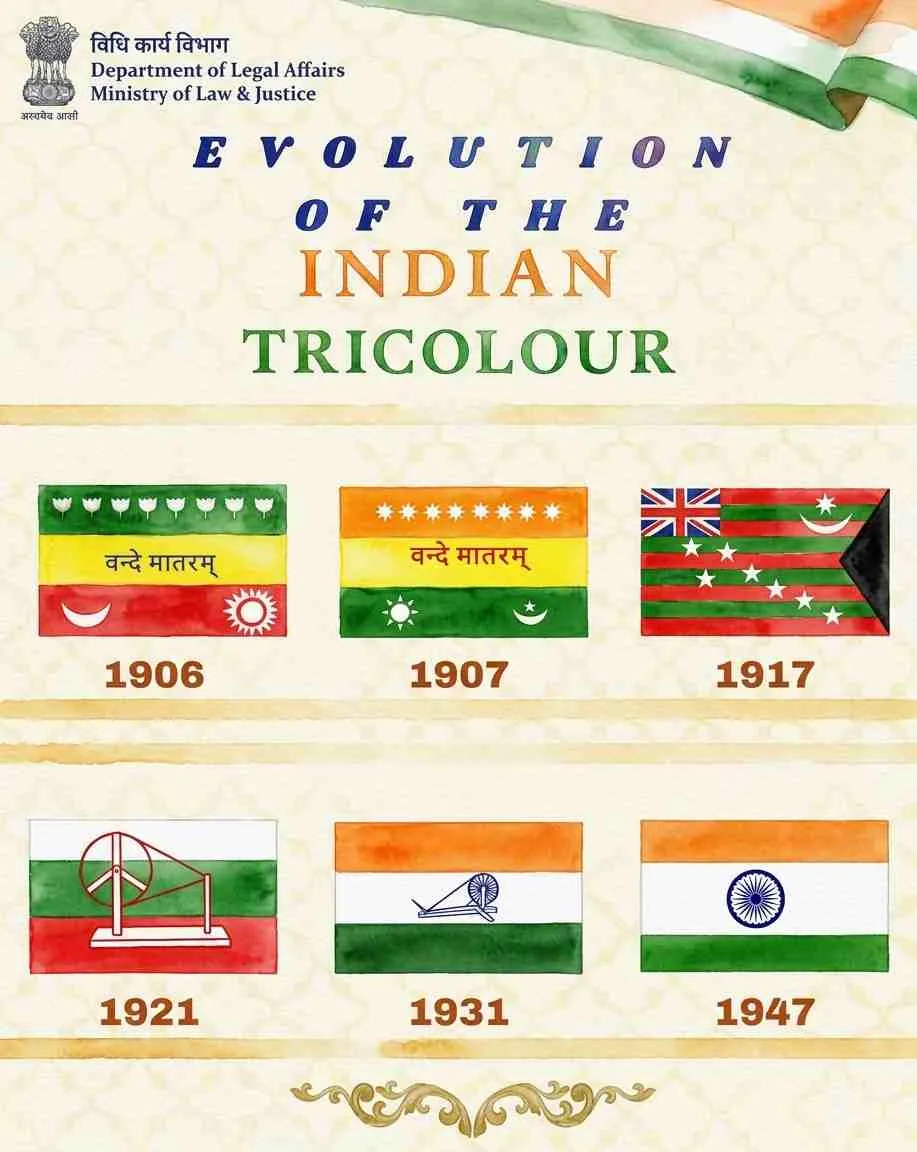
The Indian flag did not just spring out of nowhere. It evolved over a period of more than four decades through struggle, discussion, and even sacrifice.
Each design was indicative of the spirit of the times, religious in some cases, political in others, and some representing unity. In 1947, all of these concepts were combined to create the three-colour flag.
| Flag | How Did It Look? | Description |
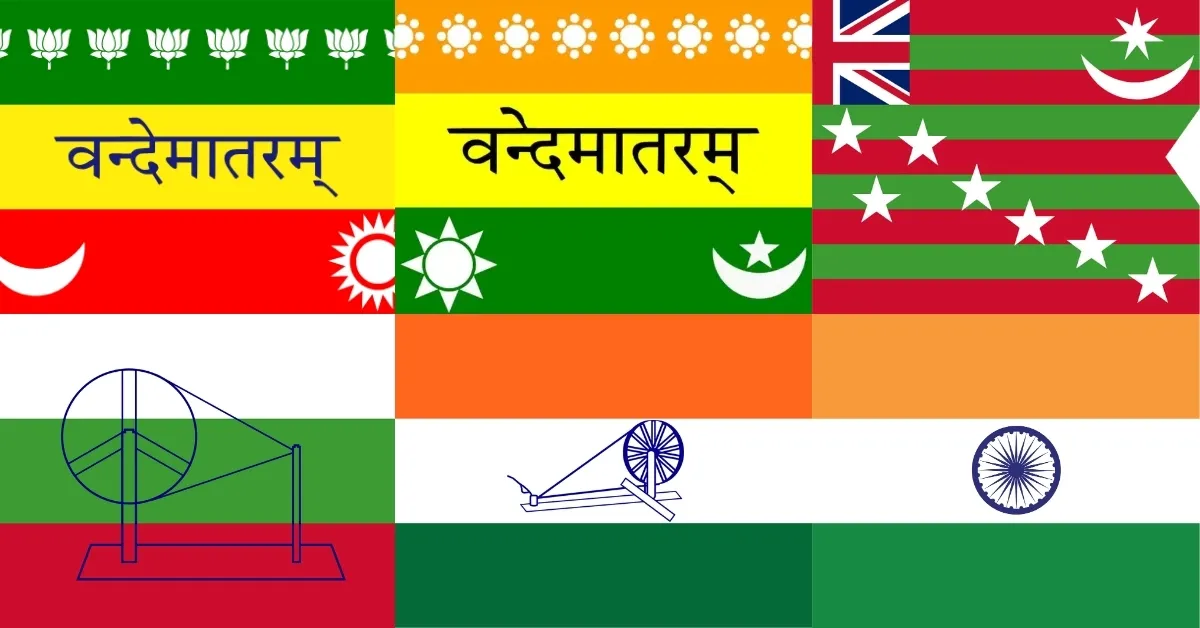
| Calcutta Flag (1906) | Three horizontal stripes — green, yellow, red — with eight lotuses, a sun, and "Vande Mataram" | First unofficial flag, hoisted in Calcutta on August 7, 1906, during Swadeshi protests |
| Berlin Committee Flag (1907) | A modified tricolour with a star and crescent pattern, similar to the Calcutta flag | Hoisted by Madam Bhikaji Cama in Germany, the first Indian flag raised on foreign soil |
| Home Rule Flag (1917) | Five red and four green stripes, seven stars, and the Union Jack in one corner | Introduced during the Home Rule Movement, it sought dominion status within the British Empire |
| Gandhi–Venkayya Flag (1921) | Red and green stripes with a spinning wheel at the centre | Designed by Pingali Venkayya, representing Hindus and Muslims through its two colours |
| Swaraj Flag (1931) | Saffron, white, and green stripes with a charkha at the centre | Adopted at the Karachi session, removing communal meaning from the flag's colours |
| National Flag (1947) | Saffron, white, green with a navy blue Ashoka Chakra of 24 spokes | Adopted on July 22, 1947, replacing the charkha with the Ashoka Chakra from Sarnath |
Why Did India Need a Flag in 1906?
The partition of Bengal by Britain in 1905 caused immense pain to the people. They protested all around the country, and the movement of Swadeshi started.
They needed something to bond them together, something which could act as an emblem for them despite any regional or religious differences. The flag of Calcutta emerged on August 7, 1906.
Sachindra Prasad Bose and his nationalists unfurled the flag at Parsee Bagan Square, today known as Greer Park. The flag was unofficial; it was not adopted after voting or deliberation by any government committee.
But it represented the rage and aspiration of the nation. Eight lotuses were present on one stripe of the flag, believed to represent the eight provinces of India then.
That is why the significance of this particular day cannot be denied, as it marks the very beginning of the flag history of India, 41 years before independence.
How Did the Flag Change During the Freedom Struggle?
The flag did not remain the same for long. In 1907, Madam Bhikaji Cama hoisted a modified flag at Stuttgart in Germany during the International Socialist Congress.
And with this one act, the flag became the first Indian flag to fly on foreign soil – a fact still found in history books.
Ten years down the line, in 1917, another flag was hoisted by Annie Besant and Bal Gangadhar Tilak during the Home Rule Movement.
This particular flag had nine stripes, five red and four green stripes, and seven stars positioned in the shape of the Saptarishi constellation, along with the Union Jack in one corner.
Why? The reason being that the aim of the movement was not independence but dominion status only.
What Role Did Mahatma Gandhi Play in the Flag's Design?
When Venkayya approached Gandhi during a Congress session in Vijayawada in 1921, he presented him with a flag that had two colours only – red for Hindus and green for Muslims.
Gandhi liked the flag but thought that there was still some element lacking from it. He advised the addition of a third colour, white, for other communities.
Besides that, he proposed placing the spinning wheel, known as charkha, in its centre to symbolise self-sufficiency and hard work. Though this flag did not become an official one, it was used throughout India nevertheless.
Why Was the Charkha Replaced With the Ashoka Chakra?
By 1931, some people had concerns that the colours of the flag appeared too religious. As a result, the Congress Working Committee gathered in Karachi and came up with a new design.
Saffron took the place of red, while the stripes were changed to saffron, white, and green, with the charkha still present in the centre. Thus was born the Swaraj Flag.
Finally, the Constituent Assembly added the last detail to it just 24 days prior to India becoming independent.
On July 22, 1947, Jawaharlal Nehru suggested substituting the charkha for the Ashoka Chakra, a twenty-four-spoke wheel, which could be found on Emperor Ashoka's Lion Capital at Sarnath.
What Do the Colours and Symbols of the Flag Mean?
Each of these colours in the flag is symbolic. Saffron is a colour that signifies bravery and self-sacrifice. White signifies purity and truth, while green signifies faith and prosperity.
"None of these colours", as explained by Nehru in his speech in the Constituent Assembly, "were intended to represent any particular religion or community."
In the middle of the flag is the Ashoka Chakra, which is blue in colour and has 24 spokes. This chakra symbolises eternal law, or dharma, and is supposed to motivate its citizens to progress without coming to a standstill.
It was taken from the Lion Capital of Ashoka in Sarnath, an ancient monument that is almost 2,200 years old. Its size has always been 2:3 (since 1947).
Conclusion
In conclusion, it becomes evident that the flag could not have been made in one go. It took nearly four decades and countless designs and inputs by people of all religions and regions.
The lotus flag of Calcutta, the banner of Cama in Germany, the flag of the charkha of Gandhi and the Swaraj flag contributed something which the tricolour would have lacked otherwise.
The changeover to the Ashoka Chakra in 1947 was no ordinary change. It represented a long collective struggle.

Kriti Barua is a skilled digital journalist and communications professional with 4+ years of experience, currently writing for the General Knowledge section at Jagran New Media. She has established herself as a subject matter expert in History, Geography, Trending National and International News, Sports, Science, and Defence, producing clear, reliable, and search-optimised content that connects with readers worldwide.
Kriti holds a BA degree from Delhi University and a one-year diploma in TV Production and Journalism, an academic background that adds research depth and strong storytelling instincts to her writing. Her experience spans brand writing, content marketing, and digital media, giving her a sharp understanding of what makes content both helpful to readers and visible in search.
At Jagran New Media, she applies this expertise to national and international news coverage, query-based articles, and in-depth pieces across her specialist subject areas. Her content is defined by easy language, factual accuracy, strong keyword strategy, and reader-friendly storytelling.