Difference Between Continental Crust and Oceanic Crust
Learn the difference between continental crust and oceanic crust with a detailed comparison of thickness, density, composition, age, formation, and key features.

Difference Between Continental Crust and Oceanic Crust
Key Takeaways
-
Earth's crust is divided into two main parts, which are continental crust and oceanic crust.
-
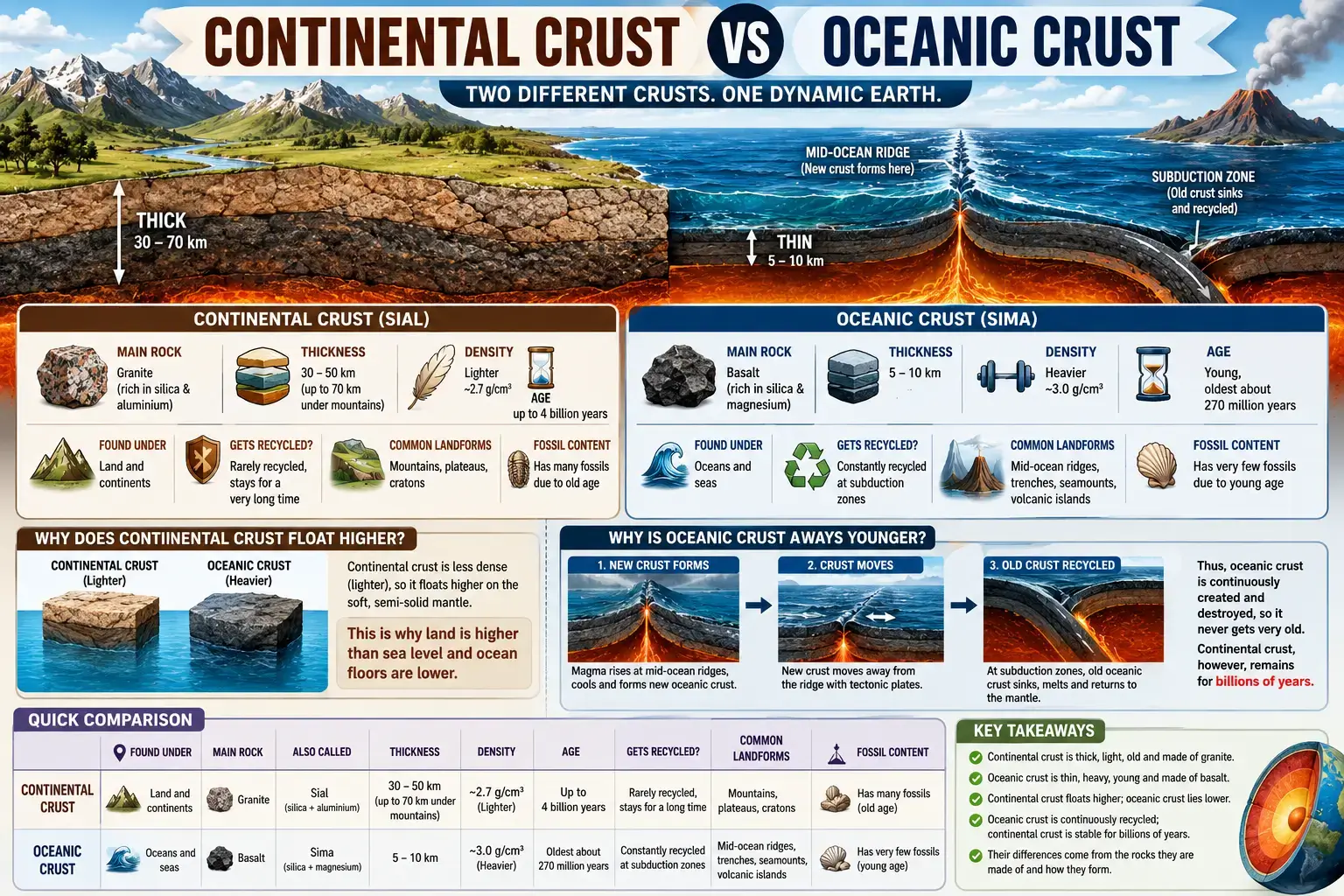
Continental crust is thicker, at about 30 to 70 km, and lighter, while oceanic crust is thinner, at about 5 to 10 km, and heavier.
-
Continental crust is made of granite and Silica (Si) and Aluminium (Al); together it is termed 'SiAl', while oceanic crust is made of basalt and is also called Silica (Si) and Magnesia(Ma), together it is termed ‘SiMa’.
-
Continental crust is much older, around 4 billion years old, while the oldest oceanic crust is only about 270 million years old.
-
Oceanic crust keeps forming at mid-ocean ridges and gets destroyed at subduction zones, but continental crust mostly stays and rarely gets recycled.
-
Because continental crust is lighter, it floats higher on the mantle, which is one reason land rises above sea level while ocean floors stay below it.
The earth is composed of many layers, and on the outermost layer, the crust, we live! However, did you know that the crust varies from place to place? It is actually divided into two main types, continental crust and oceanic crust. These two types are different in thickness, weight, age and even in the rocks they are made from.
In this article, you can cover Earth’s Crust, what is continental crust, what is Oceanic Crust, and the differences between continental crust and oceanic crust in detail.
What Is Earth's Crust?
According to National Geographic, “Crust describes the outermost shell of a terrestrial planet. Earth's crust is generally divided into older, thicker continental crust and younger, denser oceanic crust. The dynamic geology of Earth's crust is informed by plate tectonics.”
The crust is divided into two parts based on where it is found and what it is made of:
- Continental crust, found under the continents (land areas)
- Oceanic crust, which is located beneath the oceans (sea floor)
What Is Continental Crust?
Continental crust is the part of the Earth's crust that forms the land we live on, including mountains, plains and plateaus.
- Made of: Mostly granite, a light coloured rock rich in silica and aluminium. Because of this, scientists also call it "sial" (silica plus aluminium).
- Thickness: Usually 30 to 50 kilometres thick, but it can become as thick as 70 kilometres under tall mountain ranges such as the Himalayas.
- Weight (density): Lighter, about 2.7 grams per cubic centimetre.
- Age: Some parts of continental crust are more than 4 billion years old. Some of the oldest rocks on Earth have been found in Quebec, Canada.
- How it forms: Continental crust grows slowly through mountain building, which happens when tectonic plates push against each other over millions of years.
- Special features: Mountain ranges, plateaus and very old, stable regions called cratons.
What Is Oceanic Crust?
Oceanic crust is the part of the crust that lies under the ocean floor.
- Made of: Mostly basalt, a dark, heavy volcanic rock rich in iron and magnesium. Scientists also call it "sima" (silica plus magnesium).
- Thickness: Much thinner than continental crust, usually only 5 to 10 kilometres.
- Weight (density): Heavier, almost 3 grams per cubic centimetre.
- Age: The oldest known oceanic crust is found in the Ionian Sea, part of the eastern Mediterranean, and it is about 270 million years old. This is very young compared to continental crust.
- How it forms: New oceanic crust is created at places called mid ocean ridges, where hot magma rises from inside the Earth, cools down and turns into new rock. At subduction zones, old oceanic crust is dragged back into the Earth, slowly melting back down into the mantle.
- Special features: Mid ocean ridges, deep ocean trenches, volcanic islands and underwater mountains called seamounts.
Continental Crust vs Oceanic Crust
Below in the table, the difference between Continental Crust and Oceanic Crust is given in detail:
| Feature | Continental Crust | Oceanic Crust |
| Found under | Land and continents | Oceans and seas |
| Main rock | Granite | Basalt |
| Also called | Sial (silica and aluminium) | Sima (silica and magnesium) |
| Thickness | 30 to 50 km (up to 70 km under mountains) | 5 to 10 km |
| Density | Lighter, about 2.7 g/cm³ | Heavier, about 3.0 g/cm³ |
| Age | Very old, up to 4 billion years | Young, oldest is about 270 million years |
| Gets recycled? | Rarely recycled, stays for a long time | Constantly recycled at subduction zones |
| Common landforms | Mountains, plateaus, cratons | Mid ocean ridges, trenches, seamounts |
| Fossil content | Has many fossils due to old age | Has very few fossils due to young age |
Why Does Continental Crust Float Higher Than Oceanic Crust?
Continental crust floats higher than oceanic crust because of density and therefore floats higher on the soft, semi solid mantle below it.
Oceanic crust has a higher density and weight and is located at a lower level. This is the same for a light object of wood that floats up on the water more than a heavier object of wood.
This difference of elevation is also the reason that land is higher than sea level and the ocean bottoms are lower.
Why Is Oceanic Crust Always Younger Than Continental Crust?
Oceanic plates continue to be recycled and regenerated. New oceanic crust is generated at mid ocean ridges as magma rises up from within the earth. Old oceanic crust at subduction zones is recycled back into the mantle and is again melted. Thus, oceanic crust does not become very old.
Continental crust is not obliterated in this manner. After its formation, it typically persists on the surface for a very long time, and can thus be billions of years old.
Thus, continental crust is thick, light, old and consists of granite. It is the type of crust that forms the land we live on, while oceanic crust is thin, heavy, young and composed of basalt. It makes up the bottom of our oceans. Most of their differences are due to the rock they are formed from and the type of rock.
Test Your Knowledge
Q. Consider the following statement regarding Earth’s crust:
1. The oceanic crust is the younger than the continental crust
2. The continental crust is thicker than the oceanic crust
3. The oceanic crust is lighter than the continental crust.
Which of the following statements is correct regarding the Earth's crust?
A. 1 and 2 only
B. 2 and 3 only
C. 1 and 3 Only
D. All are correct
Correct Answer: A
Explanation:
-
The oceanic crust is much younger than the continental crust. The rock which is found in oceanic crust is around 200 million years old, and some of the continental rock ages are around 3200 million years old. Hence, Statement 1 is correct.
-
The thickness of both the crusts varies from each other, and the continental crust is more thicker than the oceanic crust. The thickness of continental crust is about 30 to 50 km (up to 70 km under mountains), whereas the thickness of oceanic crust is about 5 to 10 km only. So, Statement 2 is also correct.
-
The density of oceanic crust is about 3.0 g/cm³, whereas continental crust has 2.7 g/cm³, which is slightly less than oceanic crust. Hence, Statement 3 is is not correct.
So, the option A is the correct answer for this question.

Prabhat Mishra is a Subject Matter Expert and digital journalist with an extensive background in the competitive exam landscape and over 4 years of experience in education, national and international news, and current affairs. Over his tenure with top knowledge platforms like Mentorship India, IAS BABA, IAS SARTHI, and now Jagran Josh, he has a deep understanding of government exams like UPSC and State PCS, including UP and Bihar, as he has already qualified for the UPPCS 2022 Mains and Bihar 68th Mains. With his core expertise in history, polity, geography & current affairs, he specialises in creating well-researched, aspirant-centric content and simplifying complex topics for competitive examinations.


