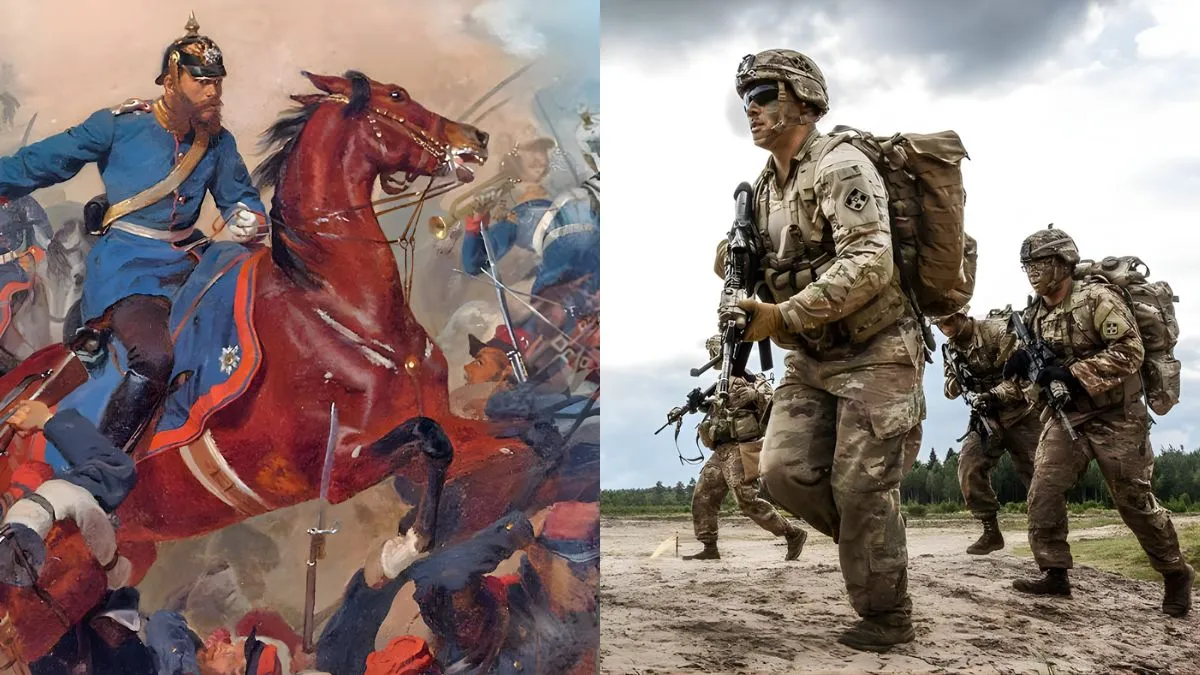
Difference Between Battle and War: Have you ever thought, why the Battle of Panipat, Battle of Plassey, Battle of Buxar were called Battles, but on the other hand, World War I, World War II, Kargil War of 1999, and the recent conflict ongoing between Iran Israel war are called War? These two terms, Battle and War, are often used interchangeably, but they are both different, and they both represent vastly different scales of conflict. Understanding the difference Between Battle and War is fundamental to history, political science, and military strategy. So, let’s explore the Battle vs War with their definition and differences between them in detail.
What is a Battle?
A battle is a localised, short-term military engagement between opposing forces. It is a single point of contention within a larger conflict.
-
Setting: Battles can occur on land, at sea, or in the air.
-
Objective: The goal is usually tactical—capturing a specific hill, defending a bridge, or defeating a specific regiment.
-
Examples: The Battle of Plassey (1757) or the Battle of Waterloo (1815).
What is a War?
A war is a prolonged state of violent conflict between organised groups, such as nations or political factions. A war is not a single event; it is a collection of many battles, diplomatic manoeuvres, and economic strategies.
-
Setting: Broad geographical areas, sometimes spanning continents.
-
Objective: The goals are strategic and political—overthrowing a government, gaining independence, or ideological dominance.
-
Examples:
-
World War II, the Vietnam War, or the Kargil War.
-
Recently, the Iran-Israel war is ongoing, which is also come in war category beacuse this geopolitical fight is between the two nations, and the US is also involved in this Iran-Israel war, where the US is supporting Israel in this Iran-Israel war.
Battle vs War: Check the Difference Between Battle and War
The battle was for a short duration, and on the other hand, the duration of war is long-term. Here, below in the table format, all the differences between Battle and War are given:
| Characteristic | Battle | War |
| Duration | Short-term (Hours to Days) | Long-term (Months to Years) |
| Scale | Localised to a specific site | Regional, National, or Global |
| Complexity | Direct military confrontation | Involves politics, economics, and society |
| Outcome | Tactical win or loss | Geopolitical shifts and peace treaties |
| Casualties | Primarily military personnel | High civilian and military toll |
What is the historical impact of the Battle and War, and how do they shape the world?
The Battles and War has imapcted in many ways, and they both have different momentum. A battle has always changed the momentum of a conflict, and a war changes the course of history. How the Battles and wars impacted, here is given below in detail:
1. Societal and Political Effects
Wars often lead to the creation of new international bodies (like the United Nations after WWII) or the redrawing of national borders. Battles, while intense, usually only result in a temporary shift in territorial control.
2. Economic Consequences
The economic impact of a battle is usually limited to the immediate vicinity. In contrast, war leads to national debt, trade disruptions, and long-term inflation. For example, the economic strain of the Cold War reshaped global markets for decades.
3. Psychological and Environmental Toll
While battles cause immediate trauma to soldiers, wars result in mass civilian migration, PTSD across generations, and large-scale environmental destruction due to prolonged bombing and resource depletion.
Key Takeaways from the Difference between Battle and War
These are the key takeaways from the Difference between Battle and War that can be noted:
-
A battle is a component of a war. You can win every battle but still lose the war (as seen in various historical insurgencies).
-
Scope matters. Battles are tactical; wars are strategic.
-
Interchangeability: Using these terms correctly is vital for academic writing and historical accuracy.
Frequently Asked Questions (FAQs)
Q1: What is bigger, battle or war?
In historical and military terms, the war is bigger than a battle, because a war is the long-term state of conflict between nations or groups, whereas a battle is a short-term, specific engagement that takes place within that war.
Q2: Can a war consist of only one battle?
Technically, no. A single engagement is a battle or a skirmish. A war implies a sustained "state of conflict" that usually involves multiple engagements and logistical efforts.
Q3: Why was the Kargil conflict called a "War" if it was localised?
Though fought in a specific region, it involved the total mobilisation of national resources, high-level political stakes between two nuclear-armed nations, and a prolonged duration that exceeded the scope of a single "battle."
Q4: When was World War 1 and between whom was the first World War fought?
World War I began on July 28, 1914, when Austria-Hungary declared war on Serbia, and ended on November 11, 1918. The first World War I (1914–1918) was fought between two main coalitions: the Allied Powers (Triple Entente) and the Central Powers. The primary Allied nations were France, Great Britain & the British Empire, Russia (until 1917), Italy (from 1915), and the United States (from 1917), while the Central Powers were led by Germany, Austria-Hungary, the Ottoman Empire, and Bulgaria.
Q5: When was World War 2 and between whom was the Second World War fought?
World War II was a global conflict that lasted from September 1, 1939, to September 2, 1945. It began with Germany's invasion of Poland and concluded in 1945 following the surrender of Germany in May and Japan in September. The war was fought between the Axis powers and the Allied powers.



Comments
All Comments (0)
Join the conversation