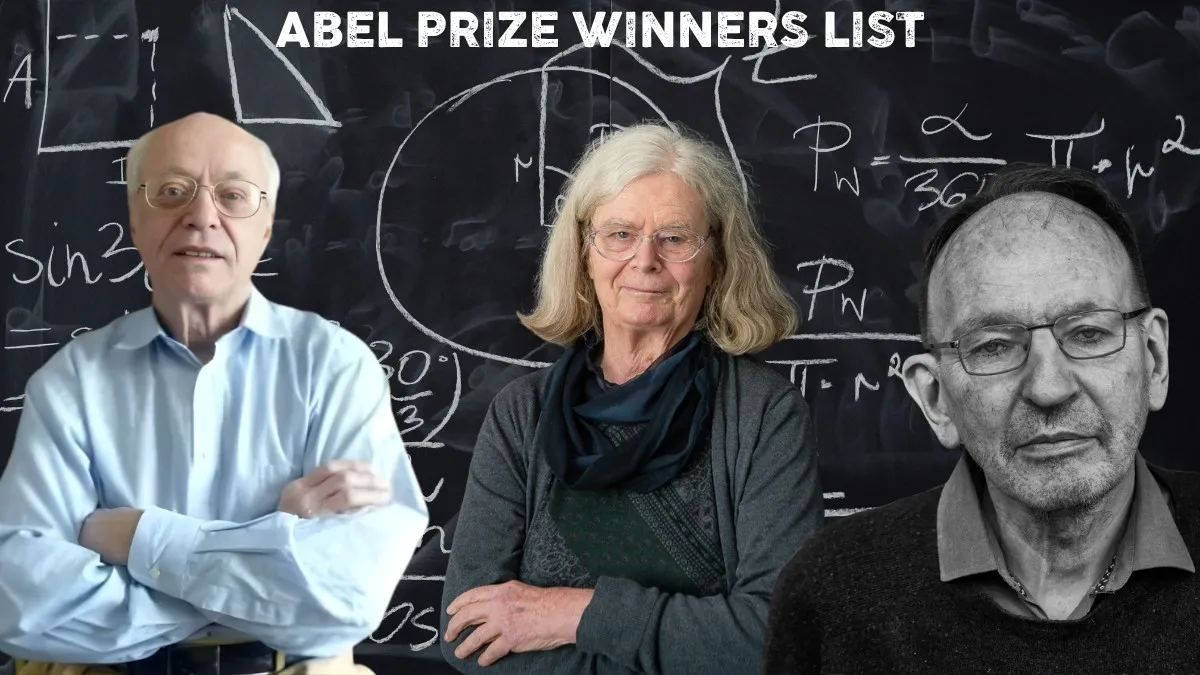
The most important award in mathematics globally is known as the Abel Prize, also referred to as the Nobel Prize of Mathematics. The award, named after mathematician Niels Henrik Abel, was established by the Norwegian government in 2001 and is awarded by the Norwegian Academy of Science and Letters.
It is presented each year at Oslo by the King of Norway and carries a cash prize of 7.5 million NOK to honor lifetime achievement in mathematics. The first recipient of the award was Jean-Pierre Serre (2003), the first female laureate was Karen Uhlenbeck (2019). The winner of 2026 is Gerd Faltings, an eminent mathematician who is the director emeritus of Max Planck Institute of Mathematics, Bonn.
What is the Abel Prize?
The Abel Prize, which was inaugurated by the Norwegian Academy of Science and Letters, was named after the great Norwegian mathematician of the 19th century Niels Henrik Abel. The Government of Norway established the award to encourage math to the world and mostly among the youths.
The Abel Prize today is considered one of the most prestigious awards mathematicians can win, it carries a price money of 7.5 million Norwegian Kroner (NOK) which is approximately equal to 700,000 USD. The Abel Committee, a committee of five internationally famed mathematicians, chooses the winner.
Abel Prize Winners (2003–2026)
Since its inception, the prize has been awarded to some of the greatest minds in modern science. Below is complete list of Abel Prize winners from 2003 to 2026.
| Year | Winner(s) | Nationality | Key Contribution |
| 2026 | Gerd Faltings | German | Introducing powerful tools in arithmetic geometry and resolving long-standing Diophantine conjectures (including the Mordell conjecture). |
| 2025 | Masaki Kashiwara | Japanese | Fundamental contributions to algebraic analysis and representation theory, particularly the development of D-modules and crystal bases. |
| 2024 | Michel Talagrand | French | Groundbreaking work in probability theory and stochastic processes, with applications in mathematical physics and statistics. |
| 2023 | Luis Caffarelli | Argentine-American | Seminal contributions to regularity theory for nonlinear partial differential equations, including free-boundary problems. |
| 2022 | Dennis Parnell Sullivan | American | Innovative contributions to topology in its broadest sense, notably its algebraic, geometric, and dynamical aspects. |
| 2021 | László Lovász & Avi Wigderson | Hungarian / Israeli | Foundational contributions to theoretical computer science and discrete mathematics, shaping them into central fields of modern mathematics. |
| 2020 | Hillel Furstenberg & Grigory Margulis | Israeli-American / Russian-American | Pioneering the use of methods from probability and dynamics in group theory, number theory, and combinatorics. |
| 2019 | Karen Uhlenbeck | American | Pioneering achievements in geometric partial differential equations, gauge theory, and integrable systems. (First female laureate) |
| 2018 | Robert Langlands | Canadian-American | For his visionary program connecting representation theory to number theory (the Langlands program). |
| 2017 | Yves Meyer | French | For his pivotal role in the development of the mathematical theory of wavelets. |
| 2016 | Andrew Wiles | British | For his stunning proof of Fermat's Last Theorem, opening a new era in number theory. |
| 2015 | John F. Nash Jr. & Louis Nirenberg | American / Canadian-American | Striking and seminal contributions to the theory of nonlinear partial differential equations and applications to geometric analysis. |
| 2014 | Yakov Sinai | Russian-American | Fundamental contributions to dynamical systems, ergodic theory, and mathematical physics. |
| 2013 | Pierre Deligne | Belgian | Seminal contributions to algebraic geometry and their transformative impact on number theory and representation theory. |
| 2012 | Endre Szemerédi | Hungarian-American | Fundamental contributions to discrete mathematics and theoretical computer science, impacting additive number theory. |
| 2011 | John Milnor | American | Pioneering discoveries in topology, geometry, and algebra. |
| 2010 | John Tate | American | For his vast and lasting impact on the theory of numbers. |
| 2009 | Mikhail Gromov | Russian-French | For his revolutionary contributions to geometry. |
| 2008 | John Griggs Thompson & Jacques Tits | American / Belgian-French | For their profound achievements in algebra, particularly for shaping modern group theory. |
| 2007 | S. R. Srinivasa Varadhan | Indian-American | Fundamental contributions to probability theory, specifically for creating a unified theory of large deviation. |
| 2006 | Lennart Carleson | Swedish | Profound and seminal contributions to harmonic analysis and the theory of smooth dynamical systems. |
| 2005 | Peter Lax | Hungarian-American | Groundbreaking contributions to the theory and application of partial differential equations and the computation of their solutions. |
| 2004 | Michael Atiyah & Isadore Singer | British / American | Discovery and proof of the index theorem, bringing together topology, geometry, and analysis. |
| 2003 | Jean-Pierre Serre | French | Playing a key role in shaping the modern form of topology, algebraic geometry, and number theory. |
Why is There No Nobel Prize for Mathematics?
One of the theories that are often wondered in the realms of general knowledge is why Alfred Nobel failed to incorporate mathematics in his initial five prize categories. Although there are a number of myths concerning the history, some of which are prone to debunking, the most probable fact is realistic.
Nobel was an innovator and a business essence. He provided rewards on those areas, which provided realistic, material gains to human beings (such as medicine, physics, and chemistry). During the period, mathematics was more of a theoretical discipline. The Abel Prize was specifically designed to occupy this noble void in the scientific community.
Check out some more interesting articles from the general knowledge section to boost your knowledge of national and international topics. Stay connected with Jagran Josh for more topics like this.


Comments
All Comments (0)
Join the conversation