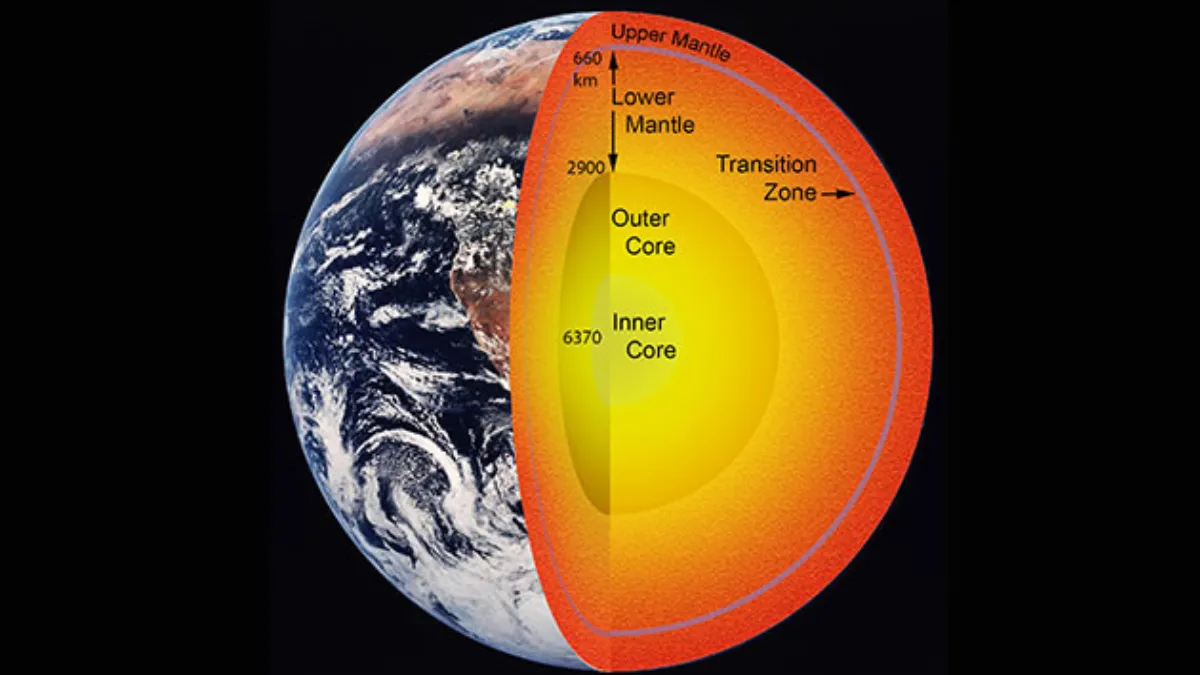
Evidence of a large underground reservoir of water has been discovered almost 700 km beneath the surface, in the transition zone of the mantle, and could hold a volume of water that is equivalent to, or possibly greater than, the sum of all the volume of oceans on the surface.
This concealed ocean is not a free-flowing liquid sea but a chemically bound water in the high-pressure mineral like ringwoodite, which has changed the interpretation of the internal water cycle of the earth and the origin of the oceans.
What Has Been Discovered?
A water-saturated domain in the mantle transition zone, the depth of which is estimated to be between 410 km and 660 km, has been found in which some minerals are capable of holding large quantities of hydrogen and water in the crystal structure.
Of utmost importance is the mineral known as the ringwoodite which is a form of olivine that is under high pressure and acts like a sponge such that it absorbs water even in extreme conditions of pressure and temperature.
The water reservoir is believed to contain as much as a few times that of all oceans on the surface of the earth, depending on the level of hydration of the transition zone.
This has been explained in an informal manner as a sixth ocean since once released the trapped water would cause a drastic change in the surface hydrology of the planet.
Where is the Underground Reservoir Located?
The reservoir is found at the mantle transition zone, between the upper mantle (composed by olivine and wadsleyite) and the lower mantle (composed by bridgmanite and perovskite). Under very high pressure in this zone, ringwoodite is formed, and has the capacity to hold water as hydroxyl groups (OH)- bound to its crystal structure, instead of in the fluid state of H2O.
The water content of ringwoodite samples found on the surface in volcanic diamonds and xenoliths have been measured and confirmed that the mineral is capable of holding water even at the pressure in the mantle.
This water is not a normal ocean, but it is sprayed out in hydration at the molecular scale in grain boundaries and mineral structures in hundreds of kilometres of rock.
Deep-sea hydrated minerals of comparable high pressure can be found in other planets on Earth and exoplanets, and so deep water reservoirs may be a typical feature of rocky worlds.
General Knowledge Flashcard Questions with Answers On India-UAE Bilateral Relations



Comments
All Comments (0)
Join the conversation