RRB Normalization Method 2026 Explained: Know How Your Railway Exam Marks Are Calculated
RRB Normalisation Method & Formula 2026 has been released officially. This explains how CBT marks are fairly standardised across multiple shifts using the percentile score method. This article covers percentile calculation, normalised marks formula, base shift logic, tie-breaking rules, and minimum qualifying marks.
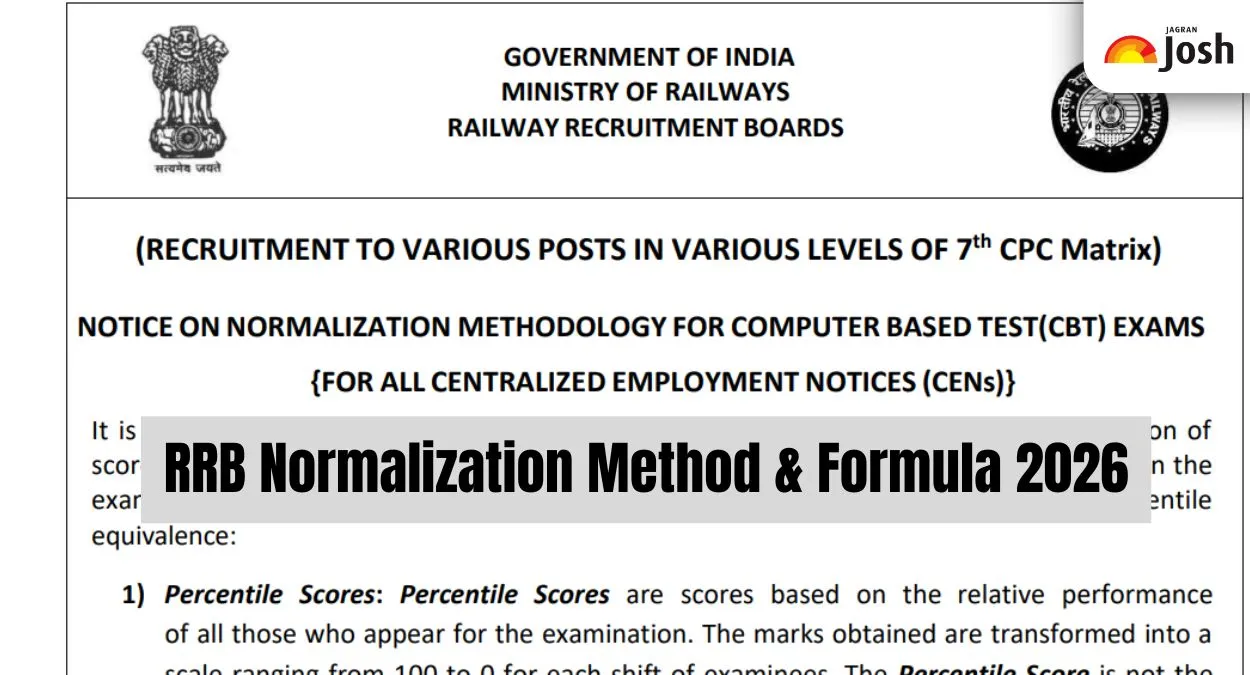
The Railway Recruitment Board (RRB) has issued an official and detailed notification explaining the RRB normalisation method used in CBT exams. This normalisation process is applicable to all Centralised Employment Notices (CENs). It will be followed for recruitment to various posts that fall under the 7th CPC Pay Matrix.
The purpose of this methodology is to ensure fair and equal evaluation of candidates appearing in multiple exam shifts. This helps maintain transparency and accuracy in the RRB recruitment process.
RRB Normalisation Method and Formula 2026
The Railway Recruitment Board (RRB) has officially announced the RRB Normalisation Method & Formula 2026. According to the notification issued on 9 February 2026, RRB will use the Percentile Score method to normalise marks of candidates who appear for the Computer-Based Test (CBT) in multiple shifts.
This method ensures that no candidate is at a disadvantage due to variations in question paper difficulty across different shifts. Raw marks are first converted into percentile scores under this system. These are then used as normalised marks for preparing the final merit list.
Also Check: RRB Exam Calendar 2026–27
RRB Normalisation Method and Formula Official PDF
The Railway Recruitment Boards have explained the normalisation process, percentile calculation, minimum qualifying marks, and tie-breaking rules through a detailed PDF notification. Candidates are strongly advised to download the official PDF and read all the guidelines carefully to clearly understand how scores are calculated and merit is prepared.
Referring to the official document will help avoid confusion and ensure complete clarity about the RRB CBT evaluation process.
| RRB Normalisation Method and Formula 2026 |
What Is a Percentile Score in RRB Exams?
A percentile score represents a candidate’s relative performance compared to others in the same shift. This score will be treated as the RRB Score (or RRC Score for Level-1 exams) and will be considered for merit list preparation.
The following is how percentile scoring works:
-
Marks are converted to a scale ranging from 0 to 100
-
The top-performing candidate of each shift is awarded a percentile score of 100
-
The percentile score shows ranking performance, not actual marks
It is important to note that a percentile score is different from a percentage. The percentage reflects marks obtained out of the total marks, and the percentile indicates how many candidates a student has scored better than in a particular shift.
This normalisation approach helps RRB maintain fairness, transparency, and equal opportunity for all candidates appearing in exams conducted across multiple sessions. Candidates ca che
Percentile Score = (Number of candidates in the same shift who scored equal to or less than the candidate ÷ Total number of candidates who appeared in that shift) × 100

Calculation of Normalised Marks for RRB Exams
If a candidate’s percentile score belongs to the Base Shift, the same value is directly treated as the normalised marks. These normalised marks are then used to decide the candidate’s eligibility for minimum qualifying marks and to calculate weightage, including CCAA weightage for the Level-1 examination.
The normalised score plays a crucial role in ensuring a fair and uniform assessment of candidates across different exam shifts.
(A) When the Candidate’s Percentile Score is Equal to or Higher than the Minimum Percentile of the Base Shift
In this case, the normalised marks are calculated using the following formula:
N = { (Y2 − Y1) / (X2 − X1) × (X − X1) } + Y1
Where:
-
N = Normalised Marks
-
X = Candidate’s Percentile Score
-
X2 = Immediate higher percentile score in the Base Shift
-
X1 = Immediate lower percentile score in the Base Shift
-
Y2 = Marks corresponding to percentile X2 in the Base Shift
-
Y1 = Marks corresponding to percentile X1 in the Base Shift
This formula adjusts the candidate’s score proportionately between two nearby Base Shift percentiles.
(B) When the Candidate’s Percentile Score is Lower than the Minimum Percentile of the Base Shift
If the candidate’s percentile falls below the minimum Base Shift percentile, the following formula is applied:
N = Y1 − { (Y2 − Y1) / (X2 − X1) × (X1 − X) }
Where:
-
N = Normalised Marks
-
X = Candidate’s Percentile Score
-
X1 = Immediate higher percentile score in the Base Shift
-
X2 = Next higher percentile score in the Base Shift
-
Y1 = Marks corresponding to percentile X1 in the Base Shift
-
Y2 = Marks corresponding to percentile X2 in the Base Shift
This method ensures that even lower percentile scores are fairly mapped to Base Shift marks.

RRB Tie-Breaking Criteria
Percentile scores are calculated up to five decimal places to minimise tie situations. If two or more candidates still obtain the same percentile score, the following rules are applied to decide merit ranking:
-
Older candidate will be placed higher in the merit list.
-
If the age is also the same, the alphabetical order of the candidate’s name (A to Z) will be used to break the tie.
This system ensures a transparent and fair ranking process in RRB CBT results.
RRB Minimum Qualifying Marks
Only candidates who meet the minimum qualifying marks set by the Railway Recruitment Boards will be considered for further stages of the recruitment process. Those scoring below the prescribed percentage will not be included in the merit list, irrespective of their percentile score. Candidates can check the minimum qualifying marks in the table below:
| Category | Minimum Qualifying Marks |
| UR | 40% |
| EWS | 40% |
| OBC (NCL) | 30% |
| SC | 30% |
| ST | 25% |
| ST (Level-1 Exam) | 30% |
Meeting these cut-off marks is mandatory for candidates to move ahead in the RRB selection process.


