Why Does A Desert Cooler Cool Better On A Hot Dry Day?
Do you know that low humidity drastically speeds up water evaporation? This process absorbs latent heat, creating an instant chilling effect. Let’s discover how a desert cooler leverages these exact principles to turn harsh, dry summer heat into refreshing, icy air.

Have you ever wondered why a desert cooler suddenly becomes a lifesaver during those blazing summer months, especially when the air feels completely dry? Imagine coming back from a tiring football match on a scorching June afternoon. You switch on the fan, and it just throws warm air at you. But the moment you sit in front of a desert cooler, you feel an instant, chilling relief. Think about how a splash of water on your face feels incredibly refreshing on a hot day or how sitting under a moving fan after sweating heavily cools you down instantly. Why does it happen? What's the reason behind it? Well, the secret lies in a fascinating scientific phenomenon that happens around us every single day. If you want to know more about this cool trick of nature and learn about how it works, read the complete article to understand it in the simplest way possible!
Why Does a Desert Cooler Cool Better on a Hot, Dry Day?
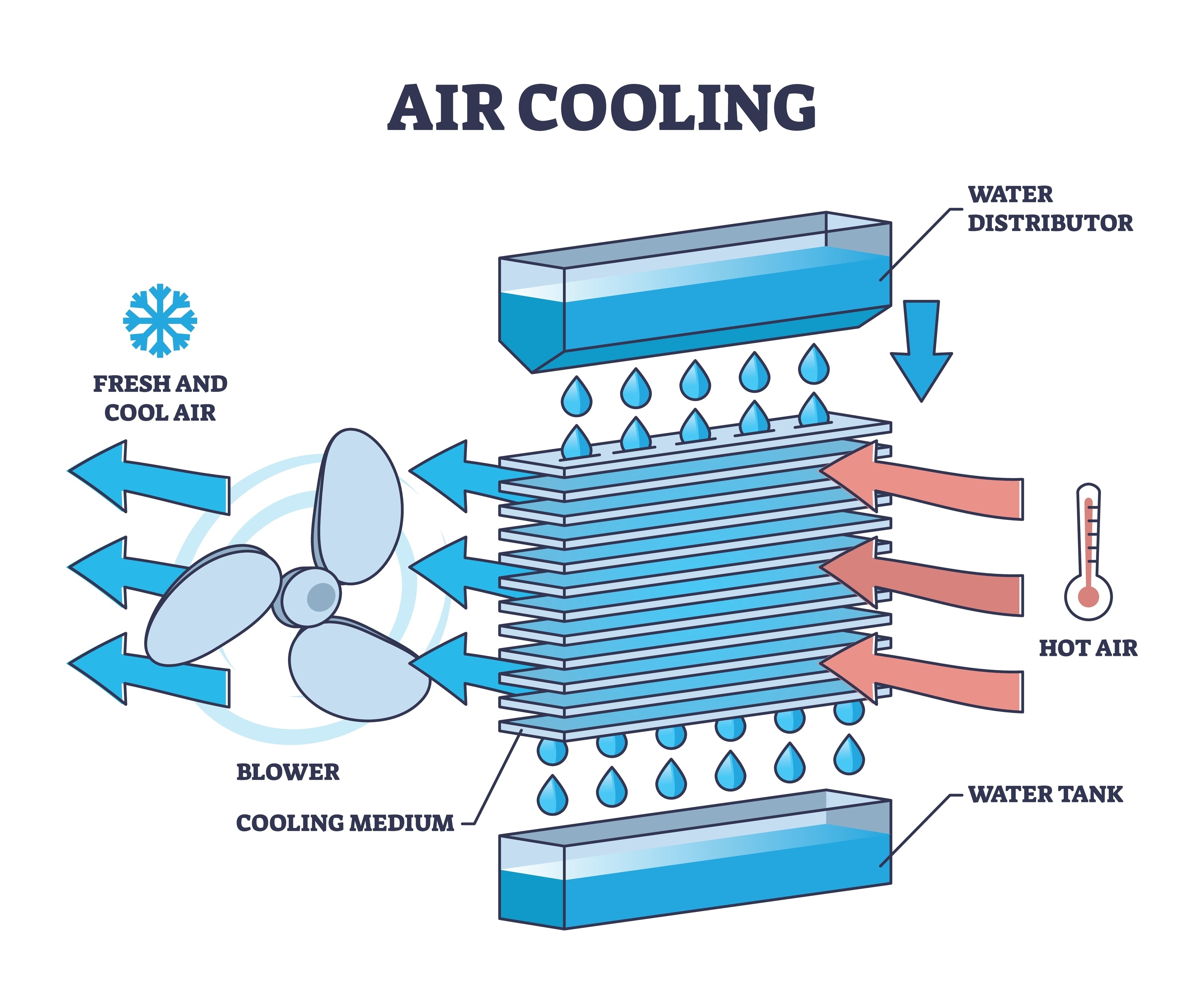
Let's break this down into simple words. To understand why a cooler works so brilliantly on a hot and dry day, we first need to look at what "dry air" actually means. Dry air simply means the air has very little moisture or water vapor trapped in it.
Think of the air around you like a sponge. If a sponge is already soaked with water, it can't pick up any more spills, right? But if the sponge is completely dry, it will greedily suck up water instantly.
On a hot, dry day, the air is just like that dry sponge. It is thirsty for moisture.
Now, inside your desert cooler, water is continuously dripping onto the cooling pads (usually made of wood wool or grass). The cooler's fan sucks the outside hot air through these wet pads. Because the air is hot and dry, it evaporates the water from the pads very quickly.
And here is the golden rule of science: whenever water evaporates, it takes away heat and leaves behind a cooling effect. On a humid day (like during the monsoon season when it's raining and sticky), the air is already full of water vapor—the sponge is already wet!
So, the water from the cooler pads doesn't evaporate easily, and the cooler just ends up making the room feel sticky instead of cold. That's why a dry day is perfect for a desert cooler.
Real-Life Examples to Help You Understand Better
To make this concept crystal clear, let's look at some everyday examples where the exact same thing happens:
- The Acetone/Nail Polish Remover Trick: If you put a drop of nail polish remover or acetone on your palm, your palm instantly feels freezing cold. Why? Because acetone evaporates incredibly fast, and as it turns into gas, it steals the heat right from your hand.
- The Earthen Pot (Matka): During summer, our grandparents prefer drinking water from a clay pot or matka. Clay pots have tiny, microscopic pores on their walls. Water slowly seeps through these pores and evaporates from the outer surface, keeping the water inside icy cold.
- Sweating in Summer: When our body gets too hot, we sweat. When that sweat evaporates into the air, it absorbs heat from our skin, which is our body's natural way of keeping us cool.
- Washing the Porch: Have you seen people spraying water on their rooftops or open verandas on a hot summer evening? The water quickly evaporates from the hot floor, absorbing the heat from the ground and making the surroundings pleasant.
The Science Behind It: Evaporation and Evaporative Cooling
So, what is the actual scientific concept working behind all of this? It's called evaporative cooling.
What is evaporation?
Evaporation is a process where a liquid changes into a gas or vapor at any temperature below its boiling point. Unlike boiling, which happens throughout the whole liquid, evaporation is a surface phenomenon. The particles on the surface of the liquid gain enough energy from the surroundings to break free from the forces of attraction of other particles and fly off into the air.
Who Discovered It?
Evaporative cooling isn't a new invention; humans have observed it for thousands of years. Ancient Egyptians used to wave fans over porous clay jars filled with water to cool rooms.
However, the formal scientific principles of latent heat and evaporation were detailed by scientists like Joseph Black in the 18th century, who discovered that liquids absorb heat when they change their state into a gas.
How Does Evaporative Cooling Work?
It all comes down to energy. Liquid particles are always moving. The particles at the surface have higher kinetic energy. When they absorb a little more heat from their surroundings, they overcome the forces holding them together and escape as vapor.
Because they took that heat energy away with them, the surface they left behind loses heat and becomes much cooler.
NCERT Class 9 Science: Matter in Our Surroundings (Chapter 1) - Exercise Solutions
Here are the official solutions to the questions related to this topic from your textbook:
Question 1: Why does a desert cooler cool better on a hot, dry day?

Answer: On a hot, dry day, the temperature is high, and the humidity (moisture in the air) is very low. Evaporation takes place faster when; the temperature is high, and the humidity is less. As the water inside the cooler evaporates rapidly, it absorbs heat from the surrounding air, leaving a soothin cooling effect.
Question 2: How does the water kept in an earthen pot (matka) become cool during summer?
Answer: An earthen pot has a large number of extremely tiny pores on its walls. Water continuously seeps through these pores to the outside surface of the pot and evaporates. The heat required for this evaporation is taken from the water inside the pot, making the remaining water cool.
Question 3: Why does our palm feel cold when we put some acetone, petrol, or perfume on it?
Answer: Acetone, petrol, and perfume are volatile liquids, meaning they evaporate very quickly at room temperature. When you put them on your palm, the particles absorb the necessary latent heat of vaporization directly from your hand and evaporate. This loss of heat makes your palm feel cold.
Question 4: Why are we able to sip hot tea or milk faster from a saucer rather than a cup?
Answer: A saucer has a much larger surface area than a cup. Since evaporation is a surface phenomenon, the larger surface area increases the rate of evaporation. This causes the hot tea or milk to cool down much faster, allowing us to sip it comfortably.
Question 5: What type of clothes should we wear in summer?
Answer: We should wear light-colored cotton clothes during the summer. Cotton is an excellent absorber of water, so it absorbs our sweat and exposes it to the atmosphere for easy evaporation. As the sweat evaporates, it takes heat from our body, keeping us cool. Light colors also reflect solar radiation instead of absorbing it.
Interactive Quiz: Test Your Knowledge!
Choose the correct option for each question below. Check the explanations to verify your answers.
1. Evaporation is a ________ phenomenon.
A) Bulk
B) Surface
C) Chemical
D) Nuclear
Answer: B
Explanation: Evaporation only takes place at the surface of a liquid where particles have enough energy to escape. Boiling, on the other hand, is a bulk phenomenon.
2. Which of the following factors decreases the rate of evaporation?
A) Increase in temperature
B) Increase in wind speed
C) Increase in humidity
D) Increase in surface area
Answer: C
Explanation: Humidity means the air already has a lot of water vapor. If the air is already full of water, it cannot hold more, so the rate of evaporation decreases.
3. What happens to the temperature of the surroundings during evaporative cooling?
A) It increases
B) It decreases
C) It remains constant
D) It fluctuates randomly
Answer: B
Explanation: During evaporation, particles take heat energy away from the surroundings, which causes the temperature of the surroundings to drop.
4. Why does a desert cooler perform poorly during rainy seasons?
A) The temperature is too low
B) The air is highly humid
C) The cooler pads get jammed
D) Wind speed is too low
Answer: B
Explanation: Rainy seasons bring high humidity. High moisture in the air prevents the water in the cooler pads from evaporating quickly, reducing their cooling performance.
5. The heat energy absorbed by a liquid to change into a gas without changing its temperature is called:
A) Specific heat
B) Latent heat of vaporization
C) Latent heat of fusion
D) Thermal capacity
Answer: B
Explanation: The hidden heat required to change a liquid into vapor at its boiling point without raising its temperature is called the latent heat of vaporization.
6. Which type of clothes are best suited for hot summer days?
A) Synthetic nylon clothes
B) Thick woolen clothes
C) Light-colored cotton clothes
D) Dark-colored silk clothes
Answer: C
Explanation: Cotton absorbs sweat efficiently and allows it to evaporate, while light colors reflect the sun's heat.
7. What will happen to the rate of evaporation if you spread out wet clothes to dry?
A) It will decrease
B) It will increase
C) It will stay the same
D) Evaporation will stop completely
Answer: B
Explanation: Spreading out the clothes increases the surface area exposed to the air, which speeds up the rate of evaporation.
8. Earthen pots keep water cool because of their:
A) Shiny outer surface
B) Porous clay walls
C) Thick bottom layer
D) Chemical composition
Answer: B
Explanation: The porous walls allow water to slowly seep through to the outside and evaporate, keeping the internal water chilled.
9. Which of the following liquids will evaporate the fastest when kept open?
A) Water
B) Cooking oil
C) Honey
D) Acetone (Nail polish remover)
Answer: D
Explanation: Acetone is highly volatile and has a very low boiling point compared to water or oils, making it evaporate almost instantly.
10. Kinetic energy of particles ____________ when we increase the temperature.
A) Decreases
B) Increases
C) Becomes zero
D) Remains unaffected
Answer: B
Explanation: Heating provides thermal energy to particles, making them move faster and increasing their kinetic energy.

Kriti Barua is a skilled digital journalist and communications professional with 4+ years of experience, currently writing for the General Knowledge section at Jagran New Media. She has established herself as a subject matter expert in History, Geography, Trending National and International News, Sports, Science, and Defence, producing clear, reliable, and search-optimised content that connects with readers worldwide.
Kriti holds a BA degree from Delhi University and a one-year diploma in TV Production and Journalism, an academic background that adds research depth and strong storytelling instincts to her writing. Her experience spans brand writing, content marketing, and digital media, giving her a sharp understanding of what makes content both helpful to readers and visible in search.
At Jagran New Media, she applies this expertise to national and international news coverage, query-based articles, and in-depth pieces across her specialist subject areas. Her content is defined by easy language, factual accuracy, strong keyword strategy, and reader-friendly storytelling.


