Why did NASA Launch the Nancy Grace Roman Space Telescope? 3 Key Reasons Explained
NASA is preparing to launch the Nancy Grace Roman Space Telescope by late 2026. Designed with a camera field 100 times larger than Hubble, the space observatory will survey dark energy, map unseen dark matter, and discover thousands of new planets outside our solar system.
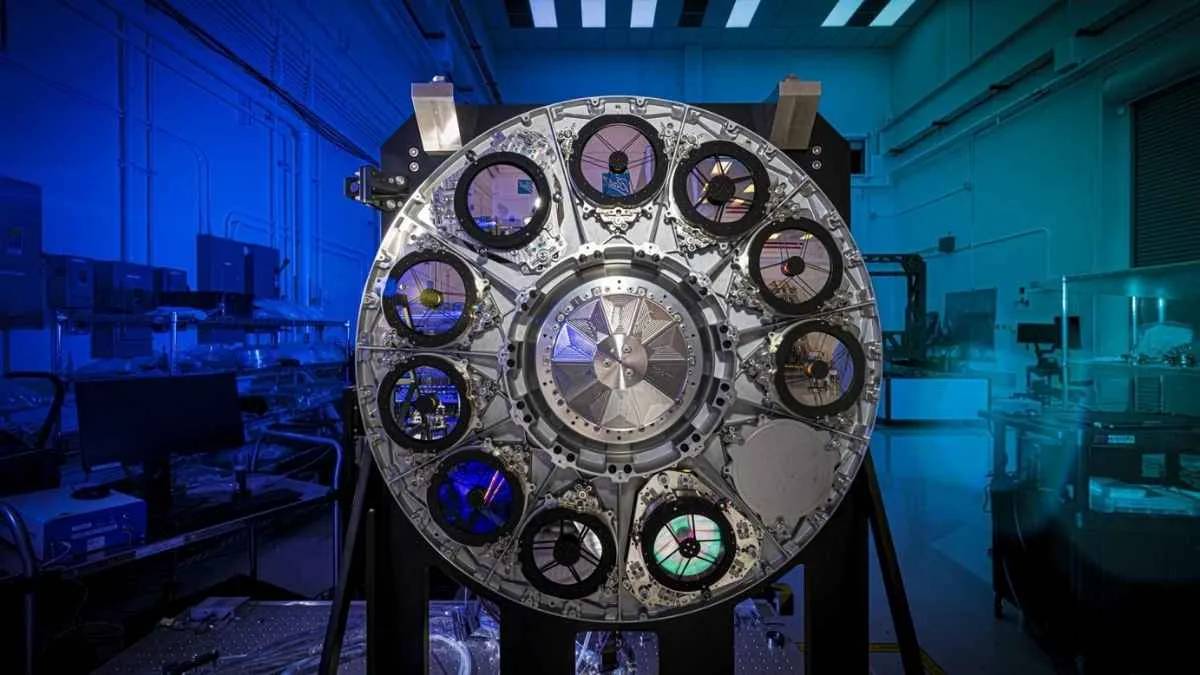
The Nancy Grace Roman Space Telescope is Nasa’s latest flagship observatory. It was successfully launched aboard a SpaceX Falcon Heavy rocket from Kennedy Space Center on August 30th 2026 around .
The $4.3 billion observatory is en route to the Lagrange Point 2 (L2) which is designed to survey the sky a thousand times faster than Hubble, roughly one million miles from Earth.
NASA Associate Administrator Nicky Fox noted, “Hubble and James Webb peer through a keyhole at the universe, while Roman will kick the door down”. The mission promises unimaginable views of dark energy, dark matter, and uncharted exoplanets.
What is the Purpose of Nancy Grace Roman Space Telescope?
The primary job of the Roman Space Telescope is to help scientists study three main things:
- dark energy,
- dark matter, and
- planets outside our solar system.
1. Studying Dark Energy
Dark energy is estimated to account for about 68% of the universe and is the cause for the expanding nature of the universe.
Roman will study the positions and distances of millions of galaxies to determine how dark energy has influenced the universe over billions of years.
2. Finding New Planets
The telescope will detect faint light bends caused by distant planets using a technique called gravitational microlensing.
Scientists are expecting it to discover thousands of worlds including smaller rocky planets similar to Earth.
3. Testing New Camera Tech
The telescope also has on board a device known as a coronagraph, which shields out the light from any bright stars so that astronomers can photograph their surrounding planets directly.
The Nancy Grace Roman Space Telescope has officially launched and is heading to its forever home at L2!
— Nancy Grace Roman Space Telescope (@NASARoman) August 30, 2026
Over the next three months, the observatory will perform final checks and power its instruments before revealing its first images by early 2027.https://t.co/IdabpolHmh pic.twitter.com/tuDHAEzgKh
Who Built the Nancy Grace Roman Space Telescope?
Building the telescope required work from several NASA centers, university labs, and aerospace firms across the country.
| Part of the Nancy Grace Roman Space Mission | Group Responsible |
| Overall Mission and Main Camera | NASA Goddard Space Flight Center |
| Coronagraph Instrument | NASA Jet Propulsion Laboratory (JPL) |
| Telescope Structure and Mirror | L3Harris Technologies |
| Science and Data Operations | Space Telescope Science Institute (STScI) |
| Rocket and Launch Services | SpaceX (Falcon Heavy) |
Why is the New Telescope Called the Nancy Grace Roman?
NASA named the telescope after Dr Nancy Grace Roman who served as the agency’s very first chief astronomer during the 1960s. People often call her the Mother of Hubble because she convinced NASA and the US Congress that building big telescopes in space was worth the investment.
She helped set up the funding, planning, and science teams that eventually built the Hubble Space Telescope.
Naming this wide field observatory after Dr Roman honors her decades of work organizing America's early space astronomy programs.
What Comes Next for the NASA Space Mission
Once the telescope reaches its position in space it will start a primary five year survey mission. Instead of focusing on single stars or galaxies one by one it will work like a high powered census taker for space. It will be gathering raw picture data that would be open to astronomers worldwide.

Harshita Singh is an education and general knowledge journalist with over 5 years of experience in educational writing. Specializing in US affairs and GK, Harshita has a track record of breaking down intricate geopolitical and historical subjects into clear, digestible insights for learners. Her strong background in text analysis, coupled with a Bachelor of Arts (Hons) in English from the University of Delhi, helps her produce authoritative, thoroughly researched content that empowers readers to engage confidently with global current affairs. For inquiries or academic insights, you can reach out to her directly at harshita.singh@jagrannewmedia.com.




![[Out] UGC NET June 2026 Result Live: यूजीसी नेट रिजल्ट ugcnet.nta.nic.in जारी, डायरेक्ट लिंक से करें चेक](https://img.jagranjosh.com/images/2026/August/2782026/UGC-NET-Result-2026-Marksheet-link-pdf.jpg)