Who is Known as the Father of Aviation?
The story of the Father of Aviation is filled with determination, innovation, and historic breakthroughs that transformed humanity’s dream of flying into reality. Learn which person holds this title and how they changed the course of aviation history.
-1779513801689.webp)
Every time a plane takes off, it carries a dream with it that became possible 120 years ago when two brothers from Ohio came along. Today, millions of people fly each and every day. But, have you ever thought that who made all this possible? Let’s find out who is known as the father of Aviation.
Who is Known As the Father of Aviation?
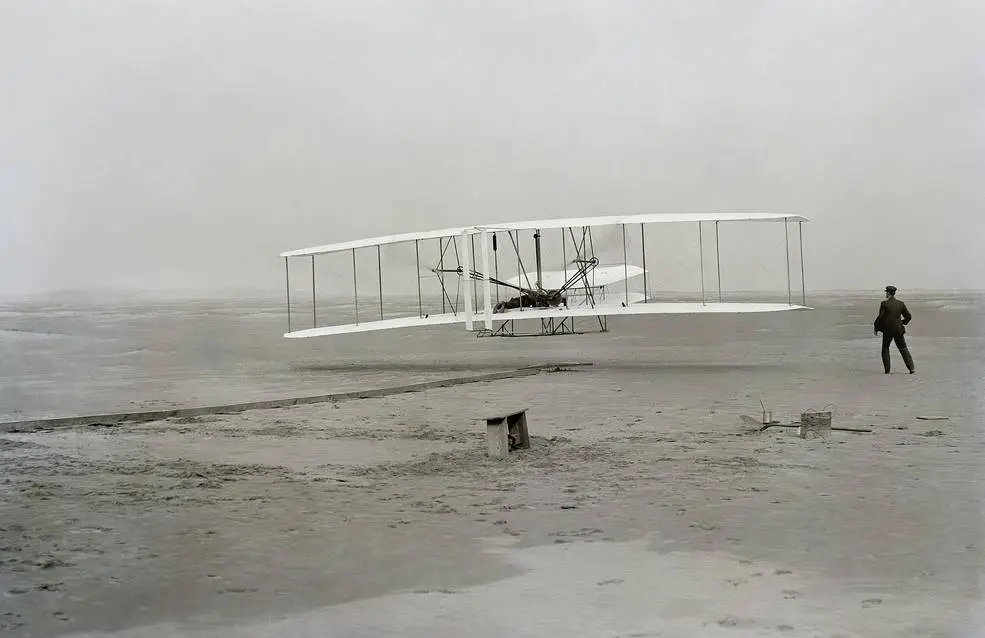
Source: NASA
While this title is shared among many people, Wilbur Wright and Orville Wright, also known as Wright Brothers, are majorly known as the Fathers of Aviation. The American inventors and aviation pioneers first flew a powered, sustained and controlled aeroplane in 1903. Their success was so historic that it forever changed the way humans travel.
Who Were the Wright Brothers?
Wilbur Wright was born in Millville, Indiana on April 16, 1867. Orville was his younger brother and he was born August 19, 1871 in Dayton, Ohio.
The inspiring part of their story is these two men were not formally educated in engineering and they never received any governmental financing. They were two brothers who had a bicycle shop in Dayton, Ohio.
However, their curiosity and hard work helped them accomplish what was previously believed to be impossible for the world.
The scientific community, and public believed that it was virtually certain that man would never be able to fly at the beginning of the 20th century. In 1897, even a well-known newspaper said that it was impossible for a human being to fly.
READ| Who is Known as the Father of the Indian Nuclear Program?
The Historic First Flight
The Wright brothers experimented for four years. It was not until December 17, 1903, at Kitty Hawk, North Carolina, that they were able to make the first successful flights in an airplane.
This flight took place for only 12 seconds, covered 120 feet and attained a maximum speed of 6.8 miles per hour. By today's standards that's a very short time but those 12 seconds altered the course of all human civilization.
The brothers didn't stop there. The most successful flight of the day was flown by Wilbur who reached a distance of 255.6 metres (852 feet) in 59 seconds.
How Did They Do It?
The Wright brothers were careful observers of nature. They observed how birds fly, and with their observation, the Wright Brothers became successful where others had been trying for years.
The brothers used their mechanical skills in building bicycles and added their genius on how to maneuver and balance the aircraft, with the help of their break-through invention, three-axis control.
NASA mentions: “Several attempts by leading designers proved unsuccessful, and the honor of the first sustained and controlled flight of a powered heavier-than-air aircraft went to two bicycle shop owners from Dayton, Ohio, Orville and Wilbur Wright. The brothers combined the mechanical experience from their business with the fundamental breakthrough invention of three-axis control to enable them to steer the aircraft and maintain its equilibrium.”
READ| Who is Known as the Father of Electricity?
Why Are They Called Fathers of Aviation?
The Wright Brothers made the first successful flights in a powered heavier than air flying machine. For thousands of years, from ancient mythology to Leonardo da Vinci's sketches, men had dreamed of flying yet no one was able to understand the mechanics of how to make controlled, powered flights.
They were not just inventors of an airplane. It paved the way to commercial planes, space shuttles and the connected world we live in today.
So, the next time you fly, think about 2 brothers with a bicycle shop and a big vision who were able to change the whole world's belief in 12 seconds.

Nikhil is a dedicated content writer with more than five years of experience, and works for the Jagran Josh General Knowledge section. He likes to create engaging and easy-to-read general knowledge content. He has spent years working on brain teasers, optical illusions, trending stories, and informative listicles that simplify facts for readers. His approach focuses on clarity, creativity, and making information feel effortless to understand.


