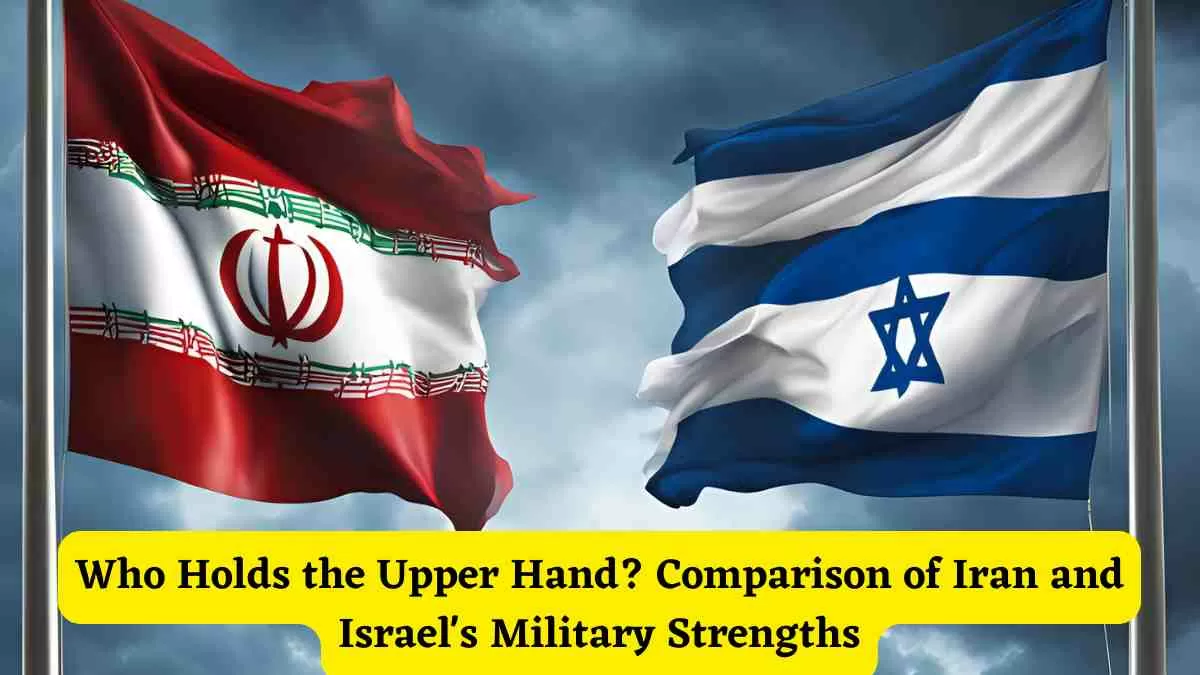
The recent developments in the Middle East have highlighted the military conflict between Iran and Israel, the two regional powers, with the drastically different attitudes toward the defence. Iran is using sheer numbers, ballistic missiles and proxy forces in asymmetric deterrence, whereas Israel is depending on state-of-the-art technology, air superiority and strong allies, especially the United States.
Based on 2026 surveys such as Global Firepower Index (GFP) surveys, Israel (15th, PwrIndx 0.2707) and Iran (16th, 0.3199) occupy almost parallel positions in terms of raw figures but have obvious qualitative disparities.
The military force of Iran is inspired by its significant population of over 88 million people who allow the conscription and the mass use of paramilitary forces. Its active forces amount to approximately 610,000 (including regular Artesh (350,000), ideologically motivated Islamic Revolutionary Guard Corps (IRGC) (190,000), reserves (350,000) and irregular warfare militia (Basij) up to 1 million). This is a form that is appropriate in the case of a long-term fight or an invasion.
Israel, having 9.5 million people, has 169,500 standing troops, but it is doing well in preparedness with universal conscription and 465,000 well-trained reserve troops capable of mobilising in 72 hours. The focus on quality more than quantity that is developed by the military service being mandatory for most Israelis provides the country with a battle-tested army trained in urban and high-intensity warfare.
| Category | Iran | Israel |
|---|---|---|
| Active Personnel | 610,000 | 169,500 |
| Reserve Personnel | 350,000 | 465,000 |
| Paramilitary/Total Available | ~1M (incl. Basij) | N/A |
| Annual Military-Age Population Reaching | 1.4M | 130,000 |
What are the Military Spending Estimates?
Iran cannot match Israel in terms of defense expenditure, which is evidence of its technological approach. Israel will spend 27.5 billion dollars (5.3 percent of GDP) in 2026 on indigenous innovation, such as Iron Dome and integration of F-35. The U.S. contributes in the form of aids amounting to 3.8 billion dollars per year and intelligence exchange.
The sanctions limit Iran’s budget of $10.3 billion (2.1% of GDP) and it has to depend on domestic production and smuggling. In spite of this, Iran spends a lot of money on missiles and drones, which maintains a strong defense industry.
| Category | Iran | Israel |
|---|---|---|
| Defense Budget | $10.3B | $27.5B |
| % of GDP | 2.1% | 5.3% |
| External Aid | Proxies (Russia, China) | $3.8B U.S. |
Ground Forces: Quality vs. Quantity
The Iranian army is more focused on mass defense, having 1,700-2,000 tanks (T-72s, homegrown Zulfiqar/Karrar), 66000 armored vehicles and more than 7000 artillery pieces- perfect in the attrition warfare. There are several rocket launchers (1,550) which facilitate saturation attacks.
The mobility and survivability of Israel (Merkava tanks (1,300) with Trophy active protection) and 36,000 vehicles have been tested during wars such as Gaza operations. There are modern artillery (530 towed, 352 self-propelled) which are of lesser numbers.
| Category | Iran | Israel |
|---|---|---|
| Main Battle Tanks | 1,996 | 1,300 |
| Armored Vehicles | 66,000 | 36,000 |
| Self-Propelled Artillery | 392 | 352 |
| Towed Artillery | 2,070 | 171 |
| MLRS | 1,550 | 228 |
Air Power Strength
The modern warfare is characterized by air superiority where Israel has over 345 combat fighters with 39 F-35 stealth fighters, 100 F-16s and F-15s as well as AWACS and refuelers. This gives accuracy in deep strikes on the enemy side.
The Iranian fleet consists of mostly U.S. pre-1979 relics (312 planes: F-4s, F-5s, MiG-29s) with a small number of spares, and 50 or more Russian Su-24s. Sanctions are a drag on upgrades, but Iran manufactures simple trainers and drones. sundayguardianlive.
| Category | Iran | Israel |
|---|---|---|
| Total Aircraft | 551 | 612 |
| Fighters/Interceptors | 188 | 241 |
| Attack Aircraft | 21 | 38 |
| Helicopters (Total) | 128 | 147 |
| Attack Helicopters | 5 | 43 |
The Iron Dome (90% success rate) of Israel, David Sling, Arrow- cancel out the threat of Iranian missiles.
Maritime Capabilities and Weapons
The navy of Iran (19 submarines, 68 patrol vessels) is oriented on Persian Gulf denial by using mines, fast boats, and anti-ship missiles. It is its crown jewel: 3,000+ ballistic missiles (Fateh, Sejjil up to 2,000km range) and drone swarms (Shahed series), which were successfully employed by proxies such as the Hezbollah.
Israel has a smaller fleet (5 submarines, 49 patrol vessels): Dolphin-class nuclear capable subs (Barak-8) and corvettes with Barak-8 missiles, best suited to operations in the Mediterranean and Red Sea.
| Category | Iran | Israel |
|---|---|---|
| Total Assets | 398 | 67 |
| Submarines | 19 | 5 |
| Principal Surface | 7 | 7 |
| Ballistic Missiles | 3,000+ | ~100 (Jericho) |
Israel has the technological and air/naval quality, budgets, and alliances advantage, which allow offensive domination and defense salvo. The manpower, missiles, and endurance of Iran are more suited to the war of attrition, which will be devastating in case proxies are used. A direct confrontation will spell doom in the region and that is the importance of deterrence.



Comments
All Comments (0)
Join the conversation