Which Indian Lake Has Two Different Types of Water?
Lonar Lake in Maharashtra is known for its two distinct water zones, one highly alkaline and the other comparatively neutral. Discover its meteorite origin, unusual water chemistry and pink water mystery.
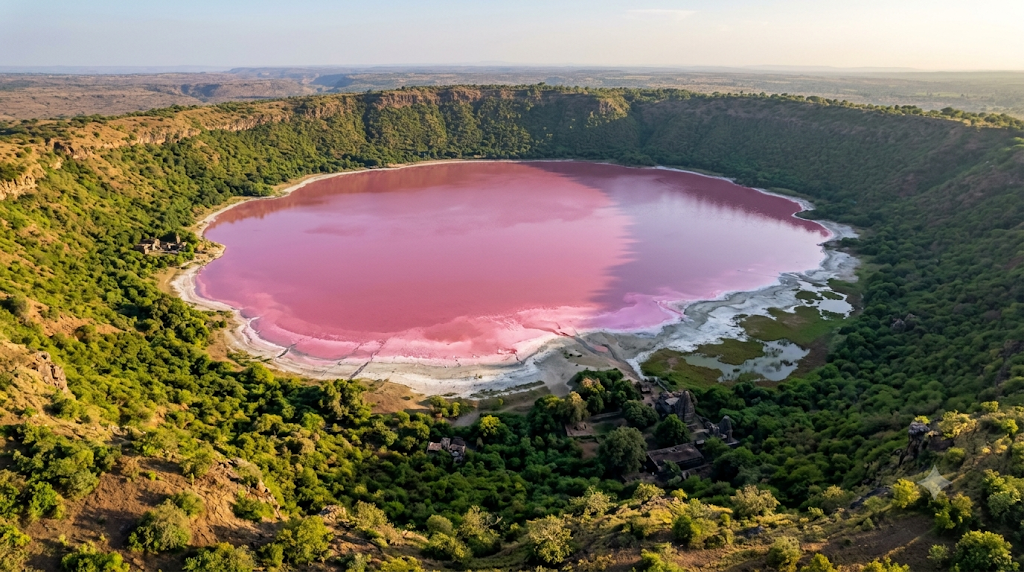
India has several unusual lakes, but one lake in Maharashtra is famous for having two distinct types of water within the same water body. Lonar Lake, located in Buldhana district, has a highly alkaline inner water zone and a comparatively neutral outer water zone. The lake is also known as the Pink Lake of India because its water turned pinkish-red in June 2020. Formed by a meteorite impact on the Deccan Plateau, Lonar Lake is a rare geological feature that attracts scientists from across the world. Keep reading in detail.
Which Indian Lake Has Two Different Types of Water?
The answer is onar Lake in Maharashtra. The lake has two distinct water zones with different chemical properties. Its inner section is highly alkaline, while the outer section has comparatively neutral water.
| Feature | Inner Water Zone | Outer Water Zone |
| Water Nature | Highly alkaline | Comparatively neutral |
| Approximate pH | 11 | 7 |
| Chemical Properties | High alkalinity | Near-neutral conditions |
| Location | Inner section of the lake | Outer section of the lake |
Where Is Lonar Lake Located?
Lonar Lake is situated near Lonar town in Buldhana district of Maharashtra. It lies within the Deccan Plateau, which is known for its extensive basaltic rock formations.
| Geographic Detail | Information |
| Name | Lonar Lake |
| State | Maharashtra |
| District | Buldhana |
| Popular Name | Pink Lake of India |
| Formation | Meteorite impact |
| Crater Diameter | Around 1.8 km |
| Lake Diameter | Around 1.2 km |
| Ramsar Recognition | July 22, 2020 |
Is Lonar Lake a Ramsar Site?
Yes. Lonar Lake received Ramsar recognition on July 22, 2020, for its international importance as a wetland ecosystem.
| Detail | Information |
| Ramsar Site | Lonar Lake |
| Ramsar Site Number | 2441 |
| Recognition Date | July 22, 2020 |
| Wetland Area | 427 hectares |
| State | Maharashtra |
| Geological Significance | Meteorite impact crater |
Why Does Lonar Lake Have Two Different Types of Water?
Lonar Lake has two distinct water zones with different chemical properties. The inner zone is highly alkaline, while the outer zone is comparatively neutral.
| Feature | Inner water zone | Outer water zone |
| Water condition | Highly alkaline | Comparatively neutral |
| Approximate pH | Around 11 | Around 7 |
| Chemical nature | Rich in alkaline minerals | Less alkaline |
| Scientific importance | Supports specialised microorganisms | Has a different aquatic environment |
Why Did Lonar Lake Turn Pink in 2020?
In June 2020, Lonar Lake attracted attention after its water changed from green to pinkish-red. Scientists linked the colour change to the lake’s high salinity and the growth of salt-loving microorganisms.
| Factor | Role in the colour change |
| High salinity | Creates conditions suitable for salt-tolerant organisms |
| Dunaliella salina | Produces reddish-orange pigments |
| Salt-loving microorganisms | Can contribute pink or red pigments |
| Environmental conditions | Changes in temperature, water levels and salinity can influence microbial growth |
How Was Lonar Lake Formed?
Lonar Lake was formed when a meteorite struck the Deccan basalt rocks of Maharashtra. The impact created a crater that later filled with water. It is particularly important because it is recognised as a meteorite-impact crater in basaltic rock.
| Feature | Details |
| Location | Buldhana district, Maharashtra |
| Geological formation | Meteorite impact |
| Rock type | Basalt |
| Approximate crater diameter | 1.8 km |
| Approximate lake diameter | 1.2 km |
| Ramsar designation | 22 July 2020 |
| Ramsar site number | 2441 |
| Wetland area | 427 hectares |
Which Other Indian Lakes Have Unusual Water Features?
| Lake | Unusual water feature |
| Lonar Lake, Maharashtra | Saline and alkaline water |
| Sambhar Lake, Rajasthan | Highly saline water and salt production |
| Pangong Tso, Ladakh | Brackish water in a high-altitude setting |
| Chilika Lake, Odisha | Brackish water influenced by both freshwater and seawater |
| Loktak Lake, Manipur | Floating vegetation masses on freshwater |
| Tso Moriri, Ladakh | High-altitude lake with a cold desert ecosystem |

Jasreet Kaur is a journalist with over 3 years of experience in digital media and news content creation. She specializes in covering Trending News, including major National and International developments, with a focus on delivering accurate, engaging, and reader-friendly stories. Prior to this, she worked with Zee News as a Content Writer, where she gained extensive experience in news reporting and content strategy. Driven by curiosity, credibility, and a passion for impactful journalism, Jasreet aims to contribute to informed public discourse while supporting positive growth in organizations, society, and the world.