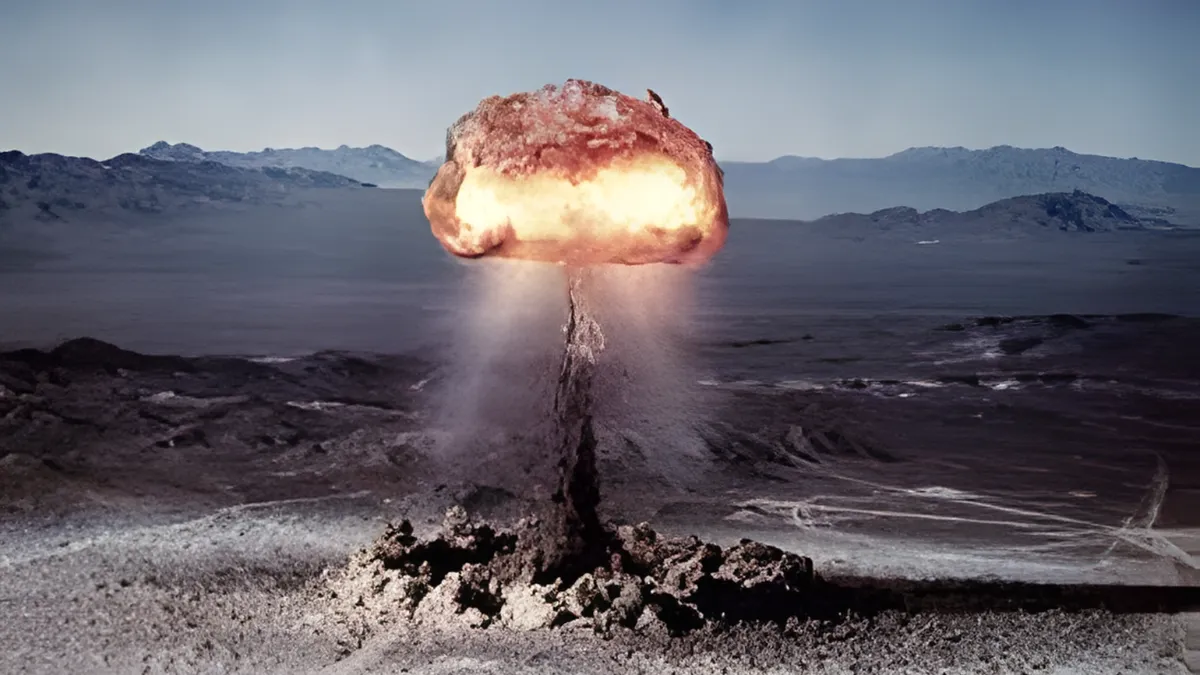
Decoupling in nuclear tests refers to a stealth method of hiding the underground explosions by deemphasizing the seismic recordings.
It includes explosive placement of a nuclear charge in a big, pre-drilled underground hole full of air or lightweight substance, which spreads the explosive power radially into gas overstrettlement of the solid rock.
This decouples the blast to the adjacent geology so that shear waves are minimized and the apparent seismic magnitude is reduced by 50-100 times the yields less than 10 kilotons.
The fully coupled test is highly efficient in transferring energy to the earth creating powerful P- and S-waves detected by international networks such as the IMS of CTBTO.
The United States has alleged in a major nuclear transparency breakthrough that China has carried out a covert underground nuclear test in its Lop Nor facility in June 2020, using a strategy called decoupling to avoid being detected.
U.S. Assistant Secretary of Nuclear Infrastructure, Christopher Yeaw, elaborated on these claims in an event at the Hudson Institute, referencing seismic data collected on PS23 station in Kazakhstan indicating a magnitude 2.75 explosion unlike natural earthquakes or mining operations.
China has strongly rejected the assertions. This advancement comes back to question the adherence to the Comprehensive Nuclear-Test-Ban Treaty (CTBT) which the two countries signed but still not ratified due to increasing tension in the world over the nuclear weapons.
What is the Decoupling Technique?
Decoupling is an evasion technique in which a nuclear weapon is detonated in an underground chamber of large size that has previously been excavated and filled with air or gas, spreading explosive energy spherically to reduce the amount of direct contact with the surrounding rock.
This decreases seismic magnitude that is detectable by a factor of 50-100 to completely coupled tests in solid media as specified in technical evaluations of the U.S. National Academies of Sciences regarding challenges of verification of CTBT.
Yeaw particularly claimed that China performed decoupling tests to conceal a low-yield test, possibly to develop advanced warheads, on the basis of Soviet experiments in the past that were recorded in declassified documents. The capability of the technique to yield less than 10 kilotons makes it a constant worry to the international watchdog systems.
What is the Nuclear Test About?
-
Assistant Secretary Yeaw showed declassified seismic signal analysis of the PS23 Makanchi array, detected on June 22, 2020 despite being approximately 720 kilometers away, on the opposite side of the country, at Lop Nor, by the CTBTO PS23 array.
-
The data indicated that there were two tightly spaced events (12 seconds) that had features of an explosion, not tectonic, such as a P-wave velocity and spectral signature that were associated with contained blasts.
-
Yeaw focused on the event yield, with an approximate of less than the 500-ton TNT limit set by CTBT, being artificially suppressed, which eliminates the possibility of mining, since the site was for military exclusion and signal clearness.
-
The revelations would be preceded by U.S. intelligence estimates of a nuclear buildup by China estimating a figure of over 600 warheads today and an estimate of 1,000 by the year 2030 leading to the call of renewed verification measures.
Seismic Evidence
In the remote Alakoskaya depression of Kazakhstan, the PS23 Makanchi primary seismic station, certified by the CTBTO in January 2002, is known to be in a low-noise environment due to its original construction in 1970 to monitor Soviet tests at Semipalatinsk.
Its 11 element array has a range of 3.7 km which attains more than 98 percent data availability as well as demonstrating a high capability of detecting small magnitude events in the distance due to the use of advanced signal processing.
Also Read: The 8th Pay Commission 2026: Check Salary Hike, Effective Date and Pension Revisions here
Although the signals detected by CTBTO on June 2020 were initially identified as unclear, with lack of data to confirm it, the U.S. experts re-examined raw waveforms, and found that the waveforms displayed explosions-related characteristics, such as high-frequency content and the lack of shear waves characteristic of quakes.
The track record of this station highlights the role of IMS in the near-real-time verification whereby it has helped in the identification of more than 2,000 events every year.
What was China's Response?
The spokesperson of China Foreign ministry and the embassy Liu Pengyu dismissed the U.S. accusations as false slanders creating justification of the re-emergence of testing by America itself.
Authorities confirmed that it was taking a voluntary moratorium that it had last declared in 1996, and consistent with other nuclear powers, and said that the U.S. had not ratified the CTBT despite signing it in 1996.
As New START expires on February 5, 2026, Beijing accuses Washington of hypocrisy and demands attention on reciprocal arms control instead of unilateral accusations. The state media in China justified the claims as encroachment in its rightful defensive modernization.
This, in the case of India, as a non-signatory witnessing P5 dynamics, highlights necessity of effective regional surveillance against Indo-Pacific security changes. Finally, the global trust and development of non-proliferation would be restored through open communication through the UN.



Comments
All Comments (0)
Join the conversation