Show Key Points
Color theory has long been a blend of art and physics, but for over a century, a significant mathematical gap existed at its core. In a breakthrough recently announced by Los Alamos National Laboratory, researchers have finally completed the physicist Erwin Schrödinger idea of color perception, proving that our perception of color is governed by the intrinsic geometry and color relationships could be explained through mathematical structures
A research team at Los Alamos National Laboratory (LANL), led by scientist Roxana Bujack, has finally repaired this map by applying advanced geometry to physics, they’ve proven that the way we perceive color isn't just a cultural byproduct or a learned behavior—it is an intrinsic mathematical property of our visual system
What is Color Theory ?
Color theory is a framework used to understand how colors interact, combine, and are perceived by the human eye. It explains the relationships between different colors and how they can be organized in systems such as color wheels or color spaces.
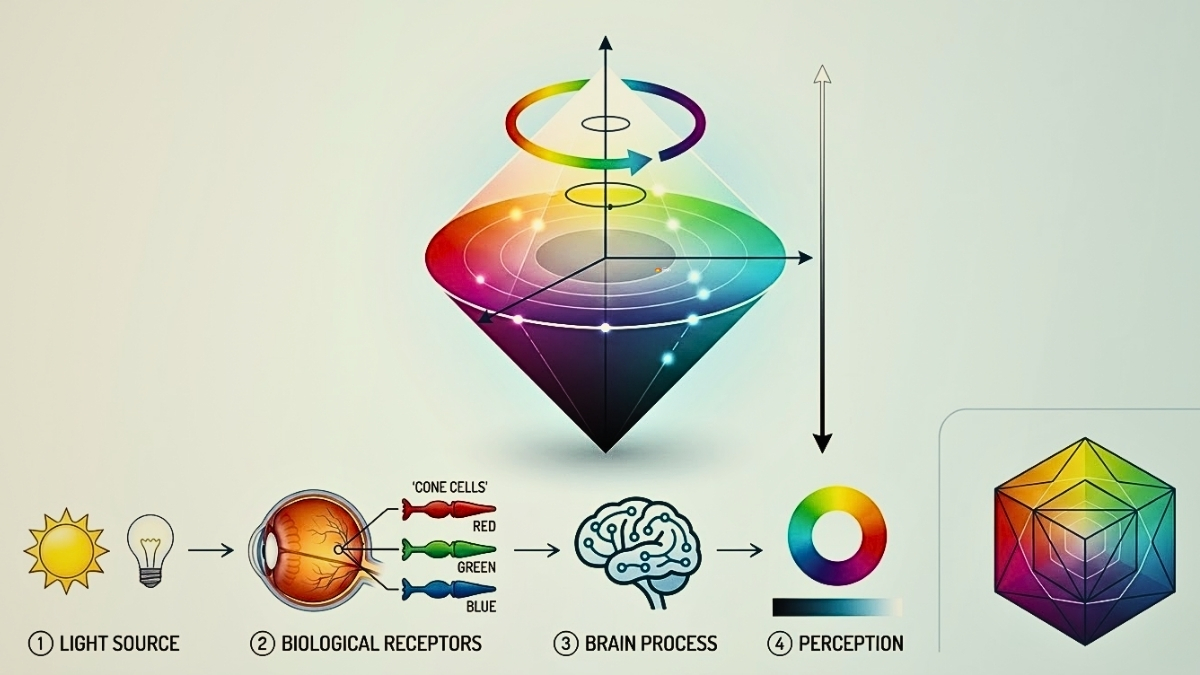
In science, color theory is closely connected with human vision and color perception. The human eye contains special cells called cones, which detect different wavelengths of light corresponding to Red, Green and Blue called three types of Cones and these are tiny biological sensors. The brain processes these signals to create the wide spectrum of colors we see.
How it works: When light hits an object, the object absorbs some wavelengths and reflects others. If you see a red apple, it’s because the apple is soaking up all the blue and green light and bouncing the red back at you. Your brain takes the signals from those three cones and "mixes" them into the millions of shades you see every day.
How It Measure: To talk about color accurately, scientists and artists use three specific terms:
-
Hue: This is the "name" of the color, referring to the specific wavelengths of light.
-
Saturation (Chroma): This is the intensity difference between a color being "vibrant" or "washed out." A neon sign has high saturation; a dusty brick has low saturation.
-
Lightness (Value): This is how much white or black is mixed in. It’s the difference between navy blue (dark) and sky blue (light).
Color theory is widely used in fields such as: Art and painting, Graphic design, Photography, Digital imaging and Vision science
Schrödinger’s 100-Year-Old Color Theory
In the early 20th century, physicist Erwin Schrödinger explored the mathematical structure behind color perception. He proposed that the range of colors humans can perceive could be represented within a specific geometric structure.
Schrödinger’s model suggested that colors form a three-dimensional space, often referred to as a color space, where each color corresponds to a point within that structure.
Famous for his work in quantum mechanics—turned his attention to the "shape" of color. He hypothesized that color space wasn't a flat, simple grid but a curved, geometric landscape.
Schrödinger believed that if we could map this space perfectly, the relationships between hue, saturation, and lightness would be mathematically self-evident. However, his model had a "missing heart": The Neutral Axis. This is the line of gray tones stretching from pure black to pure white. Without a mathematical definition of this axis, the entire geometric structure was technically "floating" without an anchor.
How Modern Geometry Confirmed the Theory
Recent research has used modern mathematical tools and geometric analysis to revisit Schrödinger’s ideas. Scientists applied advanced geometry to study the structure of color perception more precisely.
A team at Los Alamos National Laboratory, led by scientist Roxana Bujack, utilized advanced mathematics to bridge this century-old gap. Their research, published in Computer Graphics Forum and PNAS, provides several key insights:
1. Defining the Neutral Axis
The team succeeded in defining the neutral axis purely through the geometry of the color metric. They discovered that the "shortest path" between two colors in this space isn't a straight line, but a curve. By establishing this, they anchored Schrödinger’s model, making it a complete, self-contained system.
2. The Non-Riemannian Nature of Color
For years, scientists used Riemannian geometry (the math used to describe the curvature of space-time) to model color. The Los Alamos team proved that color perception is actually non-Riemannian. This explains why we experience "diminishing returns" in color—the further apart two colors are, the less we notice additional changes in their difference.
3. Solving Visual Illusions
The new model finally explains the Bezold-Brücke effect, a phenomenon where colors appear to change their hue simply because their brightness increases. By calculating the "shortest path" in their new geometric model, the researchers showed that these shifts aren't "glitches" in our brain, but a direct result of the mathematical structure of our visual system.
Modern geometry helped scientists:
-
Map color perception in a more precise mathematical space
-
Understand relationships between different colors
-
Confirm the structure predicted by Schrödinger nearly a century ago
This finding demonstrates that Schrödinger’s theoretical work anticipated ideas that modern science is only now able to verify.
Why This Discovery Matters
The confirmation of Schrödinger’s color theory has important implications for both science and technology.
First, it improves scientific understanding of human color perception and how the brain interprets visual information. Second, it strengthens the connection between physics, mathematics, and neuroscience by understanding the geometry of color perception, scientists can design systems that represent colors more accurately. The research could also help improve technologies such as:
-
Digital displays (cameras, monitors, and printers translate), data Visualization
-
Image processing systems
-
Color correction tools
-
Computer vision and artificial intelligence
-
Scientific Modeling: climate models to national security simulations, better color metrics allow for clearer interpretation of high-stakes information.
The Link Between Mathematics and Human Perception
One of the most fascinating aspects of this discovery is how abstract mathematics can describe human sensory experience. Schrödinger’s work shows that mathematical structures can capture the complexity of how people perceive the world.
Modern geometry provides powerful tools for studying patterns and relationships, making it possible to analyze phenomena like color perception that once seemed too complex to measure precisely.
This intersection of physics, mathematics, and cognitive science continues to reveal new insights into how humans experience color. Color theory has long been an important concept in both art and science. Nearly a century ago, Erwin Schrödinger proposed a mathematical model explaining how colors relate to each other within a geometric space.
Today, advances in modern geometry have confirmed that his idea was remarkably accurate. The research highlights how theoretical science can anticipate discoveries that only become verifiable many years later.
As scientists continue exploring the mathematics behind perception, discoveries like this demonstrate the powerful connection between geometry, physics, and the human experience of color.
Source:
Bujack, R., et al. (2025). "The Geometry of Color in the Light of a Non‐Riemannian Space." Computer Graphics Forum.
Bujack, R., et al. (2022). "The non-Riemannian nature of perceptual color space." Proceedings of the National Academy of Sciences (PNAS).
Official News Release: Los Alamos National Laboratory (February 2026).



Comments
All Comments (0)
Join the conversation