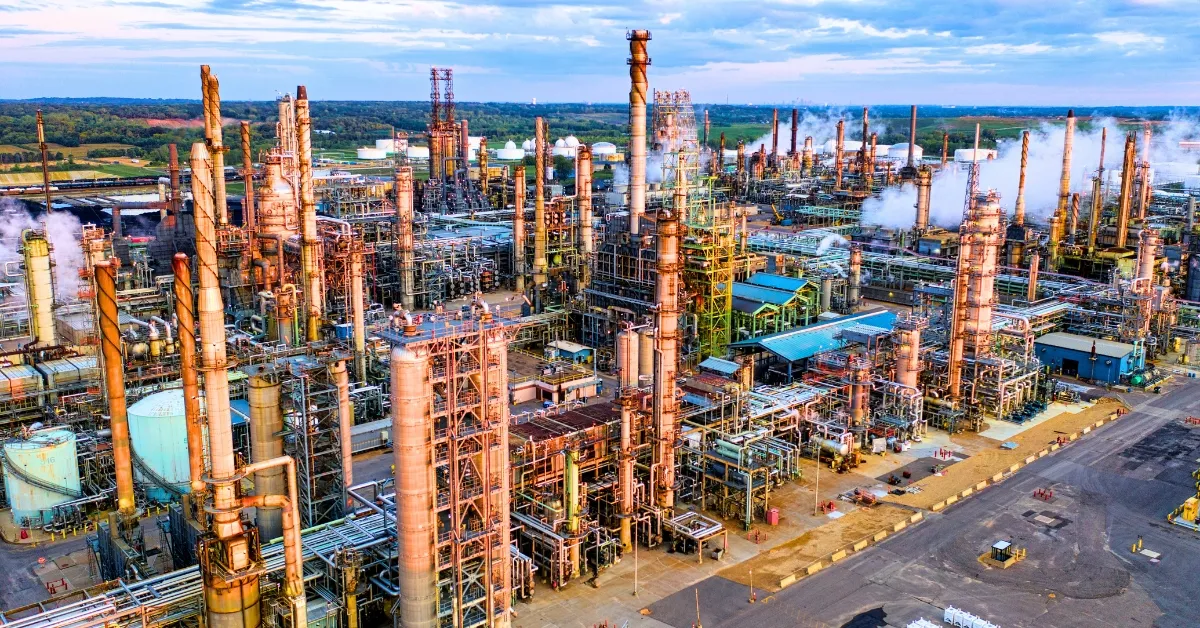
Natural gas is a strong, clean-burning fossil fuel that comes from deep underground. It forms over millions of years as small sea plants and animals get buried under rock layers. Heat and pressure slowly change this material into a gas. Most natural gas is found in only a few countries, and Russia has the largest share of reserves. Still, if you look for one specific place, there is one huge field that stands out. In this article, we will explore the world's largest gas field and why it matters so much for global energy.
ALSO READ: Which Country Has the Cheapest LPG in the World?
Which is the Largest Natural Gas Field in the World?

Source: Financial Times
The South Pars / North Dome field is the world’s largest gas field. It lies deep beneath the Persian Gulf and is shared by Iran and Qatar. This field is the largest because it contains about 19% of the world’s known natural gas reserves.
| Feature | Details |
| Name | South Pars (Iran) / North Dome (Qatar) |
| Location | Persian Gulf (Offshore) |
| Total Area | ~9,700 square kilometers |
| Estimated Reserves | contains 1,800 trillion cubic feet (51 trillion cubic meters) of gas |
| Components | Contains roughly 1,800 trillion cubic feet (51x10¹² m³) of in-situ gas and 50 billion barrels (7.9x10⁹ m³) of natural gas condensate. |
| Shared By | Iran and Qatar |
Qatar is one of the main exporters of gas from this field. They convert the gas into liquid form (LNG) and send it to countries like China, India, Japan, and South Korea. In March 2026, the field made headlines because regional conflicts affected production. Even with these issues, it remains a key energy source for heating homes and powering factories worldwide.
Facts about the Largest Natural Gas in the World
- Iran calls its side "South Pars", while Qatar calls its portion "North Dome" or "North Field".
- The field covers about 9,700 square kilometres, which is larger than some small countries.
- Scientists estimate it holds enough gas to supply the entire world’s energy needs for about 13 years.
- The gas is trapped nearly 3,000 metres below the seabed in ancient rock layers.
- Although it is a single continuous reservoir, it was discovered in stages, with Qatar discovering its portion first in 1971.
- Qatar alone provides about 20% of the world's total LNG supply from this single field.
IN CASE YOU'RE INTERESTED: Which is the Largest LNG Plant In the World?
Iran vs. Qatar: Gas Field Comparison
| Feature | Iran (South Pars) | Qatar (North Dome) |
| Daily Production | ~700 Million Cubic Meters | ~520+ Million Cubic Meters |
| Main Use | Domestic: Used for 70% of Iran's electricity and heating. | Export: Processed into LNG for the global market. |
| Global Role | Provides energy to Iraq and local industries. | Supplies ~20% of the entire world's LNG. |
| Export Method | Mostly through land pipelines. | Mostly through massive sea tankers (LNG). |
| Recent Status | Production was recently hit by 12% due to the March 2026 strikes. | Operations at the Ras Laffan hub are facing temporary delays. |
When was the Largest Natural Gas Field in the World Discovered?
The world's largest gas field was discovered in two main phases. Shell first found it in 1971 while drilling off the coast of Qatar, but its true size was not known at the time. In 1990, Iran learned that the field stretched into its own territory. This discovery transformed the Middle East, turning it into a key energy centre.
Where is the World's Biggest Gas Field?
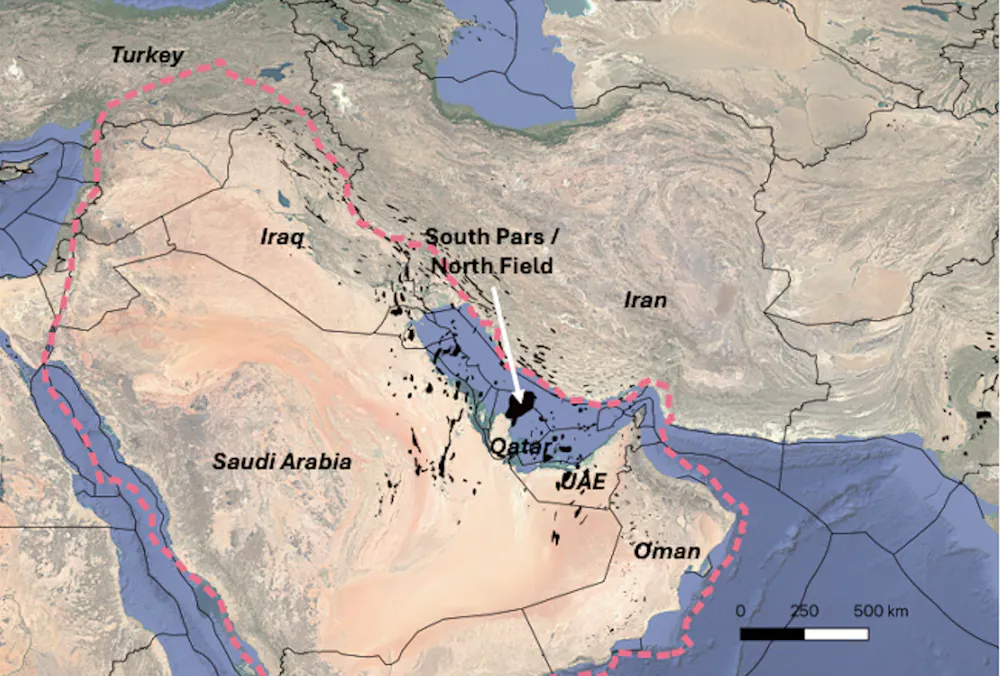
Source: The Conversation
The South Pars / North Dome field is a huge natural gas area found offshore in the Persian Gulf, right on the border between Iran and Qatar. It covers about 9,700 square kilometres, which is about the same size as Cyprus.
Iran controls around 3,700 square kilometres, while Qatar has the other 6,000 square kilometres. Since the field is underwater, large offshore platforms are used to extract the gas and send it through pipelines to the shore.
Which Countries Import their Natural Gas from Iran/Qatar?
Qatar ranks among the world’s leading exporters of Liquefied Natural Gas (LNG). In 2026, India bought almost 47% of its total gas imports from Qatar. China, Japan, and South Korea are also major Asian buyers, together purchasing about 65-70% of Qatar’s yearly output.
In Europe, countries such as Italy and Belgium depend on this supply as well. Iran mainly exports its share through pipelines to neighbours like Iraq and Turkey, but keeps about 75% of its gas for domestic electricity and heating.
What are the 5 Largest Natural Gas Fields in the World?
The top five largest natural gas fields are:
- South Pars / North Dome (Iran/Qatar): Holds about 19% of the world's total gas.
- Urengoy (Russia): Located in Siberia, it is the largest on-land field.
- Yamburg (Russia): Another massive Siberian field with huge reserves.
- Hassi R’Mel (Algeria): The largest gas field in Africa.
- Galkynysh (Turkmenistan): One of the newest "super-giant" fields discovered in 2006.
How was Natural Gas formed?
Natural gas is primarily made of methane. It was formed through a scientific process called thermal decomposition.
- Burial: Millions of years ago, microorganisms died and settled on the ocean floor.
- Pressure: Layers of sediment (mud and sand) piled on top, squeezing the remains.
- Heat: Deep within the Earth's crust, temperatures rose, breaking down the organic molecules into gaseous hydrocarbons.
- Trapping: The gas rose through porous rocks until it hit a "cap rock" (an impermeable layer), creating the massive underground reservoirs we tap into today.
WHAT'S NEXT: CNG vs LPG: Check All the Differences Here!



Comments
All Comments (0)
Join the conversation