India's 3-Stage Nuclear Power Programme: PHWRs, Fast Breeder Reactors and Thorium Reactors
India's 3-Stage Nuclear Power Programme is a unique strategy to utilize uranium and thorium for long-term energy security. Learn about PHWRs, Fast Breeder Reactors, Thorium Reactors, their working, objectives and significance.
Energy security is important in a developing country. In India, a nation with large quantities of thorium, but relatively few uranium ore deposits, traditional nuclear power schemes came to be seen as a major challenge. To get around these limitations, the eminent physicist of his time, Dr. Homi Jehangir Bhabha came up with a plan called the Three-Stage Nuclear Power Programme in the fifties.
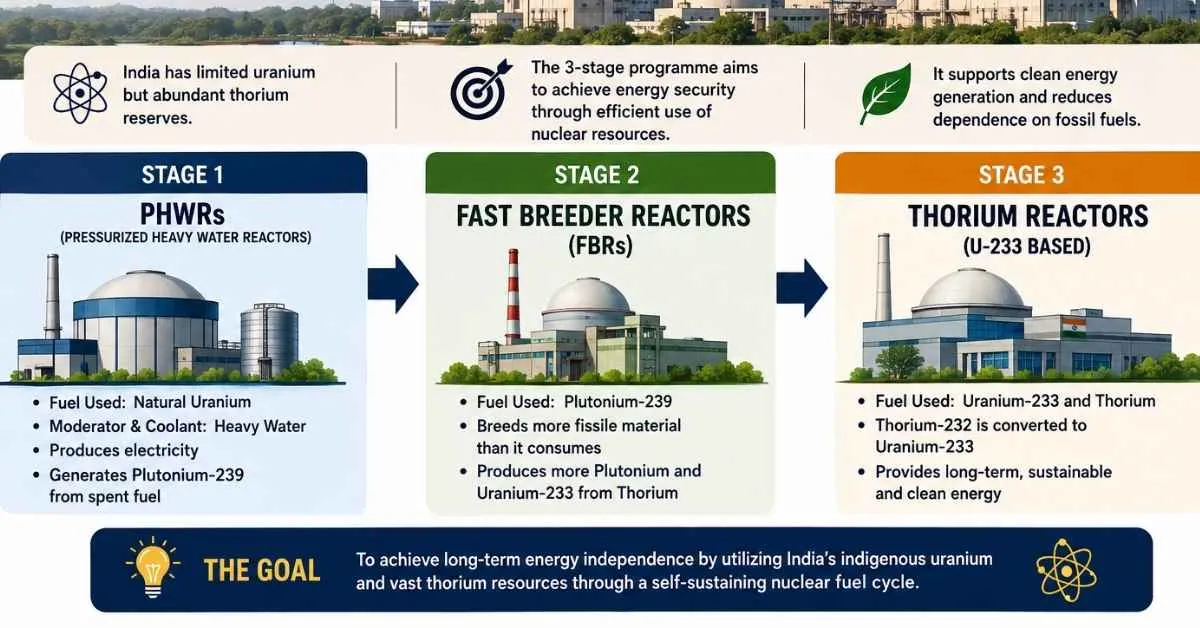
The Department of Atomic Energy (DAE) handles this plan which works on the principle of closed fuel cycle reactors and the idea of reprocessing to reuse. The different stages of the plan include pressurized heavy water reactors (PHWRs) in the first stage, followed by fast breeder reactors (FBRs) in the second stage, and finally thorium-based reactors in the last stage.
What is India’s 3-Stage Nuclear Power Program ?
The three-stage nuclear power program of India is an innovative nuclear energy program initiated in the 1950s by the father of Indian nuclear program, Dr. Homi J. Bhabha, since India is endowed with relatively less quantity of uranium ores in contrast to its huge reserves of thorium ores.
The idea behind the program is to utilize nuclear fuel at higher levels of efficiency by making use of spent fuels from one stage of the process as fuel for the next stage.
| Stage | Fuel | Moderator/Technology | Main Output / Purpose |
| Stage 1 | Natural Uranium | Heavy Water (PHWR) | Electricity + Plutonium-239 |
| Stage 2 | Plutonium / MOX | Fast Neutrons (FBR) | Power + Breeding U-233 / more Plutonium |
| Stage 3 | Thorium - Uranium-233 | Advanced Thermal Breeders | Massive, long-term energy independence |
Stage 1: Pressurized Heavy Water Reactors (PHWRs)
In this earlier phase, Natural Uranium is employed as the fuel source. Heavy water (deuterium oxide) is used as both a moderator and a coolant, enabling natural uranium, which has only 0.7% of the fissile isotope U-235, to maintain a nuclear fission chain reaction.
Objective: To generate electricity for commercial purposes while creating a small amount of Plutonium-239 (Pu-239) in the spent fuel.
Present Situation: Currently, this represents the backbone of India’s nuclear power generation, with domestic reactors of 700 MWe capacity being setup across the country at a rapid pace.
Stage 2: Fast Breeder Reactors (FBRs)
The second stage serves as a bridge, utilizing the plutonium obtained from stage one.
Fast breeder reactors (FBRs) utilize a mixture of plutonium uranium oxide (MOX) fuel. Unlike thermal reactors where a moderator is used, fast breeder reactors function without one, using instead the fast neutrons to initiate the cycle and sustain the process.
The breeding principle: the fast breeder reactor is specifically constructed in such a way that it produces more fissionable material than it consumes. The process is accomplished through the use of uranium-238 or thorium-232 as a blanket around the reactor core, where extra neutrons create plutonium-239 or uranium-233 out of those fertile materials.
The greatest achievement of this stage is that India's 500 MWe prototype fast breeder reactor (PFBR) has achieved its first criticality and went into the history as the project that made India a pioneer in the area of fast reactor technology.
Stage 3: Thorium Reactors
The key goal of the entire work is the third level: to convert Thorium-232 into energy. Natural thorium cannot undergo fission itself, so it needs the fissile material obtained via the second level in order to convert it to Uranium-233.
Energy Implications: Once fully adopted, Thorium Reactors (for instance, Advanced Heavy Water Reactors) will provide practically unlimited supplies of energy and will meet India’s long-term energy requirements.
National Mission: The mission sets the ground for the program aimed at India’s long-term decarbonization, enabling the country to reach the net-zero emissions target by 2070.
The Department of Atomic Energy deems the closed fuel cycle of the Indian program efficient as the waste from earlier-generation technologies becomes a usable resource.
In India's Three-Stage Nuclear Power Programme, we can observe a unique implementation of strategic planning, efficient utilization of resources and a technological vision. Thus, India's geographical disadvantages of lack of uranium and the presence of thorium in great quantities might change completely to become a technological advantage in the future.
While Stage 1 is putting the existing grid into operation and Stage 2 is becoming more and more advanced thanks to the implementation of major projects such as the Kalpakkam PFBR, Stage 3 is progressing toward using clean energy for centuries.

Manisha Waldia is a distinguished content strategist with 5 years of experience crafting premium educational content for UPSC and State PCS, with a focus on deep conceptual analysis across Polity, Geography, History, and Environment. She currently brings this expertise to Jagran Josh, where she covers major national and international events, current affairs, and static general knowledge. Over her career, Manisha's specialized insights have led her to curate high-impact materials and serve as a UPSC Mains answer-evaluator for India’s top institutes—including Drishti IAS, Shubhra Ranjan IAS, Study IQ, GS Score, and PWonlyIAS. She has also worked alongside leading NGOs like Oxfam India and Avani Kumaon.
Contact: manisha.waldia@jagrannewmedia.com




![[Out] UGC NET June 2026 Result Live: यूजीसी नेट रिजल्ट ugcnet.nta.nic.in जारी, डायरेक्ट लिंक से करें चेक](https://img.jagranjosh.com/images/2026/August/2782026/UGC-NET-Result-2026-Marksheet-link-pdf.jpg)