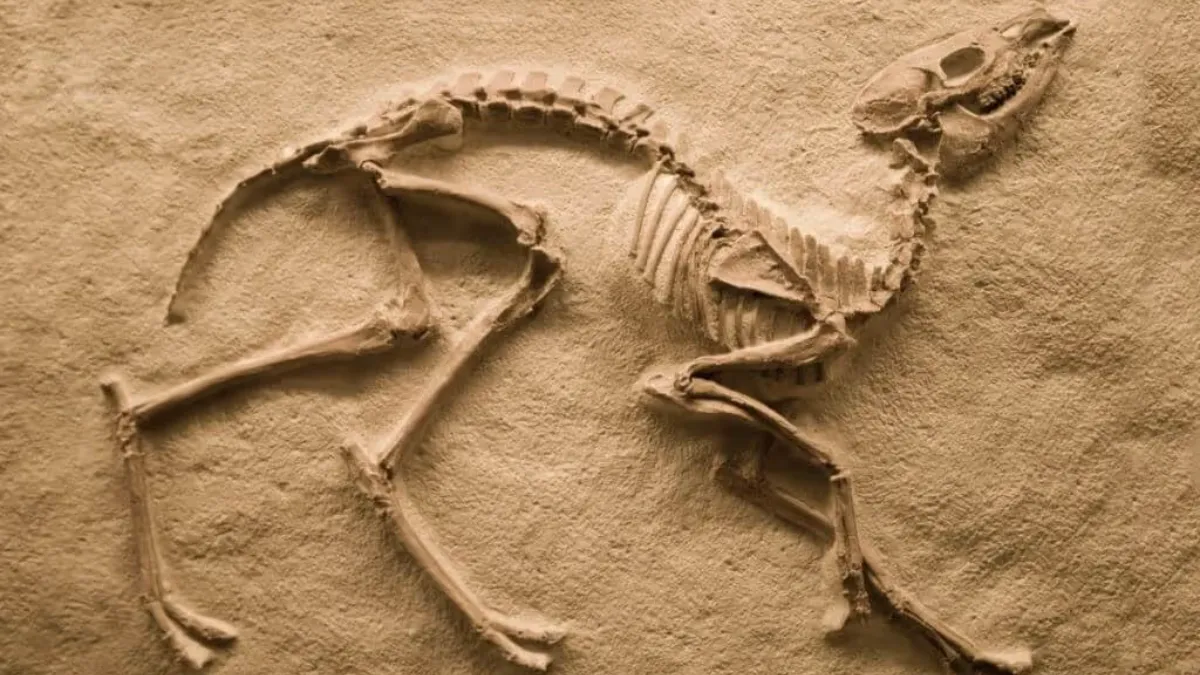
Fossils are the remains or traces left behind by life forms that existed long ago and are normally found in sedimentary rocks. They are usually very small, like micro shells or pollen, and sometimes reach huge proportions, like dinosaur bones or even forests.
Common types of Fossils include:
-
Body fossils: bones, teeth, shells, wood, leaves.
-
Trace fossils: These include footprints, burrows, coprolites (dung), nests, or feeding traces that provide information on behavior.
-
Chemical fossils: These are the remains of organic molecules left behind by ancient organisms.
How Most fossils exhibit a series of important phases between death and discovery.
1) Death and initial decay
A body dies in an area where sedimentation can begin, and this would include rivers, lakes, seas, flood plains, and ash deposits. There is rapid decomposition of soft tissues because of scavengers, bacteria, oxygen, and weathering, and only hard parts, which would be bones, shells, and wood, are left behind.
2) Burial in sediments
To start the fossilisation process, the organism's remains must have been quickly buried by either mud, sand, silt, volcanic ash, or sediment. It is this rapid burial that protects the organism from being scavenged and from further degradation while establishing a low oxygen environment.
3) Sediment accumulation and lithification
Additional layers accumulate on top of this, and the weight pushes down, forcing water and air out of the lower layers. As this compression and cementation process continues, sediments turn into sedimentary rock, which embeds fossils within a solid rock structure.
4) Mineral Changes and Fossilization
When buried, water containing dissolved minerals passes through these layers and remains. Minerals precipitate from solution in pores or replace existing tissues in a process that transforms remains into a rock while retaining their outlines and even details.
5) Uplift, Erosion
Tectonic processes can raise sedimentary rock near the surface. Weathering and erosion will break down the overlying rock, and fossils will become exposed, making them accessible to detection by paleontologists.
READ | Which Country Uses Cookie Dough As Currency?
Kinds of fossilization processes
There are varying fossil types according to the geological and chemical environments.
Permineralization and Petrification
-
Process: Mineral-rich water permeates the porous tissue (bone, wood, shells) and forms crystals in the pores, increasing the density of the tissue to rock-like consistency.
-
Petrification: In certain instances, the original organic material gets replaced cell by cell by the minerals, creating petrified wood or mineralized bones.
-
Examples: dinosaur bones, petrified forests, fossil remains of various invertebrates.
Moulds and Casts
-
Moulds: A dissolving shell or bone creates a cavity impression in the rock around it—an external/internal mould. There are no traces of the original remains of the creature at this stage.
-
Casts: Eventually, minerals or sediment enter this mould and cement together, forming a cast of the organism's outer shape.
Examples include fossilized shells, invertebrates, and plant stems.
Carbonisation (Carbon Films)
-
Process: "Under stress and heat, volatile elements (hydrogen, oxygen, and nitrogen) evaporate from buried bodies, leaving a film of carbon."
-
Result: Delicate, flat fossils that have the outlines and details of softer tissues, such as leaves or small animals.
Fossil ferns, insects, and soft-bodied fossils in fine shales.
Remains: Exceptional Preservation
Conditions: Extreme environmental conditions, such as those found in amber, tar pits, ice, or anoxic bogs, come close to preventing the process entirely.
Result: Original soft tissues, hair, and feathers, or even pieces of DNA, can remain intact. - Examples: Insects trapped in amber, frozen mammoths, mummified ground sloths
Trace Fossils
What they are: Activity traces, not body parts; footprints, trackways, burrows, marks of feeding activity, or droppings.
Significance: They show behavior, dynamics, and interactions with the environment that could not be determined from body fossils alone.
Requirements for Fossilization
In general, conditions rarely happen, but some conditions increase one’s chances of being fossilised.
Hard parts and rapid burial
-
Hard tissues: Bones, teeth, shells, and woody tissues are not as decayed as soft tissues, and hence their abundance in fossil form.
-
Rapid burial: Later burial by sedimentation layers (floods, landslides, and ash falls) prevents the body from disintegrating. Low oxygen levels and stable conditions
-
Anoxic environments: The absence of oxygen impedes bacterial and chemical weathering, allowing for the preservation of detail.
-
Gentle environments: A calm surface or basin decreases the stress caused by waves or currents.
Geological Time and Exposure
Time: Mineralization and rock formation occur after thousands and millions of years.
Exposure: If fossils are not uplifted and eroded, they will never be discovered, so areas of active geological activity are full of fossil-bearing locations.
Why are fossils important?
Fossils are living evidence of past life that help us reconstruct past environments and climates. By comparing fossil records, scientists are able to trace the emergence of large events in the history of life, for example, the evolution of tetrapods, the emergence of flowering plants, and the extinction of the dinosaurs.
Recommended Reading:
List of 9 Fruits That Grow In the Desert




Comments
All Comments (0)
Join the conversation