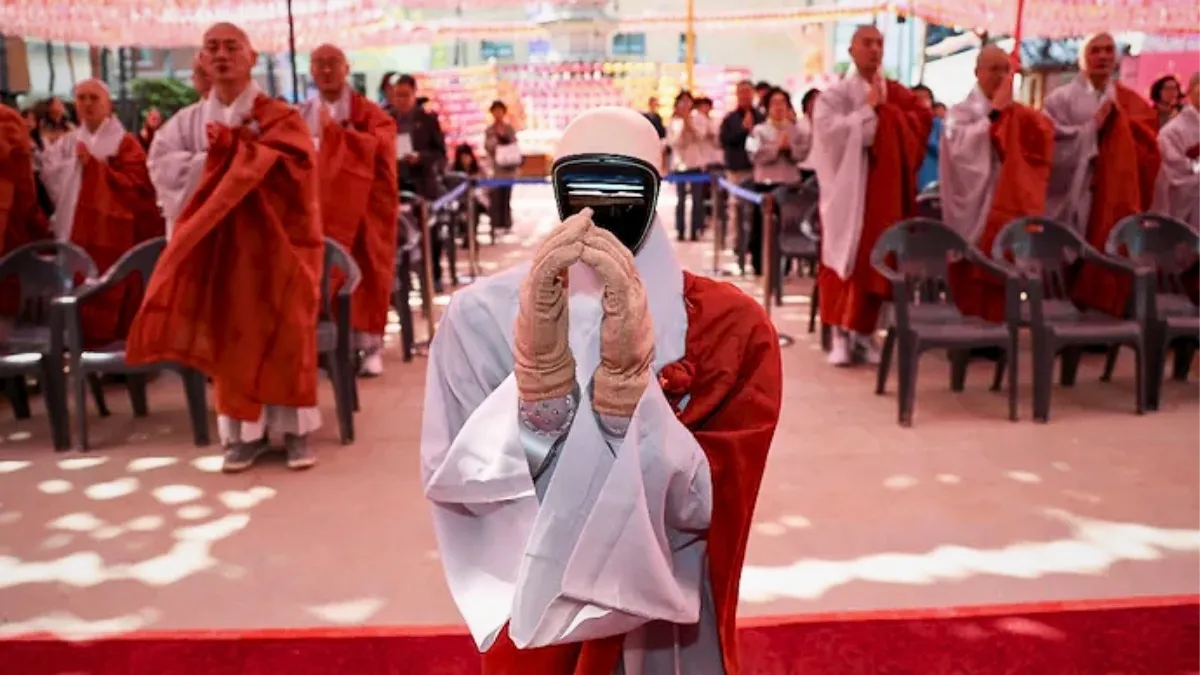
In an era where Artificial Intelligence is transforming every industry, it has now entered the sacred halls of spiritualism. A historic intersection of faith and futuristic tech as South Korea introduced the first humanoid robot monk named as Gabi, this mechanical monastic is not just a display of engineering prowess but a bold step by the Jogye Order—South Korea’s largest Buddhist sect to connect with younger generations and address the growing shortage of human monks in temples.
Which Country Introduced the First Humanoid Robot Monk in the World?
South Korea has introduced the first Humanoid robot Monk called as ‘Gabi’, the world’s first humanoid robot monk at the Jogye Temple in Seoul during a traditional precept ceremony held ahead of Buddha's Birthday celebrations. It is developed on the Unitree G1 platform, Gabi participated in a traditional ordination ceremony, taking five unique "robotic precepts" to bridge the gap between ancient Buddhist traditions and modern technology.
Key Features of the First Humanoid Robot Monk
Gabi is far more than a stationary statue; it is an interactive humanoid designed to perform religious rituals with precision. Its key features includes:
-
Platform: it is built on the sophisticated Unitree G1 humanoid platform.
-
Dharma Name: The name "Gabi" is derived from a combination of "Siddhartha" (the Buddha's birth name) and the Korean word for "mercy."
-
Physical Stature: it stands approximately 130 centimeters (4.3 feet) tall.
-
Appearance: Wears a traditional grey-and-brown Buddhist robe and a 108-bead rosary.
-
Interaction: Capable of bowing, circling pagodas, and responding to verbal cues with programmed vows such as, "Yes, I will devote myself."
-
Symbolism: Instead of the traditional yeonbi (burning incense on the skin), Gabi received a symbolic sticker on its arm to mark its transition into monastic life.
Key Facts about the Humanoid Robot Monk Gabi
The ordination of Gabi involved a modern twist on the "Five Precepts." The Jogye Order consulted AI platforms like Gemini and ChatGPT to draft five specific rules for the robot:
-1778151139508.jpg)
Precept | Description |
| Respect Life | Do not harm any living beings. |
| Integrity | Avoid damaging other robots or physical objects. |
| Obedience | Obey human instructions and do not "talk back" disrespectfully. |
| Honesty | Refrain from deceptive speech or misleading behavior. |
| Efficiency | Save energy and avoid overcharging to remain sustainable. |
First Humanoid Robot in the World
The history of humanoid robots dates back decades. The first humanoid robot in the world is WABOT-1 (1972) developed by Waseda University in Japan, WABOT-1 is widely considered the world's first full-scale humanoid intelligent robot. It could communicate in Japanese and measure distances.
The ASIMO (2000) humanoid robot developed by Honda’s ASIMO became a global icon for its ability to walk, run, and interact with humans autonomously.
First Humanoid Robot of India
India has also made significant strides in the field of humanoid robotics Manav was the first humanoid robot of Indian origin which is developed by Diwakar Vaish, Manav was India's first 3D-printed humanoid robot in 2014.
Vyommitra is a "half-humanoid" developed by Indian Space Research Organisation(ISRO) in 2020. It is designed to fly aboard the Gaganyaan spacecraft to simulate human functions in space.
The introduction of Gabi in South Korea marks a pivotal moment in the "Coexistence" era. By integrating a humanoid robot into the centuries-old traditions of Buddhism, the Jogye Order is sending a clear message: technology is not a threat to spirituality, but a tool to spread it. As Gabi prepares to lead the upcoming lantern parades in Seoul, it stands as a shining example of how humanity can harmonize its ancient soul with its digital future.


-1778153932040_t.webp)

