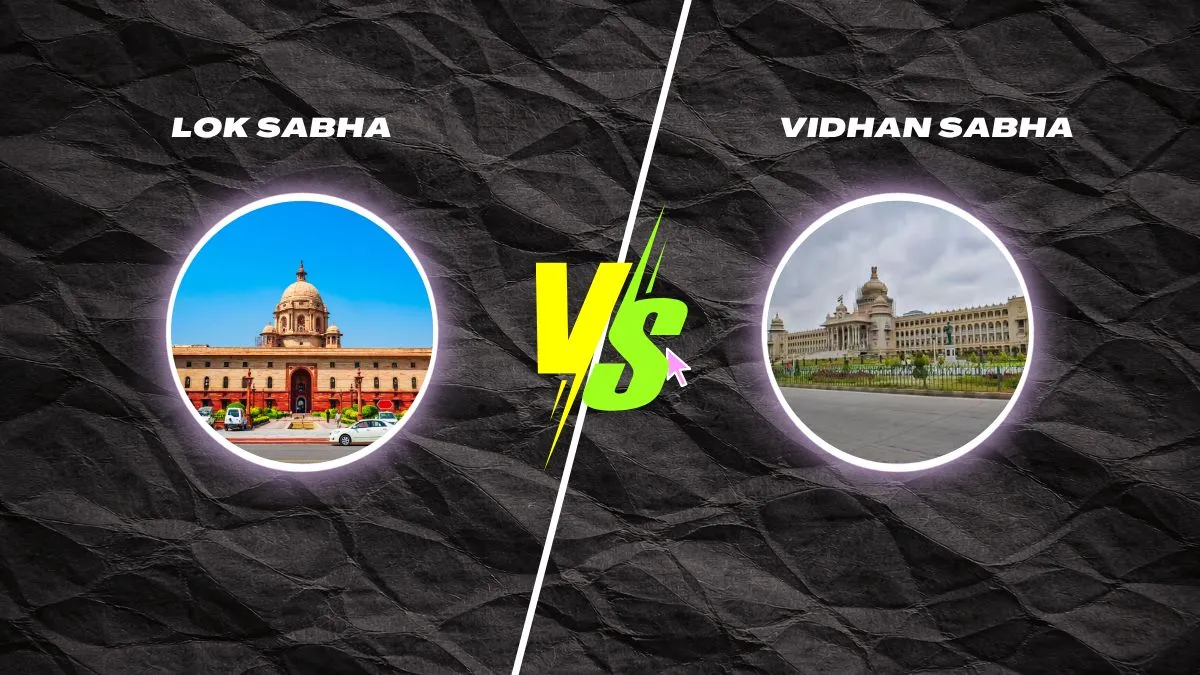
The difference between Lok Sabha and Vidhan Sabha is in terms of their jurisdiction and level of government they represent. The Lower House of the Parliament of India, which represents the whole nation at the central level, is called Lok Sabha. The lower or sole house of the state legislature in all the Indian states is called Vidhan Sabha or the Legislative Assembly. Although the two houses are made up of representatives who are directly elected by the people, their powers and geographical areas covered by them are different.
What is Lok Sabha?
The most powerful house in the Indian Parliament is Lok Sabha. It is also called the "Lower House" or the "House of the People." The reason is that its members are directly elected by the people of India by general elections.
The highest number of members that this house can have is 550 members, as stipulated in Article 81 of the Constitution. Presently, the house consists of 543 elected seats. The members are representatives of a particular geographical region known as Parliamentary Constituency. The Lok Sabha has a term of five years until it is dissolved by the President.
The primary function of Lok Sabha is passing central laws. It also regulates the finances of the country. Only in the Lok Sabha a Money Bill, i.e., connected with taxes and government expenditure, can be introduced.
What is Vidhan Sabha?
Vidhan Sabha is a state level legislative body in India. Every state has a Vidhan Sabha. Only 6 states in India have a second house known as the Vidhan Parishad or Legislature Council which is a partially nominated upper house. The Vidhan Sabha, however, is always the first law making body of the state.
Article 170 provides that the number of members of a Vidhan Sabha varies with the population of the state. It is not allowed to exceed 500 members or less than 60 members. The minimum limit is but an exception in the case of small states such as Sikkim or Goa. The members are known as MLAs or Members of the Legislative Assembly.
The Vidhan Sabha enacts laws on matters that are of interest to the state. These involve such issues as police, public health, and agriculture. The term of the Vidhan Sabha is five years. It may be dissolved by the Governor at his or her discretion on the recommendation of the Chief Minister.
Lok Sabha vs Vidhan Sabha: Check the Differences
The following table highlights the fundamental differences between Lok Sabha and Vidhan Sabha.
| Parameter | Lok Sabha | Vidhan Sabha |
| Level of Government | Central Government | State Government |
| Full Name | House of the People | Legislative Assembly |
| Member Title | Member of Parliament (MP) | Member of Legislative Assembly (MLA) |
| Maximum Strength | 550 Members | 500 Members (Minimum 60) |
| Presiding Officer | Speaker of the Lok Sabha | Speaker of Vidhan Sabha |
| Law-making Scope | Union List and Concurrent List | State List and Concurrent List |
| Minimum Age | 25 Years | 25 Years |
Key Differences Between Lok Sabha and Vidhan Sabha
1. Area of Authority
The Lok Sabha is in charge of the entire of India. Its laws are applicable to all states and union territories. Conversely, a Vidhan Sabha has limited powers to its particular state boundaries. As an example, a law enacted by the Uttar Pradesh Vidhan Sabha is inapplicable in Punjab.
2. Election and Representation
General Elections are held in which citizens throughout the country vote to elect the members of the Lok Sabha. These elections determine who will be in charge of the Central Government as the Prime Minister. The elections to the State Assembly are conducted individually in the state. These are elections that are used to decide on who will become the Chief Minister.
3. Financial Powers
The Lok Sabha is in charge of the Union Budget of India. It determines the manner in which the central government uses money in national projects such as defense and railways. State Budget is handled by the Vidhan Sabha. It concentrates on state-level expenditure on education, infrastructure, and local development.
4. Head of Government Involvement
The Prime Minister is most often a member of the Lok Sabha. He is the leader of the majority party in this house. Likewise, the Chief Minister is usually a member of the Vidhan Sabha. Both leaders are answerable to their respective houses. In case they lose a No-Confidence Motion they are forced to resign. In India, a person must be 25 years old to contest elections for both Lok Sabha and Vidhan Sabha.
Common Misconceptions
Many people think that an MP is "higher" in rank than an MLA. While an MP represents a larger area, both roles are equally important in their own domains. An MP deals with national issues hence is deemed a more powerful position, while an MLA handles state-specific problems.
Another confusion is about the term "Legislative Assembly." Some people think it refers to the national parliament. In India, "Legislative Assembly" always refers to the Vidhan Sabha at the state level. The national body is strictly called Parliament or Sansad.
What is the main difference between Lok Sabha and Vidhan Sabha?
The main difference is their level at which they operate. The Central Government of India has Lok Sabha working on its behalf and the individual State Governments have Vidhan Sabha which works on its behalf. Members of the Lok Sabha are known as MPs, members of the Vidhan Sabha are known as MLAs.
Can a person be a member of both Lok Sabha and Vidhan Sabha?
No, a person cannot be a member of both houses at the same time. In the case where a member of one house is elected to the other house, he/she must vacate his/her seat in the house within a certain time.
Which is more powerful, Lok Sabha or Vidhan Sabha?
They are powerful in different areas. Lok Sabha is more powerful regarding national laws and the Union Budget. Vidhan Sabha is the highest law-making body within its respective state for matters listed in the State List of the Constitution.
Is Lok Sabha a type of Vidhan Sabha?
No, they are quite different bodies. Lok Sabha, is one of the components of the national Parliament in New Delhi. Vidhan Sabha is a state-based institution which is situated in the capital of each state of India.
Both Lok Sabha and Vidhan Sabha play an important role in the democratic process of India. The Lok Sabha takes care of the interests of the country and the Vidhan Sabha takes care of the interest of the individual states. The knowledge of the difference between the two will make sure that citizens are aware of who represents them at the national and state level.
Check out some more interesting articles from the general knowledge section to boost your knowledge of national and international topics. Stay connected with Jagran Josh for more topics like this.