Beyond the Suez Canal: How the Northern Sea Route Could Reshape the New World Order
As Arctic ice melts, the Northern Sea Route is emerging as an alternative to the Suez Canal. Discover how India, China and Russia are using this Arctic corridor to reshape global trade and geopolitics.
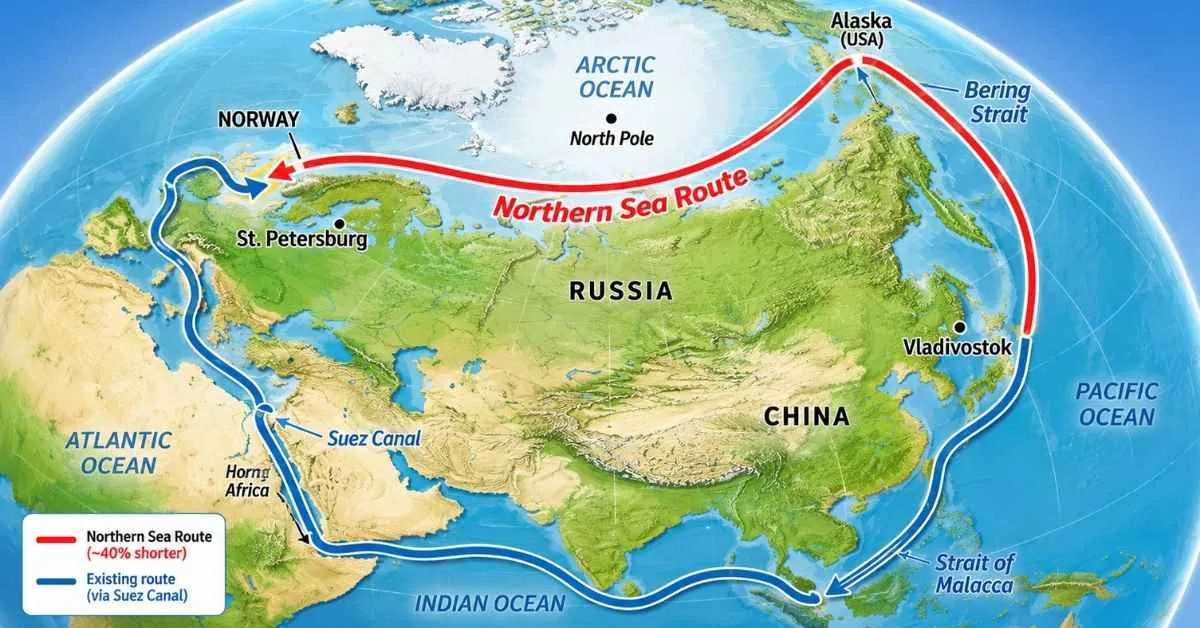
The Suez Canal has played a significant role in international maritime trade for over 150 years linking Europe and Asia through the Mediterranean and the Red Sea. But the rise of climate change, geopolitical tensions and supply chain issues have triggered nations to consider alternative routes.
One possible route is the Northern Sea Route (NSR) opening up a new Arctic shipping corridor at the North of Russia. Previously blocked by icy waters, this route is now gradually becoming increasingly navigable due to global warming. As countries like China, South Korea and India assess its commercial feasibility, Russia views it as a strategic opportunity to influence global trade processes.
What is the Northern Sea Route?
The Northern Sea Route (NSR) refers to the maritime passage that extends roughly over 5,600 kilometers covering the distance from the Pacific Ocean’s Bering Strait to the Barents Sea of the Atlantic Ocean. Travelling along Russia’s northern shore. It is the quickest sea route from Northeast Asia to Northern Europe as it covers smaller distances when compared to the conventional southern routes.
Why is the Suez Canal No Longer Enough?
Although the Suez Canal continues to be the main stay of world trade. It has recently suffered from major problems. Users of the traditional sea routes have been struggling with various problems such as security issues in the Red Sea, political instability in the region, excessive insurance costs and jammed logistics because of which operators are looking for other options.
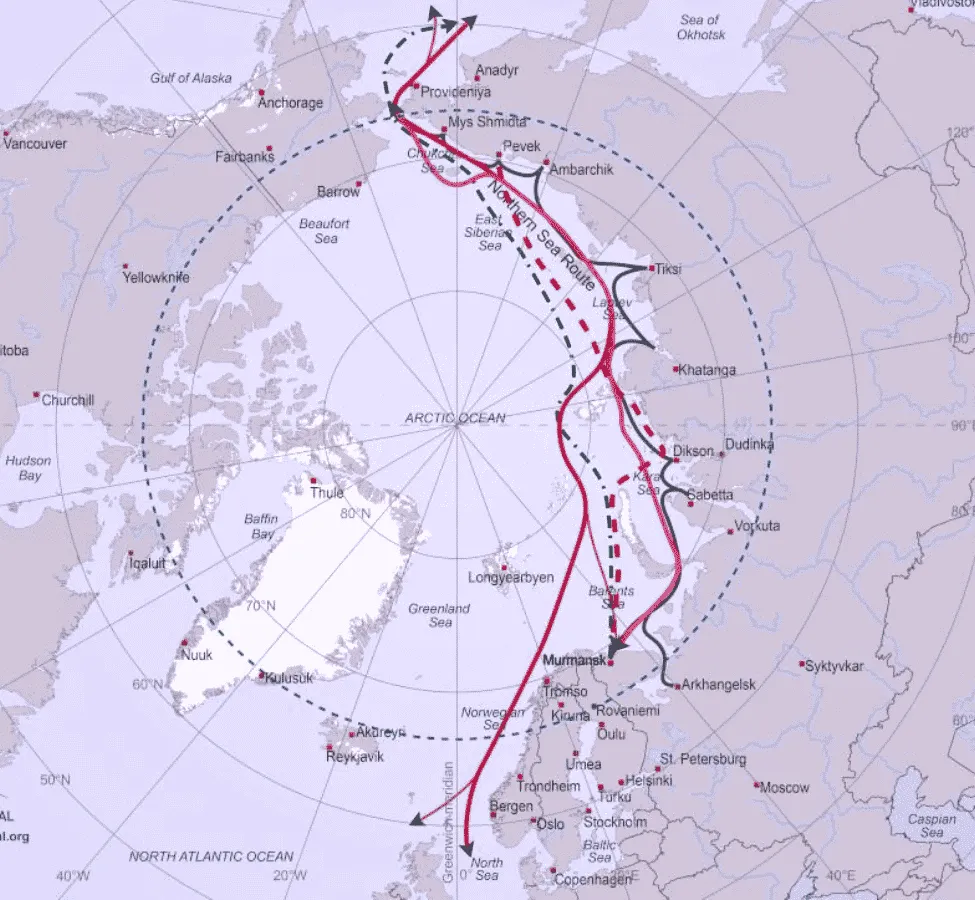
How Does the Northern Sea Route Compare with the Suez Canal
The NSR shortens the journey between Asia and Europe to approximately 18–20 days instead of 30–35 via the Suez Canal. The Arctic route is as much as 40% shorter than conventional southern routes. Classic routes are open all year.
In contrast, the NSR is only used from July to October. In addition, shipping through the Suez Canal is concerned with political turmoil in the Middle East in the region of the Red Sea while NSR operations depend on Russian laws, sanctions and severe weather conditions.
| Factor | Suez Canal Route | Northern Sea Route |
| Asia-Europe Transit Time | 30-35 Days | 18-20 Days |
| Distance | Longer | Up to 40% Shorter |
| Fuel Consumption | Higher | Lower |
| Carbon Emissions | Higher | Lower |
| Seasonal Availability | Year-round | Mostly July-October |
| Political Risks | Red Sea & Middle East | Russia-related sanctions |
China's Arctic Aspirations: The Polar Silk Road
China is considering the Arctic in its "Polar Silk Road" policy. Transport companies such as Sea Legend have established a regular weekly schedule of container transportation between eastern China and northern Europe.
This effectively avoids busy routes in the south and ensures that Beijing is getting an economic foothold in the region.
What Brings India to the Northern Sea Route?
India aims to engage itself in the NSR due to both economic and strategic considerations. In this way, New Delhi is planning its first cargo delivery through this route which is believed to reduce the travel distance by 40% from North America to Europe.
The corridor can easily fit into various domestic logistics schemes, e.g., the International North-South Transport Corridor (INSTC) and the Eastern Maritime Corridor Chennai-Vladivostok enabling fast access to the European market at a low cost.
Russia: The Custodian of the Arctic Passage
With control over the majority of the Arctic shoreline, Russia decides upon navigation permits, icebreaker guides and regulatory access. The NSR serves as an economic ‘shield’ for Russia against Western sanctions .This turning the northern waters into a lucrative trading route.
The Challenges Related to Arctic Shipping
The corridor holds great promise but it is confronted with significant natural and operational challenges.
Firstly, extreme climatic conditions cause unpredictable navigation difficulties. Secondly, ships traveling in freezing waters need specially designed reinforcements to protect their hull in icy conditions.
Thirdly, since there are environmental and operating risks of fishing in these areas, insurance costs increase. In addition, the increase in traffic raises issues of black-carbon emissions and the protection of ecosystems.
The Northern Sea Route shows that climate change and new geopolitical realities is changing the nature of human trade in the global sense. The Suez Canal will be indispensable as before but already stands alongside the Northern Sea Route as one of the key trade routes of the 21st century.

Manisha Waldia is a distinguished content strategist with 5 years of experience crafting premium educational content for UPSC and State PCS, with a focus on deep conceptual analysis across Polity, Geography, History, and Environment. She currently brings this expertise to Jagran Josh, where she covers major national and international events, current affairs, and static general knowledge. Over her career, Manisha's specialized insights have led her to curate high-impact materials and serve as a UPSC Mains answer-evaluator for India’s top institutes—including Drishti IAS, Shubhra Ranjan IAS, Study IQ, GS Score, and PWonlyIAS. She has also worked alongside leading NGOs like Oxfam India and Avani Kumaon.
Contact: manisha.waldia@jagrannewmedia.com




![[Out] UGC NET June 2026 Result Live: यूजीसी नेट रिजल्ट ugcnet.nta.nic.in जारी, डायरेक्ट लिंक से करें चेक](https://img.jagranjosh.com/images/2026/August/2782026/UGC-NET-Result-2026-Marksheet-link-pdf.jpg)