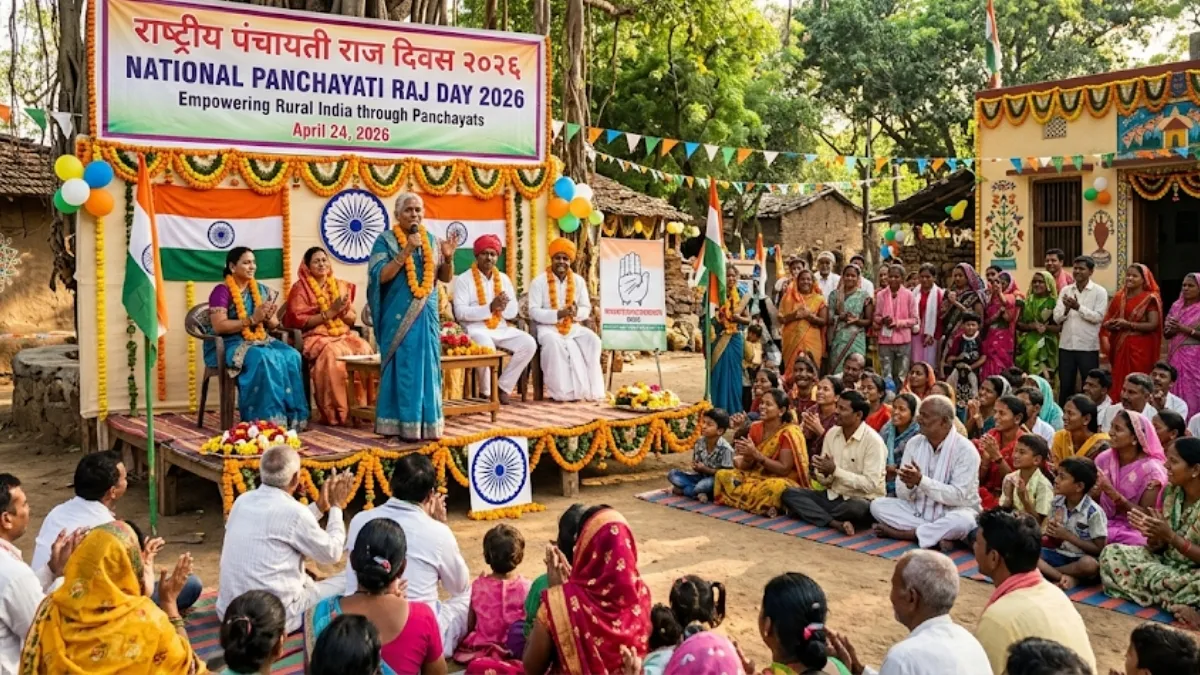
National Panchayati Raj Day, 2026: In India, the village is not just a geographical unit; it is the fundamental heartbeat of the country's democracy. National Panchayati Raj Day is celebrated on April 24 every year to commemorate constitutionalisation of local self-government and 73rd Constitution Amendment in India. standing as a testament to the power of "Gram Swaraj" or village self-rule, a vision of Mahatma Gandhi.
National Panchayati Raj Day is observed to honor the millions of elected representatives who bridge the gap between the central government and the remote corners of rural and transformed India's grassroot democracy. Read this article to have a comprehensive look at the history, Constitutional provisions, significance, and latest advancements in the Panchayati Raj system of India.
National Panchayati Raj Day 2026: Date, Theme, Celebration and Overview
The Ministry of Panchayati Raj observes this day to mark the institutionalization of local self-government.
| Particulars | Details |
| Date | April 24, 2026 |
| Nodal Ministry | Ministry of Panchayati Raj (MoPR) |
| Occasion | Anniversary of the 73rd Constitutional Amendment Act |
| Primary Goal | Strengthening democratic decentralization |
National Panchayati Raj Day 2026: Theme
Ministry of Panchayati Raj has announced the theme for National Panchayati Raj Day 2026 which is "Sashakt Panchayat, Sarvangeen Vikas" (Empowered Panchayats, Holistic Development), by emphasis on localized Sustainable Development Goals (SDGs) and digital governance through e-GramSwaraj to ensure "Viksit Bharat" (Developed India) by 2047.
National Panchayati Raj Day 2026: Celebration
The Government of India, led by the Ministry of Panchayati Raj, has shifted its focus from simple commemoration to "Action-Oriented Governance." which is centered around the theme of making Panchayats the drivers of a "Viksit Bharat" (Developed India) by announcing the
National Panchayat Awards 2026: The highlight of the 2026 celebration is the conferring of the revamped National Panchayat Awards which includes
-
The Prizes: Winning Panchayats are receiving financial incentives ranging from ₹50 Lakh to ₹5 Crore to fund further local development.
-
Key Categories of Awards: the Deen Dayal Upadhyay Panchayat Satat Vikas Puraskar are being given to villages that have achieved "Carbon Neutral" status or "100% Digital Literacy."
The Prime Minister’s office has also signaled 2026 will be the "Year of Saturation" for the SVAMITVA 2.0 during the April 24th event and announceing drone-mapping and property card distribution have reached near-completion in several key states, empowering rural citizens with legal financial assets.
National Panchayati Raj Day: History
The journey of the Panchayati Raj system in India is a story of evolving democratic values and Gandhian Philosophy of Gram Swaraj (village self-rule) and decentralisation of power. After the Independence the Article 40 of Indian constitution regarded as the Gandhian soul of the Constitution, reflecting Mahatma Gandhi’s belief that "India lives in her village
Part IV(Directive Principles of State Policy) and Article 40 of the Indian Constitution, give the power to the Central Government and State government to make policies and implementations for the welfare and social wellbeing of people of India.
1. The Early Recommendations
The foundation was laid by the Balwant Rai Mehta Committee (1957), which recommended a three-tier system. Rajasthan was the first state to adopt the Panchayati Raj system in 1959. Later, the L.M. Singhvi Committee (1986) strongly recommended giving these institutions constitutional status.
2. The 73rd Constitutional Amendment Act, 1992
The turning point came on April 24, 1993, when the 73rd Amendment Act came into force added Part IX to the Constitution (Articles 243 to 243O) and the Eleventh Schedule to Constitution of India which lists 29 subjects under the jurisdiction of Panchayats.
3. The First National Celebration of National Panchayati Raj Day:
National Panchayati Raj Day was not celebrated until 2010 when then-Prime Minister Dr. Manmohan Singh officially declared April 24 as the first National Panchayati Raj Day.
Structure of the Panchayati Raj System in India
The system is organised into a three-tier structure to ensure governance reaches every doorstep:
-
Gram Panchayat (Village Level): The basic unit where villagers directly participate through the Gram Sabha.
-
Panchayat Samiti (Block Level): An intermediate tier that coordinates between several Gram Panchayats.
-
Zila Parishad (District Level): The apex body that oversees developmental planning for the entire district.
Constitutional Provisions for Panchayati Raj
The 73rd Constitutional Amendment Act, 1992, inserted Part IX (The Panchayats) and Eleventh Schedule of the Indian Constitution. It provides a formal framework across Articles 243 to 243 O which contains 29 functional items (like agriculture, health, and primary education) for Panchayats to manage.
-
Article 243B: It mandates a Three-tier system to the constitution of Panchayats at the Village, Intermediate (Block), and District levels in every state (except those with a population under 20 lakhs, where the intermediate level is optional).
-
Article 243D: Provides mandatory reservation of seats for Scheduled Castes (SCs) and Scheduled Tribes (STs) and one-third (33%) seats for Women.
-
Article 243E: Ensures a fixed five-year term for every Panchayat. In case of dissolution, fresh elections must be conducted within six months.
-
Article 243G: Empowers Panchayats to prepare plans for economic development and social justice regarding 29 subjects listed in the Eleventh Schedule such as agriculture, health, and education.
-
Article 243K and 243I: Established the State Election Commission as independent bodies to conduct free and fair local polls and the State Finance Commission to review the financial position and recommend the distribution of taxes between the State and Panchayats.
Current Implementation Status in India (2026)
As of April 2026, the Panchayati Raj system is implemented in almost all of India, but with specific legal exceptions:
Although the Panchayati Raj system is implemented by most of the Indian State except those who come under the Sixth Schedule of the constitution such as Nagaland, Meghalaya, and Mizoram also exempted under Article 243M, and certain tribal areas (under the Sixth Schedule) due to their unique traditional local councils.
Note: It is also not applicable in the hill areas of Manipur and the Sixth Schedule areas.
PESA Act (1996): In tribal areas of 10 other states (like Jharkhand and Odisha), the system is modified under the PESA Act (1996) to respect local customs while still providing grassroots representation.
Latest Updates and Government Initiatives to Strengthen Panchayati System in India
The government has introduced several digital and administrative reforms to modernize rural governance:
-
SVAMITVA Scheme: It is a revolutionary scheme as property-mapping tool using drones to provide "Property Cards" to rural homeowners, reducing land disputes and focusing on SVAMITVA 2.0.
-
e-GramSwaraj: A unified portal for planning, accounting, and monitoring of Panchayat activities to ensure transparency.
-
PANCHAM Chatbot: PANCHAM (Panchayat Assistance and Messaging) Chatbot. Launched recently in collaboration with UNICEF, this AI-driven tool assists Panchayat leaders with messaging and administrative queries. It is being rolled out across all 2.5 lakh Gram Panchayats this week to help Sarpanches access government schemes and weather alerts in real-time.
-
Audit Online: To ensure accountability, the government has mandated the online auditing of Panchayat accounts.
-
Model Youth Gram Sabha" Initiative: the government has organized nationwide Model Youth Gram Sabhas to involve the next generation. Over 28,000 students from Jawahar Navodaya Vidyalayas and Eklavya Schools are participating in "mock panchayat" sessions to learn about the 73rd Amendment and democratic leadership firsthand.
Significance:
-
Grassroots Democracy: It shifts power from the elite to the common citizen, allowing villagers to decide their own development priorities.
-
Social Inclusion: The act mandates a one-third reservation for women and proportional representation for Scheduled Castes (SCs) and Scheduled Tribes (STs).
-
Economic Development: Panchayats manage local funds for sanitation, primary education, healthcare, and water management.
National Panchayati Raj Day 2026 is more than a commemorative event; it is a renewal of the pledge to make every village self-reliant. By empowering local leaders and integrating digital tools, India is ensuring that the benefits of progress reach the "last mile." As citizens, understanding this system is crucial for participating in the nation-building process.
Also Read: What is the Self-Enumeration in Census 2027?