Why Is Nanda Devi Called a “Sanctuary” Mountain? History, Wildlife & Conservation Explained
Why is Nanda Devi called a “Sanctuary” mountain? Discover its history, wildlife, protected basin, Nanda Devi Biosphere Reserve, and conservation journey.
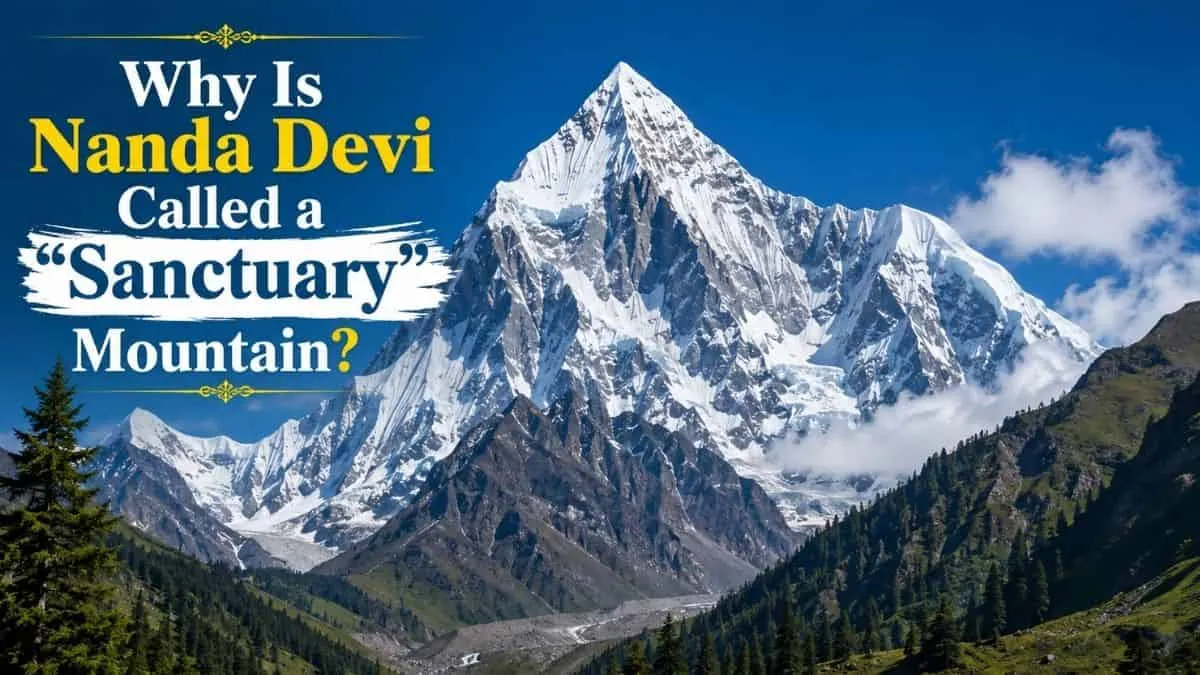
Nanda Devi is the second-highest mountain in India and the highest peak entirely within the country.
It is located entirely in a remote, hard-to-reach, high-elevation basin, which is popularly known as “Nanda Devi Sanctuary." But do you know why Nanda Devi is called a “Sanctuary” mountain?
This mountain is itself classified as a “Sanctuary” due to its protected mountain basin around Nanda Devi, and it is surrounded by Himalayan wildlife, forest, glaciers, local traditions, and conservation.
Let’s explore this article in detail and know what "sanctuary" means in Nanda Devi and why it is called a sanctuary. Also learn about the Nanda Devi Biosphere Reserve and its historical timeline.
Nanda Devi at a Glance
| Fact | Information |
| Mountain | |
| Height | 7,817 m |
| Location | Uttarakhand, India |
| Main protected area | Nanda Devi National Park |
| Historic name | Nanda Devi Sanctuary |
| Game sanctuary declared | 1939 |
| National Park established | 1982 |
| UNESCO World Heritage | 1988 |
| Biosphere Reserve | Nanda Devi Biosphere Reserve |
| Important wildlife | Snow leopard, musk deer, bharal, black bear, Himalayan tahr |
| Major river system | Alaknanda and its tributaries |
What Does “Sanctuary” Mean in Nanda Devi?
Here, “sanctuary” refers to a natural space that is protected and secluded.
Nanda Devi mountains are surrounded by steep ridges and deep valleys. The Rishi Ganga gorge is a very tough route to the inner basin.
This was this natural isolation, which meant that for a long time the area was relatively untouched.
Those who achieved the inner basin knew of a splendid, unique natural wilderness. This gave rise to the popular name "Nanda Devi Sanctuary."
As per UNESCO, the area was officially declared as a game sanctuary via Government Order No. 1493/XIV-28 dated 7 January 1939.
Therefore, the term "sanctuary" has a historical root with Nanda Devi.
Why Is Nanda Devi Called a “Sanctuary” Mountain?
Nanda Devi is called a “Sanctuary” mountain because of the following reasons, given below in the table format:
| Reason | What it means |
| Very difficult to reach | The steep mountains and deep gorges made it hard to get in. |
| Rich wildlife | Animals like snow leopard, musk deer and Himalayan black bear are present in the area. |
| Natural protection | The rugged landscape was a natural barrier. |
| Few people lived inside | The inner protected area had very little permanent human activity |
| Conservation | The area was established as a protected area to preserve flora and fauna. |
| Mountain wilderness | This basin was rather quiet in comparison to many other parts of the Himalayas. |
What Is the Nanda Devi Biosphere Reserve?
A biosphere reserve is a large area where nature conservation, research and the needs of local communities are considered together.
The Nanda Devi Biosphere Reserve includes:
-
protected national parks,
-
forests,
-
alpine meadows,
-
snow-covered mountains,
-
agricultural areas,
-
and areas where local communities live.
As per the UNESCO, this reserve has a very large altitude range, from about 1,800 metres to 7,817 metres.
Nanda Devi Biosphere Reserve timeline
| Year | Important Event |
| 1883 | The first recorded attempt was made to enter the Rishi Ganga Valley at the base of the Nanda Devi peaks. The mountaineers were stopped by the steep and dangerous gorge at the entrance of the valley. |
| 1934 | Eric Shipton and H. W. Tilman discovered a route into the “inner sanctuary” of the Rishi Basin. |
| 1936 | H. W. Tilman and N. E. Odell successfully climbed Nanda Devi for the first time. |
| 1939 | The entire Rishi Basin was declared a game sanctuary to protect its wildlife and natural environment. |
| 1962 | The India–China border was closed indefinitely. This affected the traditional trade and migration routes of the Bhotiya people. Many local people later turned to trekking and tourism for their livelihoods. |
| 1974 | Protests began against commercial forest clearing and tree cutting in Reni village, leading to the famous Chipko Movement. Gaura Devi played an important role by leading village women in protecting the forest. Women later participated in Chipko actions across Uttarakhand. |
| 1974 | Nanda Devi was opened to Western mountaineering, creating a short period of economic growth for local communities. It became one of the most popular Himalayan destinations after Everest, while Lata village became an important starting point for expeditions. |
| 1977 | The first reports of ecological damage caused by tourism raised concerns among environmental groups. |
| 1982 | The Nanda Devi Sanctuary was upgraded to a National Park. Treks, expeditions and grazing were banned in the core area to protect the environment. |
| 1988 | Nanda Devi National Park became the core area of the Nanda Devi Biosphere Reserve (NDBR). The Man and the Biosphere Programme began activities to reduce the impact of restrictions on nearby communities. |
| 1992 | UNESCO declared Nanda Devi National Park a World Heritage Site. |
| 1993 | An army-led team removed about 1,000 tonnes of rubbish left behind by mountaineering expeditions in the Reserve. |
| 1998 | Growing anger over forest restrictions led to a large protest in which people entered the protected core area. This movement became known as “Jhapto Cheeno”, meaning roughly “swoop and grab.” |
| 2000 | The Nanda Devi Biosphere Reserve became part of the newly created state of Uttaranchal (now Uttarakhand), increasing hopes that ecotourism could become an important source of local income. |
| 2001 | The Indian Mountaineering Foundation was allowed to study the tourism potential of the NDBR. Local villagers pushed for community rights to be considered first. |
| 2001 | The Lata Village Council organised a workshop with villagers and grassroots organisations. It supported community-based ecotourism and the conservation of biocultural diversity. |
| 2002 | A new state government was elected in Uttaranchal. The Nanda Devi issue became an important local political matter, and the local MLA and tourism minister lost his position. |
| 2003 | A new NDBR director, after discussions with community groups and activists, introduced a policy allowing regulated tourism with community participation. |
| 2004 | The first Annual Nanda Devi Women’s Festival was organised. Local communities also marked the 30th anniversary of the Chipko Movement. |
| 2004 | The Nanda Devi campaign received the runner-up Conde Nast Ecotourism Award. |
| 2004 | Bali Devi attended the UNEP “Women as the Voice of the Environment” conference in Nairobi, becoming the first Chipko woman activist to attend an overseas conference. |
| 2005 | Land was acquired in Lata village for a proposed museum on biocultural diversity under the Nanda Devi Education Trust. |
| 2006 | On 8 March 2006, the Nanda Devi Campaign launched its website, Mountain Shepherds. |
| The US-based Winterline Foundation supported training in basic mountaineering for 40 unemployed young people from the NDBR area and plans for a company run by trained local youth. | |
| Basic mountaineering training at the Nehru Institute of Mountaineering, Uttarkashi, was scheduled to begin on 20 August 2006. | |
| The Nanda Devi Campaign planned the first Nanda Devi Women’s Trek, with 17 women from different parts of the world, to mark the partial opening of the NDBR to community-based tourism. |

Prabhat Mishra is a Subject Matter Expert and digital journalist with an extensive background in the competitive exam landscape and over 4 years of experience in education, national and international news, and current affairs. Over his tenure with top knowledge platforms like Mentorship India, IAS BABA, IAS SARTHI, and now Jagran Josh, he has a deep understanding of government exams like UPSC and State PCS, including UP and Bihar, as he has already qualified for the UPPCS 2022 Mains and Bihar 68th Mains. With his core expertise in history, polity, geography & current affairs, he specialises in creating well-researched, aspirant-centric content and simplifying complex topics for competitive examinations.




![[Out] UGC NET June 2026 Result Live: यूजीसी नेट रिजल्ट ugcnet.nta.nic.in जारी, डायरेक्ट लिंक से करें चेक](https://img.jagranjosh.com/images/2026/August/2782026/UGC-NET-Result-2026-Marksheet-link-pdf.jpg)