Why do Auroras only occur at the Earth's North and South poles?
A G3, strong, geomagnetic storm watch for 8 to 9 June 2026 has been issued by the NOAA Space Weather Prediction Centre. Strong effects of these storms can be witnessed near the polar regions, where auroras will light up the skies. But why do auroras only occur at the Earth's polar regions?
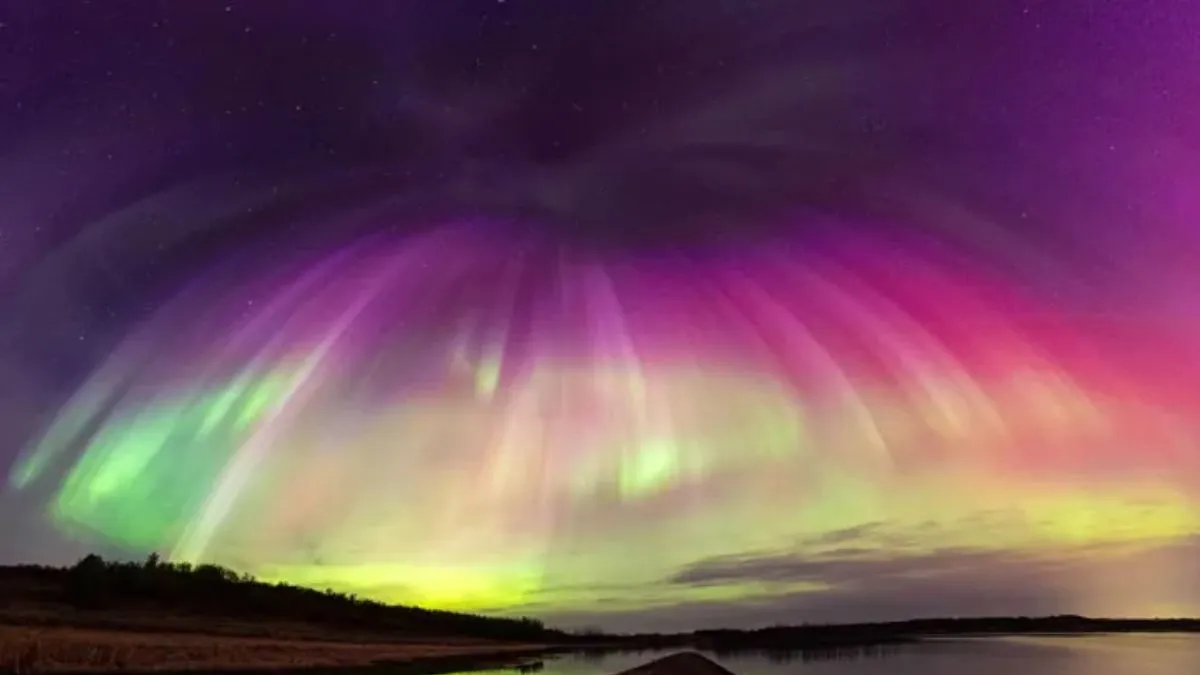
Following the eruption of a Coronal Mass Ejection (CME) from the Sun, a G3, 'strong' geomagnetic storm watch for 8 to 9 June 2026 has been issued by the NOAA Space Weather Prediction Center. A G3 geomagnetic storm watch has been issued for 8 June, and a G2 geomagnetic storm watch has been issued for 9 June. The current space weather presents a strong potential for rare auroras.
Usually, auroras are not a common sight in India. There has only been one place in India that witnessed a rare aurora sighting, and that is Hanle, Ladakh. At the high altitude of about 4,500 meters and minimal pollution, noticeable aurora sightings occurred in Hanle, Ladakh, on 19 January 2026, October 2024, and May 2024.
What is an Aurora?
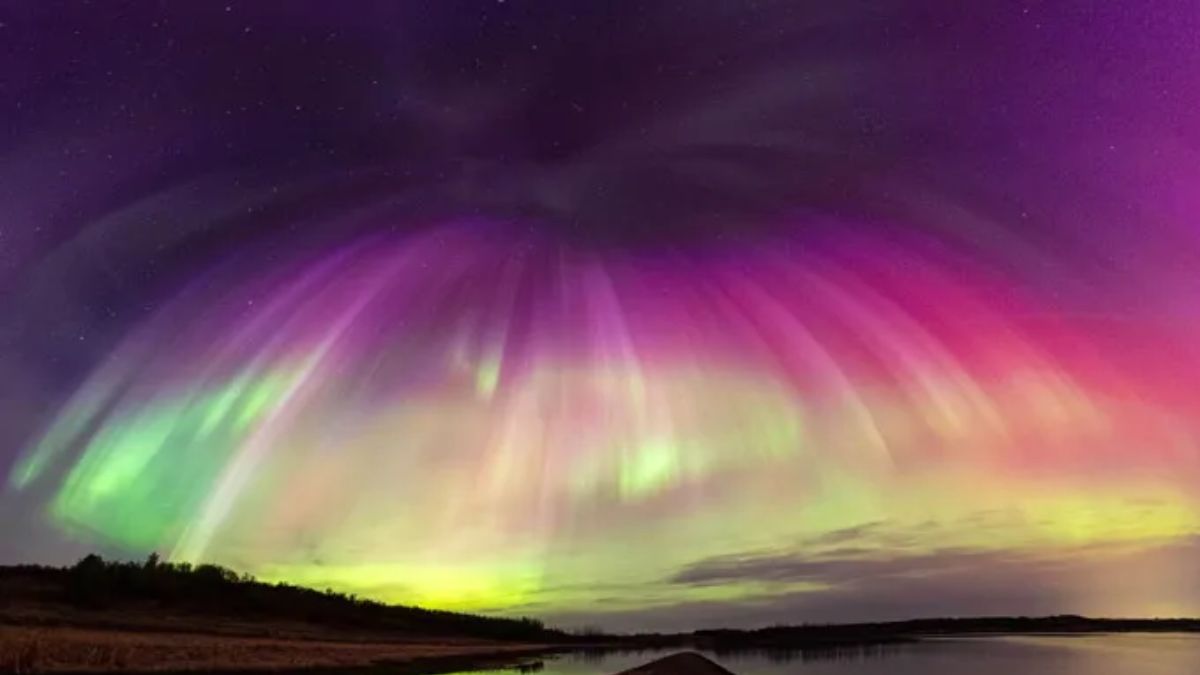
Aurora is the Latin word for 'dawn'. It is also the name of the Roman goddess of the dawn. Auroras are scientifically known as the northern lights (aurora borealis) and southern lights (aurora australis). These auroras can appear in different colours, from green to blue and red to purple, among other colours. The colour of an aurora depends on the type of gas that is hit and where that gas is located, states NASA. The colour of an aurora varies with altitude.
How do auroras form?
The Sun produces a constant outflow of charged particles known as solar wind from the coronal mass ejections. When the solar wind hits Earth, it collides with Earth's magnetic sphere and interacts with the gases in the Earth's upper atmosphere. The Earth's magnetic field deflects most of the charged particles around the planet.
However, the magnetic field at the North and South poles creates a kind of funnel which causes some of the solar particles to get trapped and travel towards the Earth's surface. These solar particles when interact with gases in the upper atmosphere such as oxygen and nitrogen, the excited atoms release the extra energy resulting in colourful auroras.
Depending on the alitutde and the gases, the colour of auroras varies:
| Aurora Colour | Altitude | Composition |
| Red | >200 km | Oxygen |
| Green | 100 to 200 km | Oxygen |
| Blue | 100 to 200 km | Nitrogen |
| Pink | <100 km | Nitrogen |
Why do Auroras only occur at the Earth's North and South poles?
Auroras are commonly visible in high-altitude regions near the Earth's poles. The Northern Lights (Aurora Borealis) are seen around the Arctic, while the Southern Lights (Aurora Australis) are seen around Antarctica.
Auroras occur at the poles because Earth's magnetic field acts like a shield deflecting the charged particles in the solar wind. However, the magnetic field lines also converge and dip inward at the poles, which causes the charges particles to funnel down and interact with atmospheric gases, resulting in auroras.
When these solar particles mix with gases in the upper atmosphere, the energising oxygen atoms emit green and red light whereas nitrogen causes blue and purple auroras.
Northern lights (Aurora Borealis) primary viewing places include Norway, Sweden, Canada, Iceland, and Alaska, where the Southern lights (Aurora Australis) can be seen from New Zealand, Australia, and Argentina.

Roopashree Sharma is a seasoned content writing professional with over 5 years of experience in digital journalism, specialising in writing explainers and IQ quizzes across geopolitics and strategic affairs, and international affairs and trade. She holds a degree in Journalism and Mass Communication and has contributed to leading media houses, including Zee, Times, and India TV. Currently serving as Deputy Manager – Editorial at Jagran New Media, she writes and produces videos for the General Knowledge (GK) section of the Jagran Josh (English) portal. For inquiries, contact her at roopashree.sharma@jagrannewmedia.com.

-1780920929302_t.webp)

