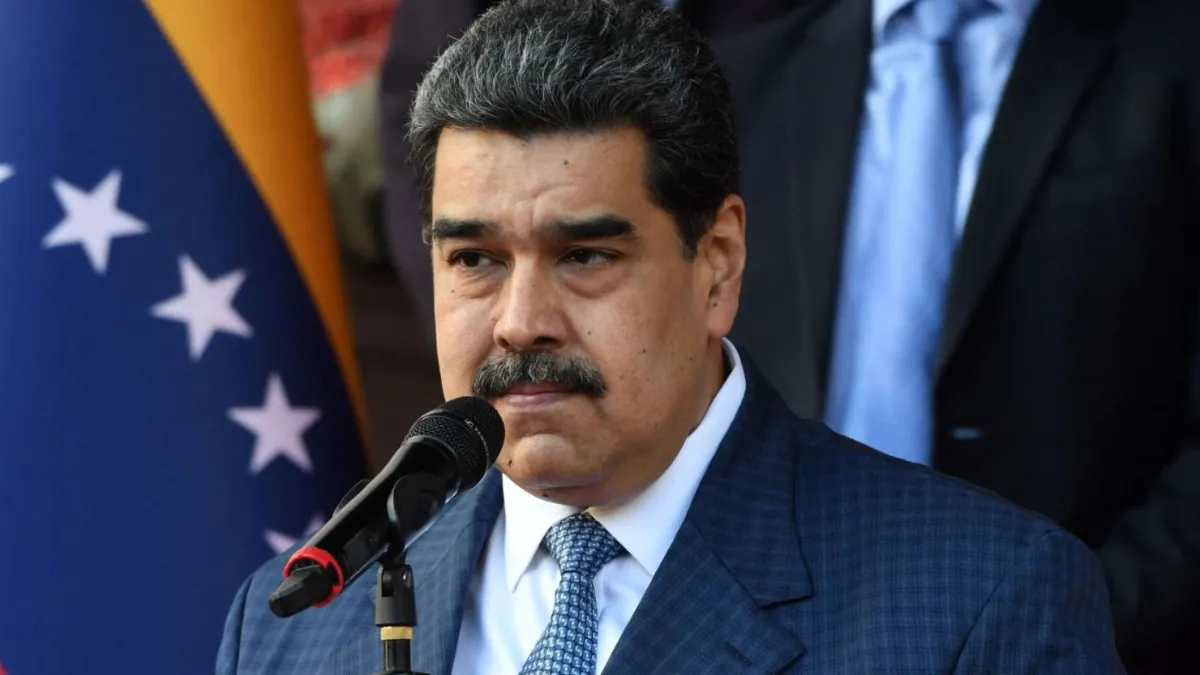
Nicolas Maduro Moros is a Venezuelan statesman and a former bus driver-union leader who was the president of Venezuela between 2013 and his overthrow in early 2026.
One of the key actors of the late Hugo Chavez socialist project, he was one of the longest and most controversial leaders in Latin America, who ruled during the severe political, economic and humanitarian crises. Check the table below for brief details on Nicolas Maduro:
Read along to know more about Nicolas Maduro, his career, and his capture.
Nicolas Maduro: Early Life and Union Career
)
Source: Business Standard
Nicolas Maduro was born on 23 November 1962 in Caracas, in a family of the working class in the El Valle neighborhood.
He dropped out of school without any university education and was a bus driver with the Caracas bus system, through which he became a member of the transit workers union.
In the early 1990s he led a campaign to free Hugo Chavez when Chavez attempted a coup in 1992, and assisted in founding the Fifth Republic Movement that shortly became the United Socialist Party of Venezuela (PSUV).
It was this experience as a grassroots organizer that enabled him to develop a reputation as a son of the people which would be at the heart of his political story later.
Nicolas Maduro’s Rise Under Hugo Chavez
The first time Maduro ventured into the politics of the country was in 2000 when he was elected into the National Assembly and became its president in 2005.
In 2006 Hugo Chavez made him foreign minister, a job he served for six years, during which he was an ardent supporter of "Bolivarian" socialism and stronger relationships with Cuba, Russia and Iran.
When the health of Chavez weakened in October 2012, Maduro was appointed as the vice president and openly appointed as the chosen successor of Chavez.
Upon the death of Chavez in March 2013, Maduro was made interim president and narrowly elected the special election of April 2013 by an approximate of 1.5 percentage point amid opposition claims of irregularities.
Presidency and Authoritarian Turn
Upon taking power, Maduro concentrated authority in decrees, extended control over the courts, electoral body and security organs and marginalized the opposition-dominated National Assembly. In 2013 and later, he acquired special powers known as economic emergency power in which he can decree his way on key matters of the economy.
When the economy broke down (hyperinflation and shortages, the GDP shrinking over 10 years by over 70 percent), in 2014, 2017 and several years after that, mass protests in the streets were crushed with great severity, killing hundreds and arresting thousands of individuals.
The extrajudicial killings, political inmates, censorship and a drastic reduction of press freedom are some of the items recorded by international organizations and human-rights groups during his reign.
READ | Top 10 Emerging Technologies of 2025: Check the List Here!
Racism and International Crisis
The election was considered by many as a fraud by opposition parties and dozens of foreign governments, most of which accepted opposition leader Juan Guaido as interim president in 2019.
The Organization of American States and some Western and Latin American nations outed his mandate as illegitimate and sanctioned Venezuelan officials and state organizations.
In 2024 he won another much-contested presidential race that regional and global authorities refused to acknowledge and intensified the political isolation of Venezuela. By that time, the country had already lost the means to support itself economically and was insecure.
This led to the flight of an estimated seven million Venezuelans, generating one of the largest contemporary displacement crises in the world.
Why Was Nicolas Maduro Captured?
Although he was anticipated to be ousted by sanctions, protests, international pressure, etc., Maduro still ruled over 12 years becoming the longest-serving leader in Latin America at the time.
Later in 2025, the United States listed him as an affiliate of a foreign terrorist group, further attempting to eliminate him.
American President Donald Trump declared that American forces had seized Maduro and had flown him out of Venezuela in early January 2026, effectively overthrowing his government, ending his presidency.
His legacy is largely linked with dictatorial leadership, institutional decay, and a severe socio-economic meltdown that remodeled Venezuela and the region at large.
Recommended Reading:
List of Most Mispronounced Words of 2025 In the United States



Comments
All Comments (0)
Join the conversation