Diamonds are clear, crystallised, highly pure forms of carbon that form at depths of 90-120 miles beneath the surface of the Earth, under intense pressure and heat, usually 1-3 billion years ago.
The word Diamond comes from the Greek word Adamas, which means indestructible.
It is the only gem known to man that is composed of one element, Carbon, other than graphite.
Diamond is completely made of Carbon atoms (Chemical Composition – C) crystallised in a cubic (isometric) arrangement.
Diamonds are known for their various nicknames like “ice”, “sparklers”, or “Ice cubes”.
But have you ever wondered which diamonds are known as the Mountain of Light?
So, let’s explore this unique diamond.
What are Diamonds?
Diamond is described in terms of composition and crystal structure, and this has made it a distinctive mineral compared to other minerals.
It is the unique jewel of one element. It is typically about 99.95% carbon.
The remaining 0.05 % may consist of a single or multiple trace elements, the atoms not a component of the necessary chemistry of the diamond.
It can be affected by some trace elements, with the determination of colour or crystal shape.
There are many diamonds found in the world, but which diamond is known as “Mountain of Light”?
So, read on to learn more about this unique diamond.
Also Read: Which is the Most Expensive Diamond in the World?
Which Diamond is known as the Mountain of Light?
Of all the diamonds, the Koh-I-Noor diamond is known as “Mountain of Light”. It is a Persian name. The history of design, curiosity and conquest is linked to this diamond.
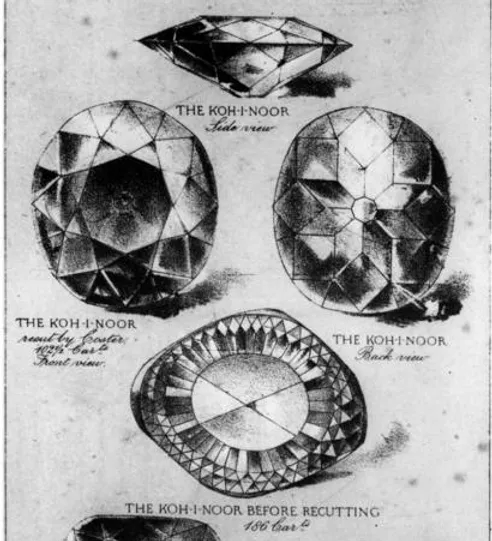
Source: diamondsbymanee
Why is the Koh-I-Noor diamond called the Mountain of Light?
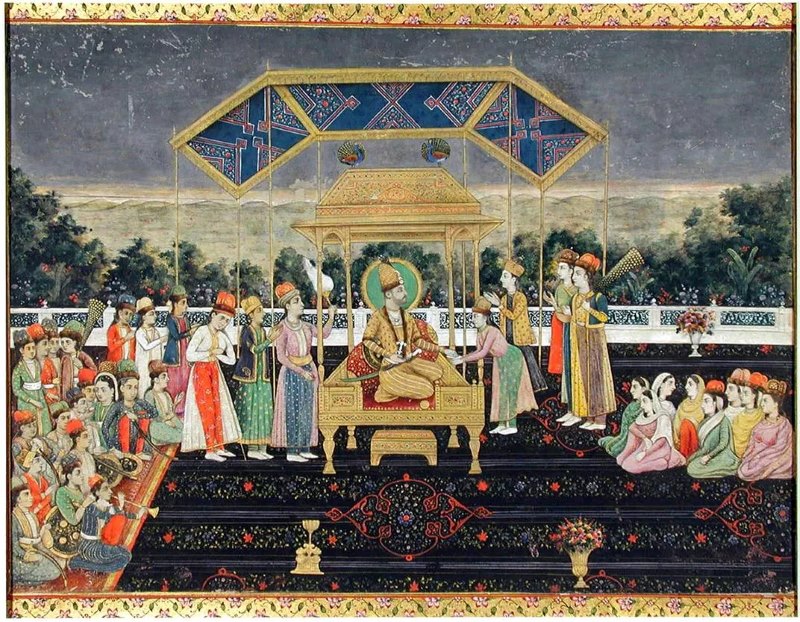
In 1739, Nadir Shah of Persia invaded and plundered the Mughal treasury in Delhi with the Kohinoor and the Peacock throne of Muhammad Shah.
It is reported that it was the first time Nadir Shah viewed the diamond, and he said, Koh-i-Noor, meaning, mountain of light.
That is how this diamond got its name.
What is the History Timeline of Koh-I-Noor Diamonds?
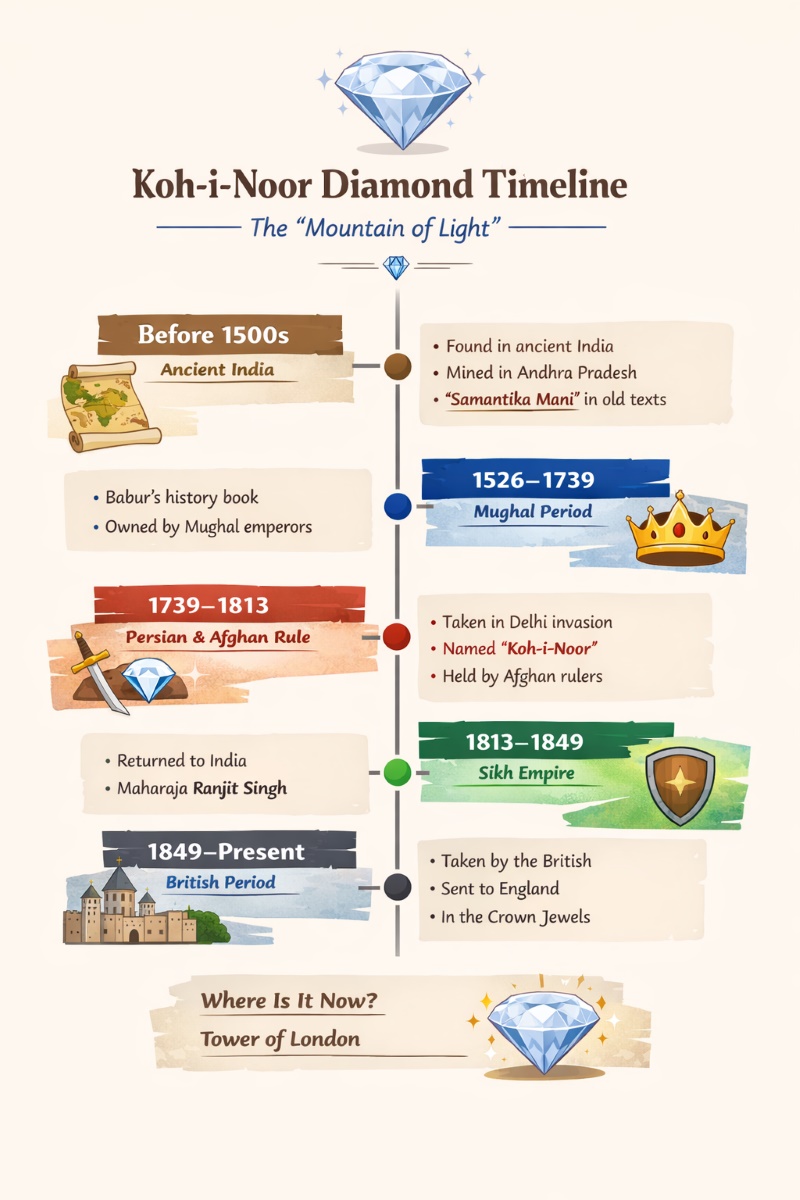
The history timeline of Koh-I-Noor diamond is:
Before 1500s — Ancient Origins
-
This diamond was originally mined in ancient India
-
Possible origin: present-day Andhra Pradesh
-
Mentioned in ancient Sanskrit texts as Samantika Mani
-
Regarded as an exceptionally valuable and powerful gem
Source: wikimedia
1526–1739 — Mughal Era
-
First verified record in the Baburnama
-
Acquired by Babur after the First Battle of Panipat
-
Passed through Mughal emperors, including Shah Jahan and Aurangzeb
-
Symbol of imperial wealth and authority
1739–1813 — Persian & Afghan Rule
-
Seized by the Persian ruler Nadir Shah during the invasion of Delhi
-
Named Koh-i-Noor (Mountain of Light)
-
After Nadir Shah’s death, it passed to the Afghan Durrani dynasty
-
Remained with the Afghan rulers for several decades
1813–1849 — Sikh Empire
-
Returned to India via Shah Shuja Durrani
-
Given to Maharaja Ranjit Singh in exchange for political asylum
-
After Ranjit Singh’s death, political turmoil followed
-
Owned briefly by young Maharaja Duleep Singh
1849–Present — British Possession
-
It was given to the British Crown after the Second Anglo-Sikh War
-
Transferred under the Treaty of Lahore
-
Taken to England and recut under royal orders
-
Placed in the British Crown Jewels
-
Currently housed in the Tower of London
Facts about the Koh-I-Noor Diamond
-
The meaning of Kohinoor
-
The Kohinoor diamond is known as the Mountain of Light. It is a Persian name.
-
The diamond is linked to design background, curiosity and conquest.
-
The original name of the Kohinoor diamond
-
This diamond was known earlier by the name “Samantika Mani”, which was referred to in the old Sanskrit literature dating back 4000 to 5000 years.
-
The diamond was reported to be the most valuable and conspicuous one.
-
The Kohinoor has a number of mythical tales surrounding it.
-
Kohinoor is a Type IIA diamond
-
Type IIA diamonds, be it the lab-grown diamonds or the mined ones, are the ones that are absolutely free of any impurities and are the highest quality types. These are the rare diamonds which are difficult to mine.
-
Though there exists the possibility of developing Type IIA lab-made diamonds. Ethically, Type II A diamonds can be manufactured by the CVD diamond manufacturing methods and HPHT methods in laboratories.
-
The size of the Kohinoor
-
The Kohinoor diamond originally weighed 793 carats. But, gradually, it has been trimmed down several times, making it smaller. It is at present of about 105 carats.
-
According to sources, at the time the Kohinoor diamond reached Britain, it had a weight of 190.3 carats.
-
Polishing and recutting the diamond minimised the weight of the diamond, which was 186 carats to its present weight of 105.6 carats.
-
And what is so special about its great size? The reason being, it is difficult to come by large-sized mined diamonds.
-
Diamonds which are grown in laboratories can be produced in relation to the desirable size.
-
The colour of the Kohinoor diamond
-
Kohinoor is a diamond of D-colour. It lacks the hue of any colour. It has exceptional clarity.
-
It is a Type IIa diamond and thus does not have nitrogen impurities, making it yellowish.
-
The diamond is exceptionally transparent and clear.
-
The Kohinoor is as clear as the lab-grown diamonds can be.
-
Other features of the Kohinoor diamond
-
It is cut in an oval shape
-
It is a Type IIa diamond
-
It is a wonderful cut diamond and has 68 facets.
-
It is colourless, and it is said to be the best white.
-
Kohinoor discovery took place in India during 13 th century.
-
Can lab-grown diamonds have the quality of the Kohinoor?
-
Diamonds produced in the lab are made in two processes - HPHT and CVD diamonds. Lab diamonds can be produced to the same quality as they are manufactured and manmade.
-
An example of this is that they can be customised in the preferred colours.
-
The pink diamonds, which are produced in the lab, blue, green, and yellow lab-grown diamonds are not hard to produce.
-
The Kohinoor is of extraordinary clearness. Diamonds synthesised in the lab can also be fully clear.
-
As laboratory diamonds are prepared with the help of scientific technologies and an innovative approach, manufactured diamonds could be created with great clarity.
Conclusion
The Kohinoor was and is still considered the most exceptional quality and most valued diamond in the world. It is also known as “Mountain of Light” due to its unique characteristics, chemical composition and crystal structure.
However, with the introduction of lab-grown diamonds, it is now possible to make diamonds that are larger than the Kohinoor.
But the valuation of this particular diamond will always be unique.





Comments
All Comments (0)
Join the conversation