Arable land is land that can be used to grow crops, and it is vital for food security, the agricultural economy, and the sustainability of a country. Not all the countries have, however, been blessed with fertile land or favourable climatic conditions. In some nations of the globe, arable land is critically scarce because of bitter desert landscapes, mountain ranges, volcanic soils or easily damaged island ecosystems.
This article explores the top 10 countries with the least arable land (% of total land area), based on the given data. We also take a closer look at the top five countries to understand why agriculture is so limited in these regions.
Top 10 Countries with the Least Arable Land (% of Land Area)
| Rank | Country | Arable Land (%) |
| 1 | Faroe Islands | 0.05% |
| 2 | Djibouti | 0.13% |
| 3 | Northern Mariana Islands | 0.17% |
| 4 | Oman | 0.28% |
| 5 | Seychelles | 0.33% |
| 6 | New Caledonia | 0.33% |
| 7 | Suriname | 0.33% |
| 8 | Mauritania | 0.44% |
| 9 | Kuwait | 0.45% |
| 10 | Botswana | 0.46% |
Data Source: World Bank Group (This Above Data is as per Year 2023)
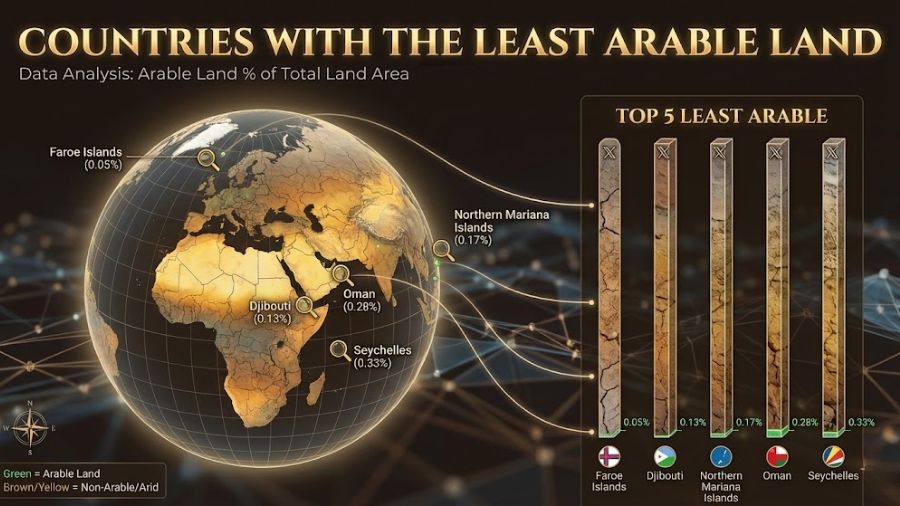
Countries with the Lowest Arable Land as a percentage of land Area.
1. Faroe Islands (0.05%)
The Faroe Islands possess the least share of arable land on earth. The islands, which are located in the North Atlantic, are dominated by:
-
Stepped rocky, hilly terrain and cliffs.
-
Cold, windy climate
-
Thin, poor-quality soil
Almost all agriculture is restricted to growing livestock on grass as opposed to farm produce.
2. Djibouti (0.13%)
Djibouti is a country in the Horn of Africa, and its characteristics include:
-
Arid and semi-desert climate
-
Tremendously high temperatures.
-
Minimal rainfall
The majority of the land cannot be cultivated and hence the country has to depend on food imports.
3. Northern Mariana Islands (0.17%)
The Northern Mariana Islands are agriculturally constrained by:
-
Coral-based and volcanic soils.
-
Limited flat land
-
Vulnerability to typhoons
There is small-scale agriculture, and the acreage is limited.
4. Oman (0.28%)
This is because Oman has a low area of arable land, which is largely because of:
-
Huge deserts (Rub al Khali).
-
Water scarcity
-
Harsh climatic conditions
The agricultural lands are limited to the oases and the irrigated coastal plains.
5. Seychelles (0.33%)
Seychelles is a small island state with:
-
Mountainous islands
-
Fragile ecosystems
-
Inadequate freshwater supply.
Most of the land is being saved for biodiversity and tourism as opposed to agriculture.
Conclusion
Naturally, countries with the least arable land have natural challenges like deserts, rocky terrain, and peninsular island ecosystems. Following examples of the Faroe Islands, Djibouti, and Oman, small areas of cultivable land make people more dependent on imports of food and underline the issues of sustainable land management and alternative food systems.



-1766337791473.jpg)


Comments
All Comments (0)
Join the conversation