Did you know the animal kingdom is full of masters of disguise? There are millions of different animal species on our planet. Each one has its own special way of surviving. Some animals are fast runners to escape danger. Others have sharp claws to catch their food. A fascinating group uses camouflage to blend into its surroundings. Some animals, like the leopard, are known for their speed and strength. A leopard can drag prey up to three times its own weight into a tree. The cheetah is famous for being the world's fastest land animal; it can reach speeds up to 75 mph. The octopus, often called the 'chameleon of the sea' or 'master of mimicry', can change its skin colour and texture in seconds. The praying mantis has the nickname 'the ambush predator' because it waits perfectly still to catch insects. Do you know which animal is known as the ultimate "King of Camouflage"? In this article, we'll take a look at the unique adaptations and exceptional hiding skills of the world's best-camouflaged creature.
Which Animal Is Known As The King Of Camouflage?

The animal known as the King of Camouflage is the Cuttlefish. This fascinating marine mollusc belongs to the class Cephalopoda, which includes squid and octopuses. The most well-known species is the Common Cuttlefish, Sepia officinalis, found in temperate and tropical ocean waters, particularly along the coasts of Europe, Africa, and Asia (but not the Americas).
It is called the "King" because it can change its skin colour, pattern, and even texture in a fraction of a second to perfectly match its background. This is done using specialised pigment sacs called chromatophores beneath its skin. The cuttlefish is a carnivore, preying on small crabs, shrimp, and fish, which it catches with two long, extendable tentacles. It has a flat body, eight arms, two tentacles, and a unique internal shell, the cuttlebone, which controls buoyancy.
10+ Lesser-Known Cuttlefish Facts
- The cuttlefish has three hearts. Two pumps blood to the gills, and one circulates oxygenated blood to the rest of the body.
- Its blood is blue-green because it uses a copper-based protein called hemocyanin to transport oxygen, not the iron-based haemoglobin found in humans.
- Amazingly, the cuttlefish is generally thought to be colour-blind. It achieves perfect colour-matching by sensing polarised light to perceive contrast.
- They have a distinct, easily bending W-shaped pupil that helps them control light intensity.
- The cuttlebone is a porous, gas-filled internal shell that acts like a scuba diver's buoyancy control device (BCD), allowing them to move up and down in the water with precision.
- Cuttlefish have one of the largest brain-to-body ratios of any invertebrate, displaying complex behaviour like self-control and the ability to count small quantities.
- The word Sepia, its genus name, comes from the Greek/Latin word for its ink, which was historically used to make a brown drawing/writing pigment.
- Smaller male cuttlefish can mimic female patterns on one side of their body to trick larger males, allowing them to sneak past and court a female unseen.
- They can use their dazzling colour changes not just to hide but also to hypnotise or stun their prey before striking.
- Despite the name, they are molluscs, not fish, and belong to the group of soft-bodied invertebrates without spines.
List of Animals that are the Masters of Camouflage
The word comes from the French verb camoufler, meaning "to disguise," which itself may be related to an old dialect word for "to smoke" or "to disguise oneself." The word camouflage refers to a method of concealment that allows an otherwise visible animal or object to remain unseen by blending in with its surroundings. It uses colours, patterns, and shapes to disrupt an outline. Here's the list of the top 10 animals that are the masters of camouflage:
| Rank | Name | Scientific Name | Where Found | Physical Characteristics |
| 1 | Cuttlefish | Sepia officinalis (Common) | Temperate/Tropical coastal oceans worldwide (Europe, Africa, Asia). Not the Americas. | A marine mollusc with 8 arms, 2 tentacles, and a cuttlebone. Famous for active camouflage using chromatophores to change skin colour, pattern, and texture instantly. |
| 2 | Mimic Octopus | Thaumoctopus mimicus | Shallow waters of the Indo-Pacific Ocean (Southeast Asia). | A slender octopus that not only blends into the sand but also mimics the appearance and movement of other venomous animals (like sea snakes, lionfish, or flatfish) for defence. |
| 3 | Mossy Leaf-Tailed Gecko | Uroplatus sikorae | Rainforests of Madagascar (Eastern and central tropical forests). | A reptile with a flattened tail and body covered in dermal flaps along its sides and limbs. Its mottled skin pattern, often in greenish-brown, grey, and black, perfectly mimics moss- and lichen-covered tree bark. |
| 4 | Pygmy Seahorse | Hippocampus bargibanti | Indo-Pacific coral reefs (e.g., Southeast Asia, Australia). | Tiny seahorses (< 1 inch) that grow calcified, bumpy tubercles on their skin that precisely match the colour, shape, and texture of the sea fan coral polyps they live on. |
| 5 | Stonefish | Synanceia verrucosa (Reef) | Shallow tropical waters of the Indo-Pacific and Red Sea. | A heavily textured, lumpy fish covered in bumps and ridges that make it look exactly like an encrusted rock or piece of coral. It is one of the world's most venomous sit-and-wait predators. |
| 6 | Orchid Mantis | Hymenopus coronatus | Tropical forests of Southeast Asia (e.g., Malaysia, Indonesia). | A praying mantis with legs that have widened, petal-like structures and bright pink/white colouration, allowing it to mimic an orchid flower to ambush pollinating insects perfectly. |
| 7 | Stick Insect | Order: Phasmatodea | Found on every continent except Antarctica. | Long, cylindrical insects that look precisely like twigs, branches, or leaf stems. Many species remain completely still or sway gently to mimic the movement of branches in the wind. |
| 8 | Common Potoo Bird | Nyctibius griseus | Central and South America (tropical forests/woodlands). | A nocturnal bird with mottled grey, brown, and black plumage. During the day, it perches upright and freezes on a broken tree stump or branch, looking precisely like the broken end of the wood. |
| 9 | Arctic Fox | Vulpes lagopus | Arctic Tundra regions (Northern Canada, Greenland, Russia, Scandinavia). | A small fox with thick fur that changes colour seasonally: pure white in winter to blend with snow and ice, and brown or grey in summer to match rocks and vegetation. |
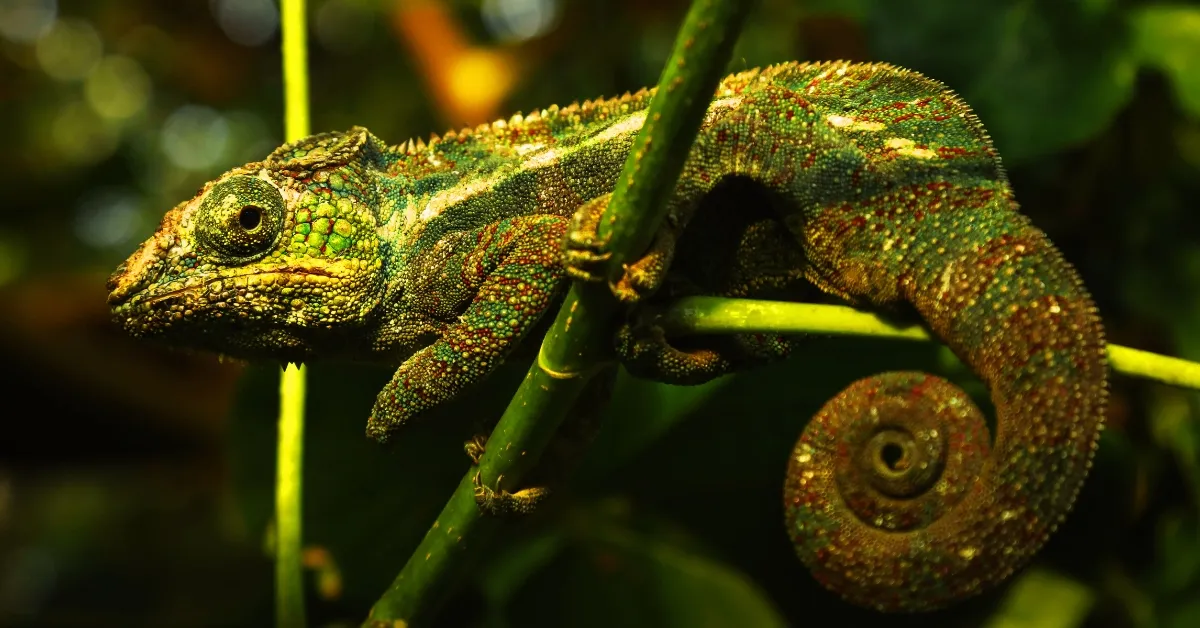
| 10 | Chameleon | Family: Chamaeleonidae | Africa (Madagascar, nearly half of all species), the Middle East, and Southern Europe. | Known for changing colour using chromatophores, primarily for communication and thermoregulation, but their base colours (often green/khaki/brown) naturally provide excellent background matching in leafy habitats. |
| 11 | Leafy Seadragon | Phycodurus eques | Southern and Western Australian coastal waters (seaweed/kelp beds). | A marine fish covered in elaborate, leaf-like, fluttering appendages that allow it to mimic floating seaweed or kelp as it drifts perfectly. |
| 12 | Snow Leopard | Panthera uncia | Mountain ranges of Central and South Asia (the Himalayas, Mongolia). | A large cat with thick, smoky-grey to pale yellow fur covered in dark rosettes and spots. This pattern disrupts its outline against the rocky outcrops and shadows of its habitat. |
| 13 | Orange Oakleaf Butterfly | Kallima inachus | Tropical Asia (India, Southeast Asia, and Japan). | When its wings are closed, the underside is patterned to look exactly like a dead, dried-up leaf, complete with a "midrib" line and faux leaf-stalk. |
| 14 | Flounder | Order: Pleuronectiformes | Seafloors worldwide (both marine and freshwater). | A flatfish that can actively change its pigment to match the exact colour and pattern of the sand, gravel, or pebbles on the seabed where it lies. |
| 15 | Gaboon Viper | Bitis gabonica | Tropical rainforests of Sub-Saharan Africa. | One of the world's largest vipers, its scales feature an intricate pattern of brown, grey, and black geometric shapes that perfectly mimic dead leaves and forest litter on the rainforest floor. |
1. Mimic Octopus
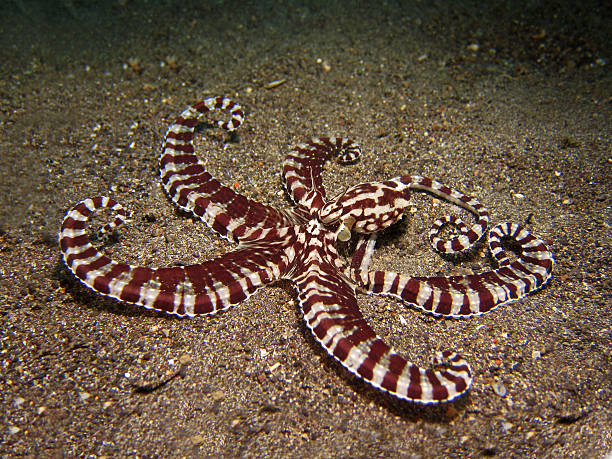
The Mimic Octopus (Thaumoctopus mimicus) is found in the shallow, muddy seabeds of the Indo-Pacific. It's the only known animal that actively impersonates up to 18 other marine animals, such as lionfish and sea snakes, through rapid colour changes and body movements. Its base colour is light brown/beige, which it uses to blend into the sand before striking prey or intimidating predators.
2. Mossy Leaf-Tailed Gecko

Native to the rainforests of Madagascar, the Mossy Leaf-Tailed Gecko (Uroplatus sikorae) is a master of blending into moss- and lichen-covered bark. This reptile has a flattened tail, fringed skin flaps along its body, and mottled skin patterns in shades of green, brown, and black. It remains perfectly still during the day, making its outline disappear completely against the trees.
3. Pygmy Seahorse

The Bargibant's Pygmy Seahorse (Hippocampus bargibanti) is one of the world's smallest vertebrates, living exclusively on specific gorgonian sea fans in the Indo-Pacific coral reefs. Its tiny body is covered in bulbous tubercles (knobs) that perfectly match the colour and texture of the coral polyps. This makes it almost impossible to detect, even for predators.
4. Stonefish
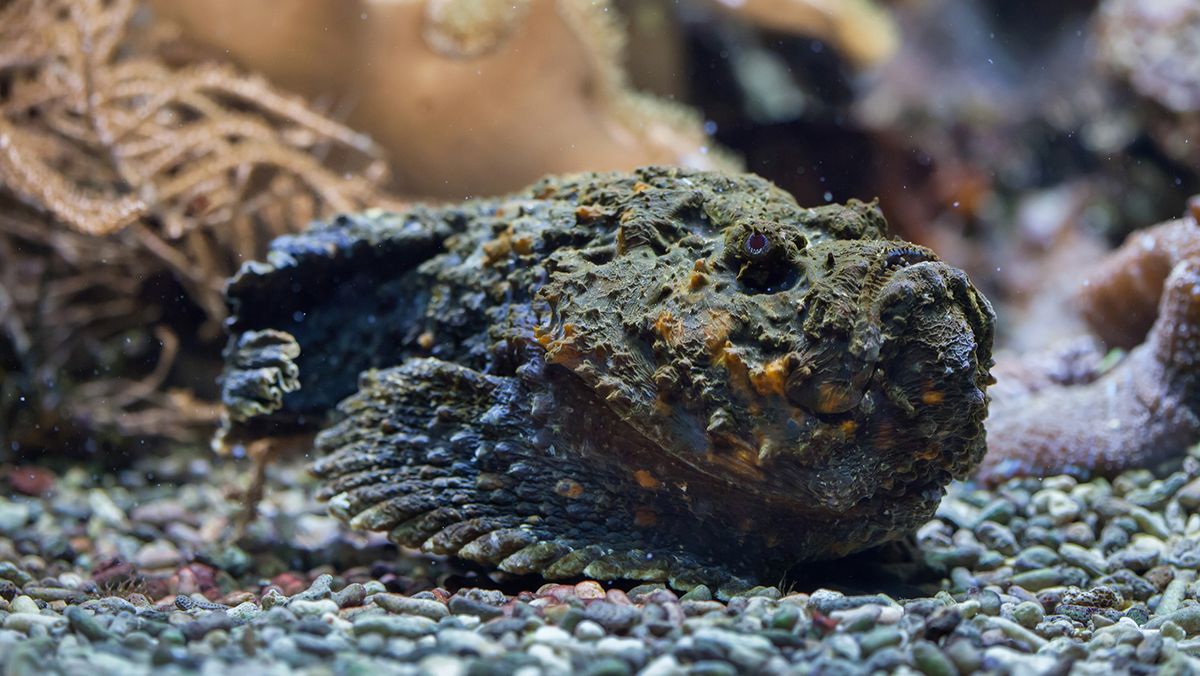
The Stonefish (Synanceia verrucosa) is found in the shallow tropical waters of the Indo-Pacific Ocean. Its warty, scaleless skin is covered in bumps, ridges, and often algae, making it look like an encrusted rock or lump of coral on the seabed. This perfect disguise helps this venomous ambush predator wait motionless for prey.
5. Orchid Mantis

The Orchid Mantis (Hymenopus coronatus) lives in the tropical forests of Southeast Asia. This beautiful insect uses aggressive mimicry, featuring white and pink colouration and flattened, petal-like legs. It disguises itself as an orchid flower to attract pollinating insects, which it then ambushes with its powerful forelegs.
Who Is Known As The King Of Camouflage?

The animal most commonly known as the King of Camouflage is the Cuttlefish. This marine mollusc has the fastest and most complex camouflage ability in the animal kingdom. It can instantaneously change its skin colour, pattern, and even texture by controlling millions of pigment sacs called chromatophores. This is used for hunting, hiding, and communication.
Which Animal Is Known For Its Camouflage?
Many animals are known for their camouflage, but the Chameleon is arguably the most famous. Although they primarily change colour for communication and temperature regulation, their base colours, combined with the ability to shift hues, make them expert hiders in leafy environments across Africa and Madagascar. The Cuttlefish is also highly renowned.
Which Insect Is Known As The King Of Camouflage?

While there is no single universally crowned "King of Camouflage" insect, the Stick Insect (or Walking Stick) is often cited for its perfect mimicry. Found worldwide, it looks exactly like a twig or branch, making it virtually impossible to spot.
Who Is The Father Of Camouflage?
The Father of Camouflage is considered to be American artist and naturalist Abbot Handerson Thayer (1849–1921). He was a pioneer in the study and description of principles such as countershading (Thayer's Law) and disruptive colouration in the animal kingdom, which later influenced the development of modern military camouflage.


-1764566231536.jpg)
Comments
All Comments (0)
Join the conversation