Show Key Points
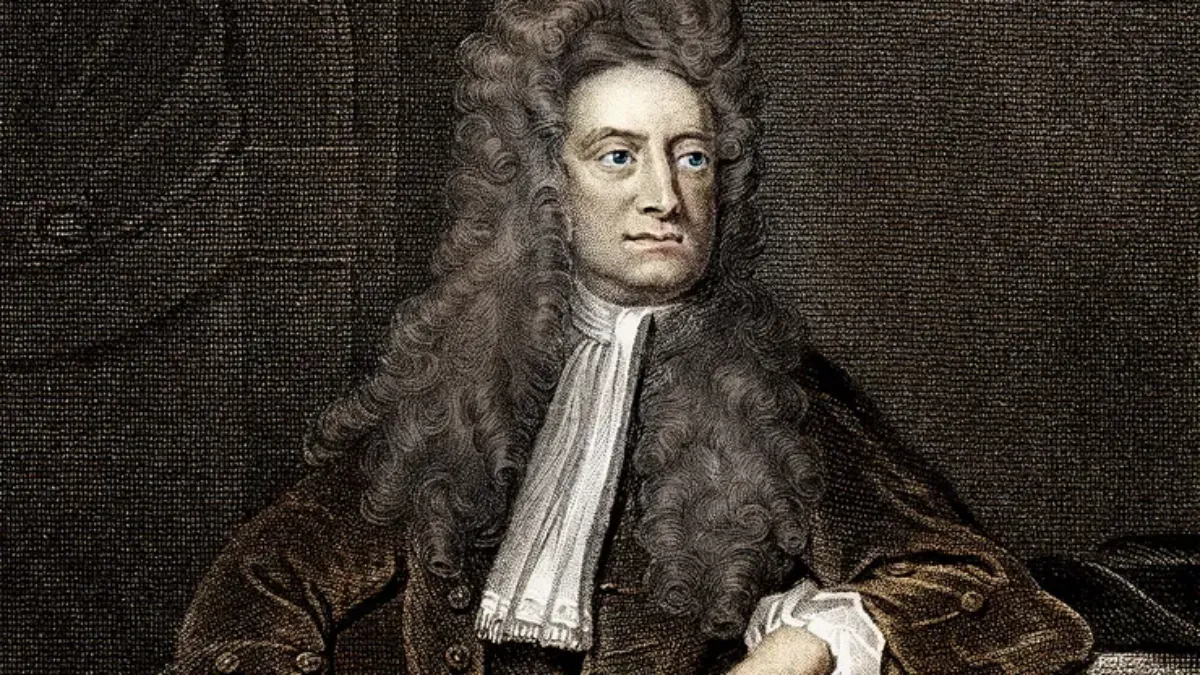
Sir Isaac Newton (1643-1727) was one of the greatest scientists in history whose contribution in the scientific revolution transformed our perception of the universe.
Newton was born prematurely in Lincolnshire, England and despite the early setbacks, he attended the University of Cambridge in 1661 and indulged himself in the new mechanical philosophy.
His most prolific years were 1665-66 Great Plague, when Cambridge was shut and he had to go to his family farm, in Woolsthorpe, this was where the name annus mirabilis (year of wonders) was given to it.
What is the History Behind Newton’s Inclination Towards Discoveries?
The isolation of Newton with the plague was a good breeding ground of genius. He explored the fields of optics, motion, and mathematics, building upon the works of such thinkers as Descartes and Galileo and pushing them to the boundary.
There were events that were instrumental such as the chemistry of Robert Boyle and the geometry lectures of Isaac Barrow at Cambridge. This was the time that gave birth to initial concepts of gravity and calculus that were later developed during competitions.
His philosophical character which was a fusion of rationalism and alchemical interests compelled him to continuous experimentation.
Top 10 Discoveries of Isaac Newton
The discoveries of Newton, which were documented in such masterpieces as Philosophiae Naturalis Principia Mathematica (1687) and Opticks (1704), covered physics, math, and optics. These 10 picks are his most transformative works, based on the records of Royal Society studies.
| Discovery | Description | History | Lasting Impact |
| Laws of Motion | Inertia (1st), F=maF=ma (2nd), action-reaction (3rd). | Conceived 1665; Principia Book I. | Basis for engineering, rocketry. |
| Universal Gravitation | F=Gr2m1m2 - unifies earthly and celestial forces. | Apple insight; Kepler synthesis 1687. | Enables orbital mechanics, space exploration. |
| Infinitesimal Calculus | Fluxions for derivatives/integrals. | 1669 manuscript; priority feud with Leibniz. | Underpins modern analysis, AI algorithms. |
| Composition of White Light | Prism refraction reveals spectrum; recombines to white. | 1666 Woolsthorpe experiments. | Spectroscopy in chemistry, astronomy. |
| Reflecting Telescope | Parabolic mirror eliminates color fringing. | Constructed 1668; Royal Society gift. | Precursor to professional observatories. |
| Theory of Color | Light interacts with bodies to produce hues. | Opticks (1704); thin-film tests. | Color science, digital displays. |
| Binomial Theorem Generalization | Infinite series for (a+b)n(a+b)n | 1665 isolation. | Probability, approximations. |
| Centripetal Force | Fc=rmv2 | De motu Corporum (1684). | Circular motion in vehicles, planets. |
| Newton's Rings | Interference in reflected light. | 1717 Opticks update. | Wave optics, precision measurement. |
| Law of Cooling | Exponential cooling via temperature gradient. | 1701 lectures. | HVAC systems, forensics. |
Isaac Newton’s Legacy
The Principia by Newton with the help of Halley crowned the Scientific Revolution and the Opticks investigated the corpuscular nature of light, a precursor of quantum discussions.
Being the president of the Royal Society (1703-1727) and Master of the Mint, he turned science and economics into professions. This was enriched by his personal theology and alchemy, but he was not fond of fame: "I know not what I shall make myself; but to myself I shall be only a boy at play upon the shore.
Principia is the greatest intellectual monument described by Einstein; it brought relativity and quantum mechanics.
The 10 discoveries by Newton shed light on the strength of observation and mathematics, iPhones, Mars rovers. His legacy is a call to find out boldly the law of nature in an age of AI and space races.



Comments
All Comments (0)
Join the conversation