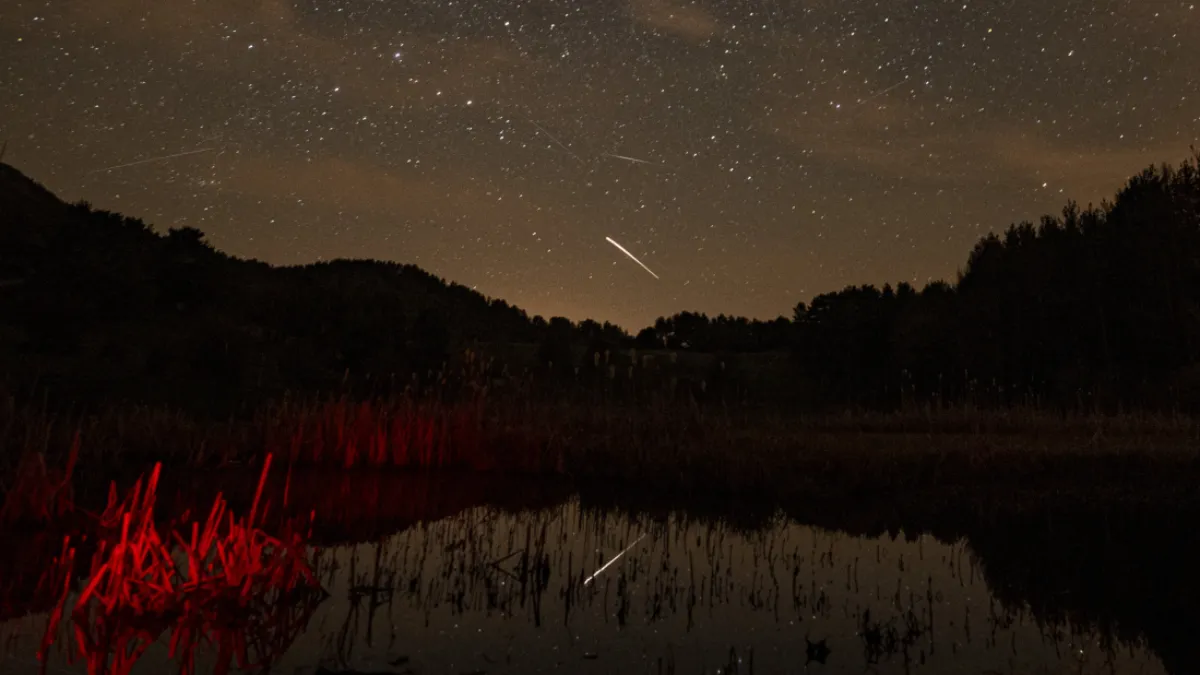
The Lyrids will be one of the most predictable spring meteor shower shows of the year in the night skies in April 2026, with the meteors falling at a high speed and blazing brightly against the constellations of Lyra and Hercules. To skywatchers in India and throughout the Northern Hemisphere, this gives them a free pass to go out in the dark pre-dawn and enjoy the free light show by nature.
What is the Lyrid Meteor Shower?
The Lyrid meteor shower is an annual spectacle that occurs when the Earth crosses a trail of dusty debris around Comet Thatcher (C/1861 G1), a long-period comet that revolves around the Sun every 415 years or so.
When these minute particles, not bigger than grains of sand, crash into the upper atmosphere of the earth at a speed of approximately 49 km per second, they vaporize forming the brilliant streaks that we observe as shooting stars.
Another important aspect of Lyrids is their history: it is one of the oldest known meteor showers, and the observation dates back to around 2,700 years ago, with the Chinese records of the event dating back to the same period. This makes the 2026 Lyrids a part of a centuries old astronomical tradition that has captivated the eye of skywatchers.
Lyrid Meteor Shower 2026: Dates and Time of Maximum.
The Lyrids are active between about 16 and 25 April 2026, peak meteor activity will be around the evening of 2122 April. In most places in the mid-northern latitudes the viewing window is the pre-dawn hours of 22 April when the radiant of the constellation Lyra is overhead.
The peak is predicted to occur in most areas during the night of 21 April to the early morning of 22 April when the Moon has already set or is low which leaves the sky relatively dark. Skywatchers are advised to start scanning the sky around midnight local time, but the most meteors should appear a few hours before sunrise on the 22nd.
The Anticipated Rates and Watching Conditions in 2026
At the maximum of the Lyrids those who watch on dark and clear skies may usually expect to see about 10-20 meteors per hour. The display is characterized by occasional bright “fireballs which flare in several seconds and can leave a glow behind them, or a trail of meteors, across the sky.
In 2026, the Moon will be very favourable: it will be a waxing crescent, setting well before the pre-dawn peak hours, and, therefore, the moonlight cannot be expected to obscure weaker meteors. This means that escaping urban light pollution is the main obstacle between you and a good show.
Optimal Locations and Environments to View
Darkness is the most essential ingredient to an enjoyable Lyrids. The fainter meteors may be obscured by city lights, streetlamps, and even neighboring buildings, and, thus, the most optimum observation points are rural areas, open fields, the tops of hills, or dark-sky friendly parks that are not located in large urban centers.
The local weather forecast is also to be checked before going out because the display may be entirely obscured by the cloud cover or haze. National weather services and sky-watching guides geared to astronomy (as with the monthly What’s Up column at NASA), may give an update and skywatching suggestions on the night of the peak.
The evening of 21 April until the early morning of 22 April: The degree of activity rises, and most of the meteors are seen during the predawn hours.
The shower itself runs between approximately 16 and 25 April but the main concentration of the visible meteors will be between 21 and 22 April. When you miss the peak you are still able to scan the sky of the other nights but you are likely to have fewer meteors per hour.