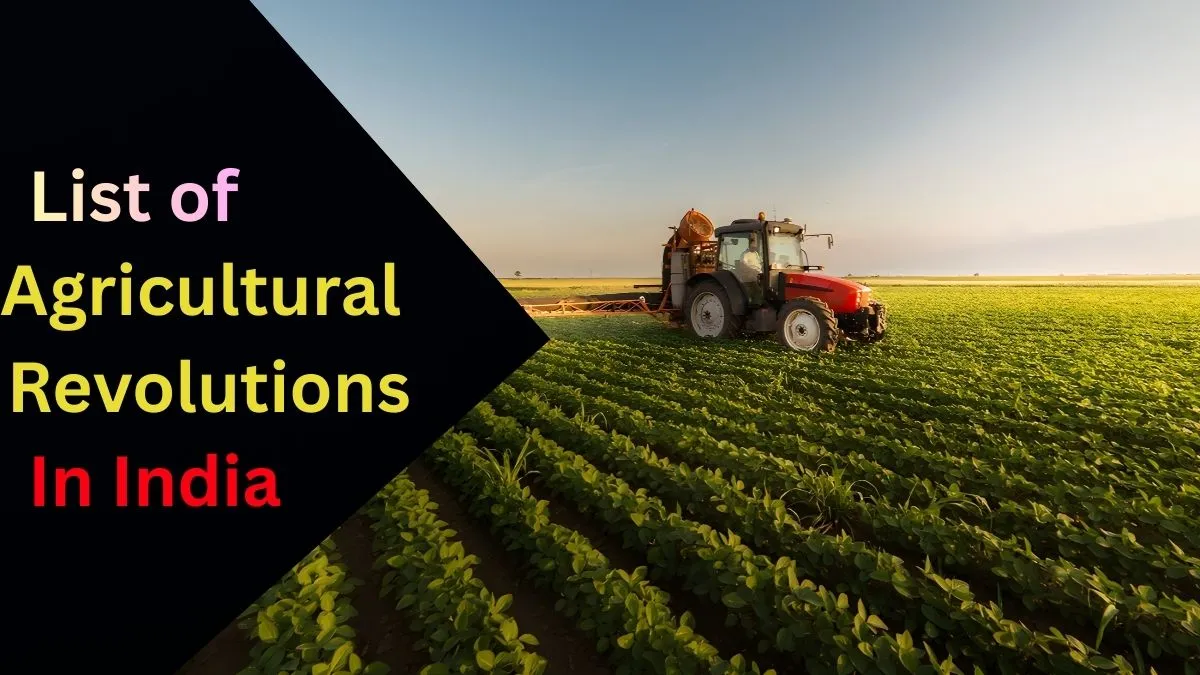
Agriculture always remains the backbone of the Indian economy, which supports nearly half of the Indian population and contributes significantly to food security, rural livelihoods, and inclusive growth.
India has experienced multiple sector-specific agricultural revolutions over the decades, with each attempting to increase productivity, value addition and self-reliance.
The Economic Survey 2024-25 reiterates that the transformation of agriculture in India has been evolutionary as opposed to singular and that it has shifted to nutrition security, sustainability and agri-entrepreneurship as opposed to food security.
TheUnion Budget 2024-25 continues these revolutions in line with climate resilience, digital agriculture, and an income boost to farmers.
Agricultural Revolutions in India
Indian agricultural revolutions are policy interventions, the adoption of technology, and institutional changes that resulted in accelerated growth in individual areas of agricultural development, including food grains, milk, fisheries, oilseeds, horticulture, and livestock.
These revolutions collectively contributed to:
-
Self-sufficiency of national food.
-
Agricultural diversification.
-
Similar enhancement of allied sectors.
-
Market-value agribusiness.
-
Increase in the income of farmers.
List of Agricultural Revolutions in India
After we got independence on 15 August 1947, India always tried to transform every core sector, including agriculture.
Since the 1960s, there have been various agricultural revolutions being transformed in India. The List of Agricultural Revolutions in India is given below in the table:
| Revolution | Products / Focus | Period | Father of the Revolution |
| Round Revolution | Potato | 1965-2005 | — |
| Food grains (rice and wheat) | 1966-1967 | ||
| Grey Revolution | Fertilisers/wool production | 1960s-1970s | — |
| Pink Revolution | Prawn or onion production | 1970s | Durgesh Patel |
| White Revolution (Operation Flood) | 1970-1996 | ||
| Blue Revolution | Fish production | 1973-2002 | Dr. Arun Krishnan |
| Red Revolution | Meat or tomato production | 1980s | Vishal Tiwari |
| Yellow Revolution | Oilseed production | 1986-1990 | Sam Pitroda |
| Brown Revolution | Leather/cocoa production | — | Hiralal Chaudhari |
| Golden Fibre Revolution | Jute production | 1990s | — |
| Golden Revolution | Fruits/honey / horticulture production | 1991-2003 | Nirpakh Tutaj |
| Silver Revolution | Egg/poultry production | 2000s | Indira Gandhi |
| Silver Fibre Revolution | Cotton | 2000s | — |
| Protein Revolution | Agriculture | 2014-2020 | Narendra Modi |
| Evergreen Revolution | Overall development of agriculture | 2017-2022 | M.S. Swaminathan |
| Black Revolution | Petroleum production | — | — |
Major Agricultural Revolutions in India
1. Green Revolution – Food Grain Security
The Green Revolution marked a turning point in Indian agriculture by introducing High-Yielding Variety (HYV) seeds, assured irrigation, chemical fertilisers, and mechanisation.
What are the changes seen in the Budget 2024-25?
The Survey notes that even though the Green Revolution guaranteed food security, the new frontier is on the second-generation reforms that include crop diversification, natural farming, and sustainable use of inputs.
2. White Revolution – Dairy Development
The White Revolution, which is popularly referred to as Operation Flood reorganized India into the largest producer of milk in the world by reinforcing the institutions of cooperation and the procurement systems in the villages.
What are the changes seen in the Budget 2024-25?
Changes which are seen in the Budget 2024-25 is:
-
Infrastructure assistance in dairy.
-
Milk cooperatives intensification.
-
Marketing of the value-added dairy products.
3. Blue Revolution – Fisheries and Aquaculture
The Blue Revolution was started for the fish production, and it was focused on inland fisheries, coastal development, and aquaculture.
Economic Survey 2025:
Fisheries are considered a sunrise industry, as it has export, employment and nutritional security, particularly in the coastal and inland areas.
4. Yellow Revolution – Oilseed Self-Reliance
The Yellow Revolution was started to decrease India’s dependence on imports of edible oil.
What are the changes seen in the Budget 2024-25?
Changes which are seen in the Budget 2024-25 is:
-
National Mission of Edible Oils.
-
Specialise in mustard and palm plantation.
-
Lessening imported susceptibility.
5. Golden Revolution – Horticulture Expansion
The Golden Revolution promoted fruits, vegetables, honey, and floriculture, significantly improving farmers’ income through high-value crops.
Economic Survey 2025 Highlight:
Horticulture contributes more than food grains in value terms, signalling India’s shift towards income-oriented agriculture.
6. Pink, Red, and Silver Revolutions – Livestock & Poultry
These revolutions targeted:
-
Pink: Meat and onion production
-
Red: Meat and tomato production
-
Silver: Poultry and egg production
What are the changes seen in the Budget 2024-25?
Changes which are seen in the Budget 2024-25 is:
-
Animal health infrastructure
-
Breed improvement programmes
-
Market access for livestock farmers
7. Round and Golden Fibre Revolutions – Crop Diversification
-
Round Revolution focused on potato production
-
Golden Fibre Revolution promoted jute cultivation
These revolutions supported regional crop specialisation and rural industrialisation.
8. Evergreen Revolution – Sustainable Agriculture
The Evergreen Revolution emphasises productivity with sustainability, integrating technology, ecology, and farmer welfare.
What are the changes seen in the Budget 2024-25?
Changes which are seen in the Budget 2024-25 is:
-
Climate-resilient agriculture
-
Natural and organic farming
-
Efficient water and soil management
9. Protein Revolution – Nutrition Security
Protein Revolution is concerned with the supply of more pulses, dairy, fish, and livestock products to solve malnutrition.
What are the changes seen in the Budget 2024-25?
Changes which are seen in the Budget 2024-25 are:
-
POSHAN objectives
-
Support to pulses production
-
Strengthening nutrition-centric agriculture
Conclusion
The Agricultural Revolutions of India are an indication of a gradual shift from food scarcity to nutritional abundance and sustainability.
As per the Economic Survey and Union Budget of 2024-25, India always reinforces the future of Indian agriculture, which always lies in the technology-driven, climate-resilient, and income-centric reforms that are built on the sound foundation of these sector-specific revolutions.





Comments
All Comments (0)
Join the conversation