Key Points
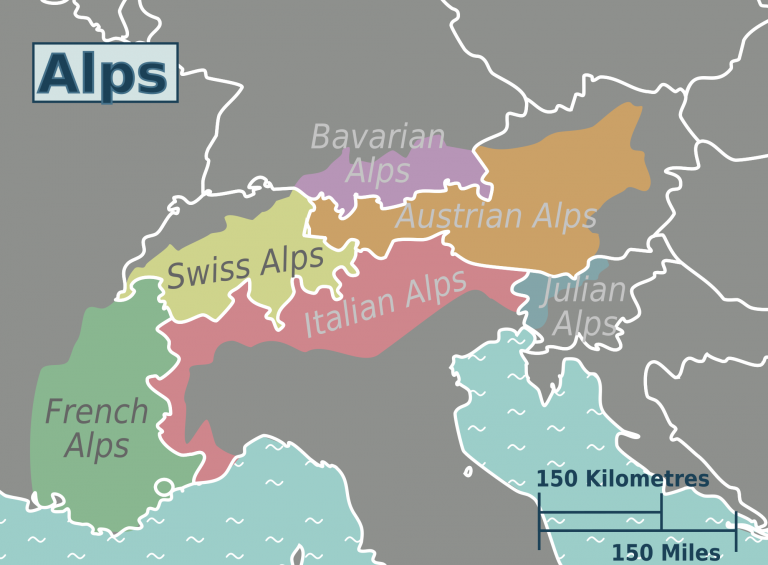
- Eight countries share the Alps: Italy, France, Austria, Switzerland, Liechtenstein, Germany, Slovenia and Monaco
- The Alpine Convention, safeguarding the ecosystem, began in 1995.
- There are 1,599 peaks in the Alpine countries, 29 exceeding 4,000m.
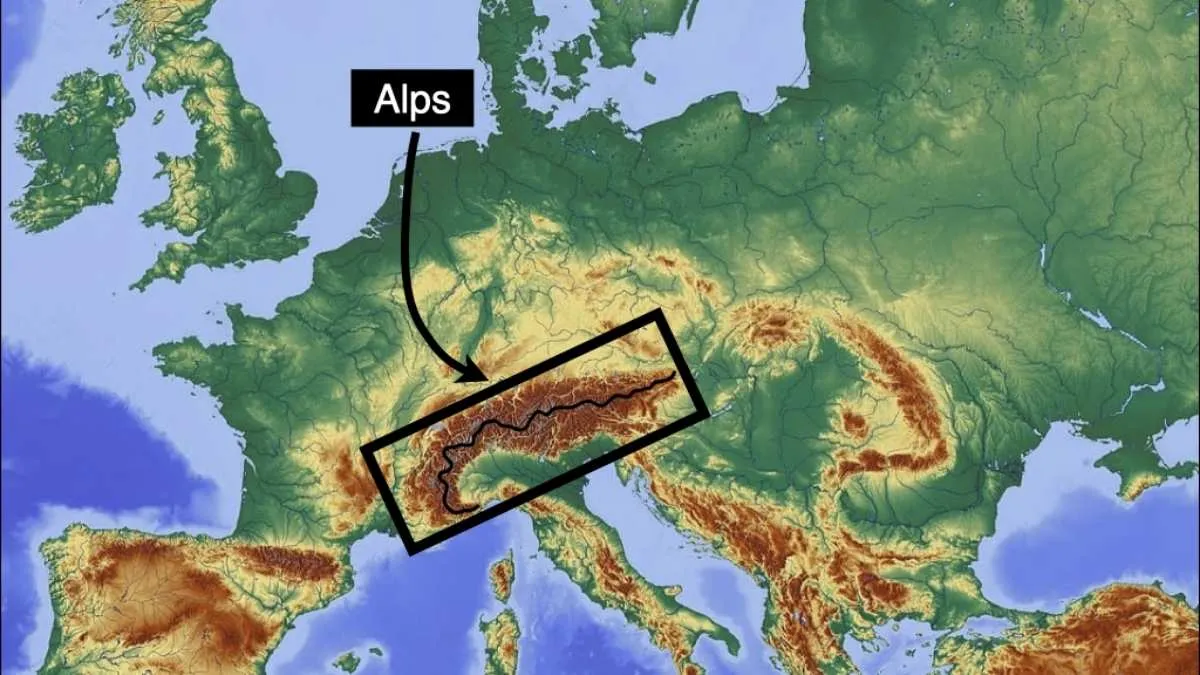
The Alps are the highest and most extensive mountain range system that lies in south-central Europe. This mountain range stretches approximately 750 miles (1,200 kilometres).
It was formed millions of years ago during the collision between the Eurasian and the African tectonic plates.
Many notable rivers flow in the Alpine Mountain region with Several vegetation zones.
But, apart from this, do you know how many Countries are Surrounded by the Alps Mountain Range?
If yes, then good. If you are not aware of the Alpine countries, let’s explore this article in detail.
How many Alpine Countries are Surrounded by the Alps Mountain Range?
The area around the Alps is referred to as the Alpine countries of Europe. As we know, the Alps are one of the continuous, unspoilt natural areas in Europe, with their outstanding, unique and diverse natural habitat, cultural diversity and constitute an economic and cultural hub shared by numerous peoples and countries of Europe.
To save the dignity of the Alps Mountain Range, the first Alpine Conference of Environment Ministers was held in Berchtesgaden in October 1989, by agreeing on the total number of 15 articles given in this conference.
Source: pbs
Under this convention, there are eight countries included, which are:
-
Italy
-
France
-
Austria
-
Switzerland
-
Liechtenstein
-
Germany
-
Slovenia
-
Monaco
Among these nations, Austria and Switzerland contain the greatest region of mountain cover, and Liechtenstein and Monaco lie entirely within the Alpine territory, within their borders.
Also, these Alpine countries are represented by about 6,200 municipalities, 83 territorial units and 3 local administrative divisions.
What is the Alpine Convention?
The Alpine Convention is an international agreement which was created to safeguard the ecosystem around the Alps as well as to enable the region to experience sustainable economic growth.
It has been in practice since 1995 and occupies a total area of 73,636 square miles, 746 miles in the longest and 186 the widest.
The Alpine countries are also represented by representatives in the Permanent Committee that is an executive body.
The body is mandated to formulate work groups which formulate protocols and recommendations to be adhered to by the member countries.
Also, these working groups perform research on the ongoing development projects and report to the Permanent Committee with their findings.
Among the working groups that are currently working include the following issues: natural hazards, mountain farming, sustainable tourism, transport, mountain forests, ecological network, large carnivores and wild ungulates and water management.
How many Mountains are there within the Alpine Countries?
There are 1,599 peaks located in the Alpine countries. Among them, it is only 29 are 4,000 meters above the sea level or more.
Details of all the mountains are given below in the table:
| Rank | Country | 2000+ | 2500+ | 3000+ | 3500+ | 4000+ | Total |
| 1 | Austria (AT) | 206 | 150 | 93 | 14 | 0 | 463 |
| 2 | France (FR) | 71 | 95 | 75 | 40 | 4 | 285 |
| 3 | Germany (DE) | 14 | 11 | 0 | 0 | 0 | 25 |
| 4 | Italy (IT) | 149 | 197 | 169 | 48 | 7 | 570 |
| 5 | Liechtenstein (LI) | 4 | 1 | 0 | 0 | 0 | 5 |
| 6 | Slovenia (SI) | 22 | 9 | 0 | 0 | 0 | 31 |
| 7 | Switzerland (CH) | 66 | 114 | 147 | 44 | 24 | 395 |
| 8 | Alps Total | 507 | 530 | 416 | 117 | 29 | 1599 |
Data Source: World Atlas
Conclusion
The Alps mountain range is shared by eight European nations, which is also known as the Alpine countries: Italy, France, Austria, Switzerland, Liechtenstein, Germany, Slovenia, and Monaco.
These alpine countries are committed to supporting the Alpine Convention to ensure the ecological and economic sustainability of this vital and diverse natural area.



Comments
All Comments (0)
Join the conversation