Which Five Mighty Cities Ruled the World Until They Fell?
Discover five mighty cities that once ruled the world: Rome, Babylon, Carthage, Constantinople, and Vijayanagara, and learn how these powerful empires rose and fell.
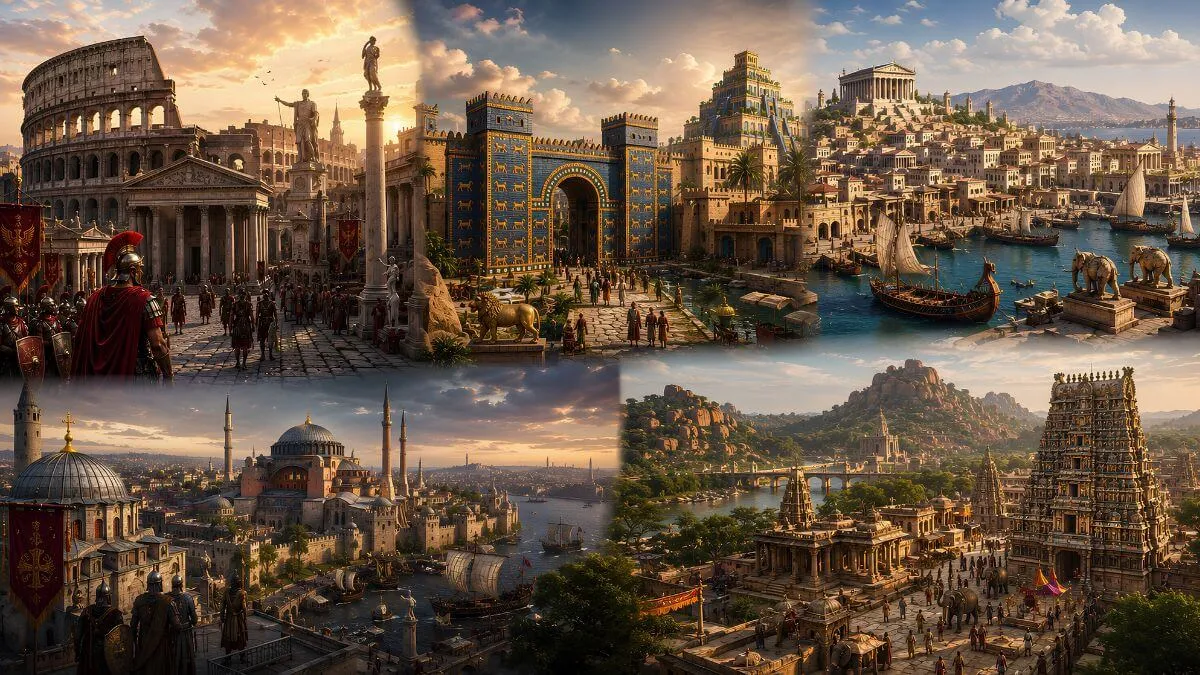
Throughout history, many cities were once the centre of power, money, and culture, and many cities ruled the world until they fell. These cities ruled even a large empire in their longer period of time and are known all over the world.
In this article, we will look at five mighty cities that ruled the world and later fell. This topic is useful for UPSC aspirants because it covers world history and ancient and medieval indian history, which are part of the GS Paper 1 syllabus.
Five Mighty Cities That Ruled the World Until They Fell
These are the Five Mighty Cities that Ruled the World Until They Fell:
-
Rome (Roman Empire)
-
Babylon (Babylonian Empire)
-
Carthage (Carthaginian Empire)
-
Constantinople (Byzantine Empire)
-
Vijayanagara (Vijayanagara Empire, India)
Rome: The City That Built a World Empire
The city of Rome was founded in Italy in 753 BC as a small town. Later, it evolved into the Roman Empire, which was one of the largest and most powerful empires in history when it ruled over Europe, North Africa and the Middle East for many years until it fell in 476 AD.
This city has also contributed to many things which are still used in modern times, including roads, systems of law, and the Latin alphabet.
Why did Rome fall?
The Western Roman Empire fell in 476 AD. The principal causes included attacks of the Germanic tribes, weak and corrupt rulers, monetary difficulties, and the empire was too large to be managed.
Babylon: The City of the Hanging Gardens
Babylon was located in Mesopotamia, currently it is located in Iraq. This city was one of the powerful state under the leadership of King Hammurabi, who compiled one of the earliest known codes of law called the Code of Hammurabi.
Why did Babylon fall?
In 539 BC, Persian king Cyrus the Great conquered Babylon with little resistance. After this, Babylon slowly lost its importance as a centre of power.
Carthage: Rome's Biggest Rival
Carthage was a strong trading city situated in North Africa (now Tunisia). It was equipped with a powerful navy and was in control of trade routes throughout the Mediterranean.
There were three great conflicts between Carthage and Rome known as the Punic Wars. Hannibal, who was a famous general of Carthage, crossed the Alps with elephants.
Why did Carthage fall?
After the Third Punic War, held between Carthage and Rome in 146 BC, Rome won the war, Carthage was destroyed, and the whole city was burnt down, and its land became part of the Roman Empire.
Constantinople: The Bridge Between Europe and Asia
Constantinople was established by Roman Emperor Constantine in 330 AD. It was to become the capital of the Byzantine Empire (Eastern Roman Empire) and remain strong for more than 1,000 years. It was a great hub for trade, religion and culture.
Why did Constantinople fall?
In 1453 AD, the Ottoman Turks led by Sultan Mehmed II took the city after a long siege. Later, the city of Constantinople came to be known by the name today, Istanbul.
Vijayanagara: India's Golden City
Vijayanagara was the capital of the Vijayanagara Empire in South India, located near present-day Hampi in Karnataka.
It was one of the wealthiest and largest cities in the world in the 15th and 16th centuries. Foreign visitors who came to the city spoke of the grand markets, temples and palaces.
Today, Hampi is a UNESCO World Heritage Site and is of great importance for the study of medieval Indian history.
Why did Vijayanagara fall?
The Battle of Talikota in 1565 AD was between the Vijayanagara Empire and an alliance of Deccan Sultanates. The city of Vijayanagar was destroyed and never regained its glory after this loss.
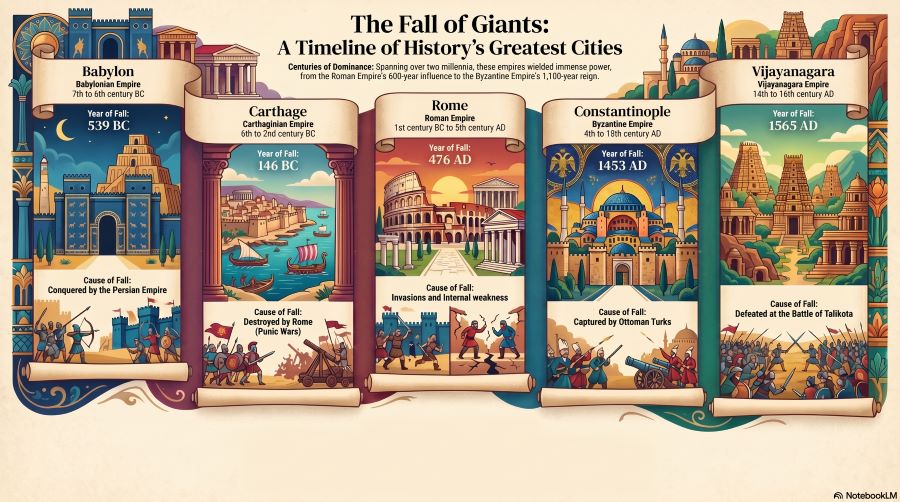
Source: notebooklm
Comparison Table: Five Mighty Cities That Ruled the World Until They Fell
| City | Empire | Period of Power | Year of Fall | Cause of Fall |
| Rome | Roman Empire | 1st century BC to 5th century AD | 476 AD | Invasions and internal weakness |
| Babylon | Babylonian Empire | 7th to 6th century BC | 539 BC | Conquered by the Persian Empire |
| Carthage | Carthaginian Empire | 6th to 2nd century BC | 146 BC | Destroyed by Rome (Punic Wars) |
| Constantinople | Byzantine Empire | 4th to 15th century AD | 1453 AD | Captured by Ottoman Turks |
| Vijayanagara | Vijayanagara Empire | 14th to 16th century AD | 1565 AD | Defeated at the Battle of Talikota |
Rome, Babylon, Carthage, Constantinople and Vijayanagara had been powerful cities at one point of time and fell later. Though they were rich and powerful and influential, each faced difficulties that brought it down.

Prabhat Mishra is a Subject Matter Expert and digital journalist with an extensive background in the competitive exam landscape and over 4 years of experience in education, national and international news, and current affairs. Over his tenure with top knowledge platforms like Mentorship India, IAS BABA, IAS SARTHI, and now Jagran Josh, he has a deep understanding of government exams like UPSC and State PCS, including UP and Bihar, as he has already qualified for the UPPCS 2022 Mains and Bihar 68th Mains. With his core expertise in history, polity, geography & current affairs, he specialises in creating well-researched, aspirant-centric content and simplifying complex topics for competitive examinations.


