
Fact of the Day: In today’s series of daily facts, we will discuss and explore the Earth, a planet formed by water, rock, air, and time. Earth is not one of the largest planets in our solar system, but the only one to support life with its unbelievable diversity.
Daily reading and knowing these facts will help you to understand the core understanding of this topic, which will also help you in clearing various exams like UPSC, SSC, Banking and also many other state exams.
So, let’s explore the Earth, which is one of the important topics of Geography, in detail.
About the Earth
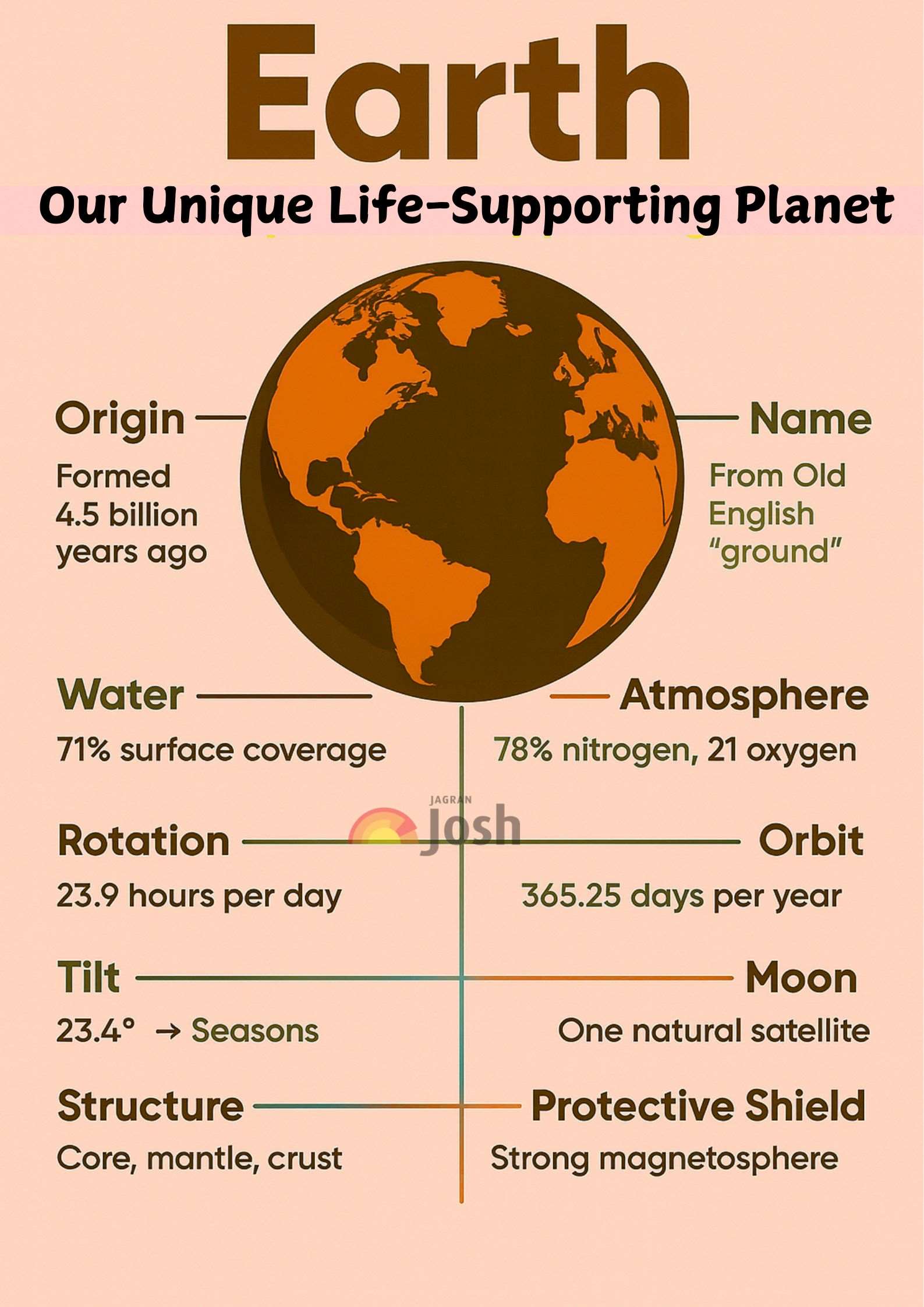
Earth is the third planet and the largest of the terrestrial or rocky planets. The name Earth is a derivative of the old Germanic and English language, which needed old Germanic and English words meaning ground, unlike the mythologically-named worlds it surrounds.
It was also created approximately 4.5 billion years ago when the clouds of gas and dust swirled around. Its oceans, mountains and atmosphere have since then changed continuously, creating the perfect environment in which life emerged around 3.8 billion years ago.
10 Interesting Facts About Earth
1. Earth Is the Only Known Planet with Liquid Water
The presence of water as ice on Earth to its temperature, keeps life thriving here to a large extent. Oceans are spread out at 71 per cent of the surface and so the cradle where life first came to be.
2. Its Name Has Ancient Origins
In contrast to other planets with their Roman-themed names, the Earth was named after Old English and Germanic words that signify soil or ground and demonstrate that human beings are strongly tied to the land.
3. Earth Has the Ideal Conditions for Life
A perfect mix of oxygen, nitrogen, sunlight, and water has shaped Earth into a thriving home for millions of species. Its mild temperatures and chemical balance make life possible.
4. It Is the Biggest Terrestrial Planet
The Earth is the fifth-largest largest in our solar system and the fifth-largest rocky planet with a diameter of 12,756 km.
5. A Day and Year Are Precise but Complex
The Earth takes approximately 23.9 hours to rotate and 365.25 days to orbit around the Sun. To ensure the congruency of the calendars with this orbit, we insert a leap day every four years.
6. Seasons Exist Because Earth Tilts
Earth’s axis tilts at 23.4 degrees. It is this tilt that brings about the different amounts of sunlight throughout the year, and we have spring, summer, autumn and winter.
7. Earth Has One Powerful Moon
Earth has only one moon, so it has to balance the tilt of the Earth and influence the tides. It was created several billion years ago due to a massive collision of the Earth and another large body.
8. Earth’s Crust Is Split into Plates
The crust and the upper mantle of the planet are composed of vast tectonic plates that are stationary gradually. They collide and separate, thus forming earthquakes, mountains, and volcanoes.
9. The Atmosphere Shields Us
Nitrogen and oxygen make up 78 per cent and 21 per cent of the atmosphere on Earth, respectively. It controls the weather, absorbs the harmful energy of the sun and vaporises meteoroids before they hit the Earth.
10. Earth Has a Strong Magnetic Field
The spinning molten core causes the magnetic field to form a protective bubble, which is known as the magnetosphere. It repels the wind of the sun and illuminates the sky with light showers.
Conclusion
Our planet is a very extraordinary one that is formed by water, air and constant movement. It is not like any other world we are familiar with due to its atmosphere, magnetic shield and life-supporting climate. The insights of learning about the systems on the earth allow us to value the delicate equilibrium of the earth and may also make us understand why we need to take good care of this home so that future generations can enjoy it.
Check below for more Interesting Facts: |



Comments
All Comments (0)
Join the conversation