Article 17 and 18 of Indian Constitution: Articles 17 and 18 are very important articles of the Indian Constitution and together they play a major role in the Constitution’s mission to establish social equality and eliminate practices that promote hierarchical discrimination.
While Article 17 abolishes untouchability, Article 18 prohibits titles that create artificial social rankings.
Read further to know more about Article 17 and Article 18, meaning, relevance in current times, landmark supreme court judgements, and others.
What Do Articles 17 & 18 Mean
Article 17: Untouchability is abolished. Its practice in any form is punishable by law.
Article 18: The State cannot confer titles that create social inequality, except for military and academic distinctions.
Together, they protect Indians from caste-based discrimination and artificial social hierarchies.
ARTICLE 17 of the Indian Constitution
Article 17 of the Indian Constitution is titled as “ Abolition of untouchability”, and states that "Untouchability" is abolished and its practice in any form is forbidden. The enforcement of any disability arising out of "Untouchability" shall be an offence punishable in accordance with law.
Article 17: Abolition of Untouchability
Article 17 talks about untouchability, and abolition of its practice in any form. This means that nobody should be discriminated against and treated differently from others in any form.
As per the Untouchability Offences Act, 1955, renamed as Protection of Civil Rights Act, 1976, untouchability is considered as a criminal offense and is punishable under the Act. According to the Act, anything that is accessible to the general public should be accessible to all the Indian citizens.
Key Features of Article 17
Untouchability Abolished Completely
No person can be denied access to:
-
Temples
-
Wells, ponds
-
Shops, restaurants
-
Schools, public transport
-
Public offices or public facilities
Practising Untouchability is a Criminal Offense
The Parliament enacted the Untouchability Offences Act, 1955 to prohibit untouchability in all forms. Then the Act was renamed to the Protection of Civil Rights Act, 1976 and further provisions were added. The Parliament also enacted SC/ST (Prevention of Atrocities) Act, 1989 to enforce Article 17.
Punishments include:
-
Imprisonment
-
Fines
-
Enhanced penalties for repeated offenses
“Untouchability” Means Caste-Based Discrimination
The term “Untouchability” has not been defined anywhere in the Indian Constitution. The term was defined by the Supreme Court in its judgement. As per the Supreme Court’s verdict, ‘The subject matter of Article 17 is not untouchable in its literal or grammatical sense but the ‘practice as it had developed historically in the country’. It refers to the social disabilities imposed on certain classes of persons because of their birth in certain castes. Hence, it does not cover the social boycott of a few individuals or their exclusion from religious services, etc.
Important Supreme Court Judgments on Article 17
People’s Union for Democratic Rights vs. Union of India (1982)
The Supreme Court stated that the right to equality under Article 17, if breached by any private individual, then the State must take immediate action against it.
State of Karnataka vs. Appa Balu Ingale (1992)
The Supreme Court in its judgement for this case had stated that Untouchability in any form is a form of slavery which is a part of the caste system.
ARTICLE 18 of the Indian Constitution
Article 18 of the Indian Constitution is titled as “Abolition of titles”.
(1) No title, not being a military or academic distinction, shall be conferred by the State.
(2) No citizen of India shall accept any title from any foreign State.
(3) No person who is not a citizen of India shall, while he holds any office of profit or trust under the State, accept without the consent of the President any title from any foreign State.
(4) No person holding any office of profit or trust under the State shall, without the consent of the President, accept any present, emolument, or office of any kind from or under any foreign State.
Article 18: Abolition of Titles
Article 18 protects Indian citizens from artificial social hierarchy created through titles.
Key Provisions of Article 18
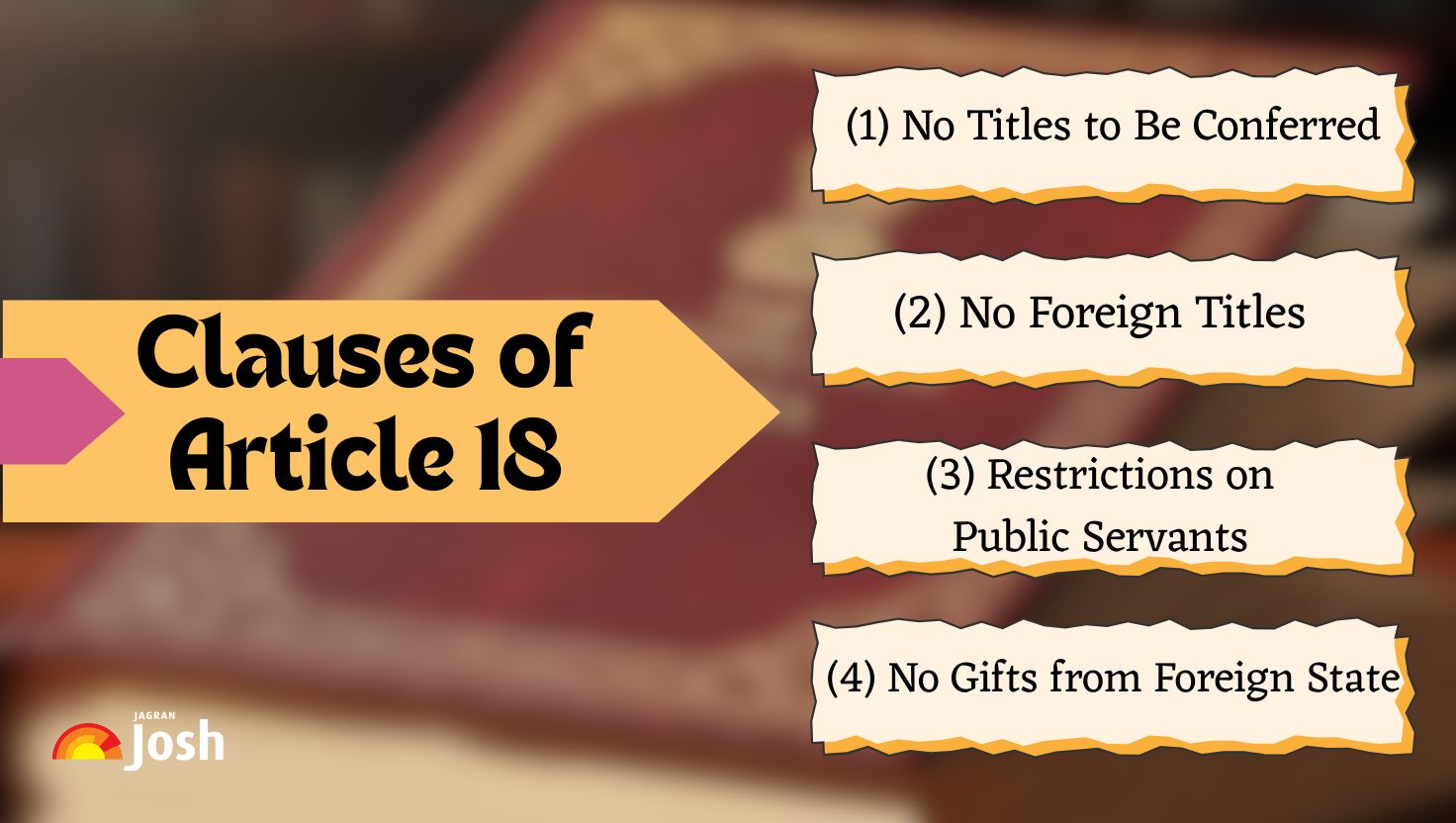
Article 18(1): No Titles to Be Conferred
The State is prohibited from creating titles like:
-
Sir
-
Rai Bahadur
-
Maharaja
-
Nawab
-
His Highness
But, the military and academic titles are an exception which means that these titles are being earned by the individual through their hard work.
Article 18(2): No Foreign Titles
Indian citizens are prohibited from accepting titles from a foreign state.
Article 18(3): Restrictions on Public Servants
Non-citizens cannot accept the titles from the Foreign state if they are working with the Indian Government or any state government or with any authority under the Indian state without the permission of the President.
Article 18(4): No Gifts from Foreign State
The citizens as well as the non-citizens are not allowed to accept salary, gifts, or office from any Foreign state if they are working under the Indian state or any trust.
ALSO READ:
Article 14 of the Indian Constitution
Article 15 of the Indian Constitution
Article 16: Your Constitutional Right to Equal Opportunity in Government Jobs
Important Supreme Court Judgement on Article 18
As Article 18 of the Indian Constitution abolishes the titles in any form, there were questions raised as to the use of titles such as Padma Vibhushan, Bharat Ratna, and other national awards. These awards are being proffered for the exceptional work by the individuals.
Balaji Raghavan Vs. Union of India (1996)
The Supreme Court ruled that these awards are not considered as titles under the clause (1) of Article 18. The Supreme Court asked to set up a High Level Committee, which will help in selection of the candidates for these awards.
Article 17 and 18 At a Glance
| Article | What It Guarantees |
| Article 17 | Abolition of untouchability and criminalization of its practice |
| Article 18 | Abolition of titles; only academic & military distinctions allowed |




Comments
All Comments (0)
Join the conversation