Show Key Points
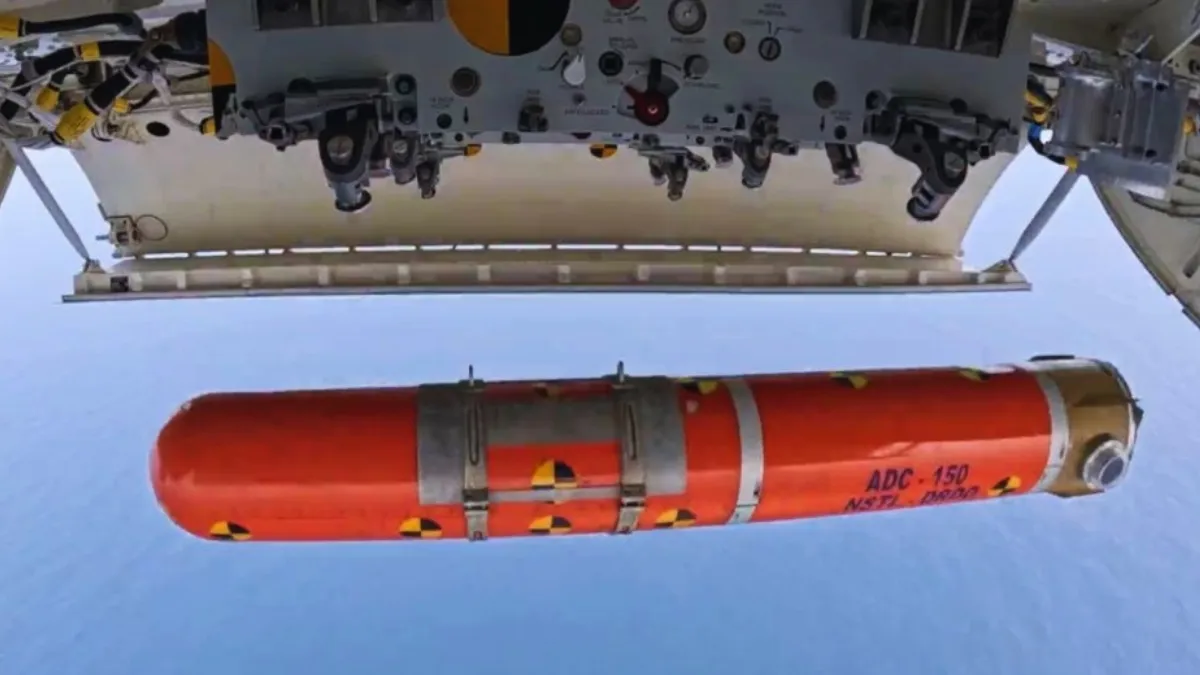
DRDO’s ADC-150 is India's first indigenous air-droppable container with a 150 kg payload capacity under the Aatmanirbhar Bharat (Self-Reliant India) in defense. The Defence Research and Development Organisation (DRDO) and the Indian Navy successfully completed the final phase of in-flight trials for the ADC-150.
ADC-150, indigenous Air Droppable Container is designed to bridge a critical gap in naval logistics, ensuring that Indian warships remain operational even when thousands of miles away from the home coast.It enables the Indian Navy to deliver critical spares, medical supplies, and stores to ships deployed deep at sea over 2,000 km away significantly boosting maritime operational reach and self-reliance.
What is ADC-150?
The ADC-150 is a high-precision, indigenous airdroppable container that can carry a payload of up to 150 kg. It is a specialised "cargo pod" that is launched from an aeroplane to carry important supplies such as spare machinery, medical emergency kits, or specialised tools directly to a ship at sea.
Between February 21 and March 1, 2026, four successful in-flight release testing took place off the coast of Goa. The containers were dropped by a P-8I maritime patrol aircraft under harsh release conditions. These tests confirmed the container's structural integrity, parachute deployment system, and ability to hit the target precisely.
Key Features of the Indigenous Air Droppable Container
The DRDO's ADC-150 is not just a box; it is a sophisticated piece of aerial delivery hardware. Its key features include:
-
150 kg Payload Capacity: Sufficient for heavy engineering spares or life-saving medical equipment.
-
Advanced Parachute System: A multi-stage parachute ensures the container enters the water at a safe velocity, preventing damage to the contents.
-
High-Speed Release: Qualified for release from high-performance aircraft like the P-8I and the IL-38SD.
-
Rugged Design: Built to withstand the aerodynamic stresses of high-altitude release and the impact of hitting the ocean surface.
-
GPS/Electronic Tracking: Allows the receiving vessel to locate and retrieve the container quickly from the water.
Indigenous Air Droppable Container
The development of the ADC-150 is a testament to the collaborative ecosystem of Indian defense laboratories such a
-
Nodal Agency: Naval Science & Technological Laboratory (NSTL), Visakhapatnam.
-
Parachute System: Developed by the Aerial Delivery Research & Development Establishment (ADRDE), Agra.
-
Certification: Flight clearance was provided by the Centre for Military Airworthiness & Certification (CEMILAC), Bengaluru.
-
Instrumentation: Supported by the Defence Research & Development Laboratory (DRDL), Hyderabad.
What is the Significance of the Indigenous Air Droppable Container?
-
Extended Blue-Water Reach: Previously, if a ship deployed 2,000 km away from the coast suffered a technical failure, it often had to return to port or wait for a slow supply ship. With the ADC-150, a P-8I aircraft can fly to the location and drop the necessary part within hours.
-
Enhanced Mission Readiness: By delivering critical spares via air, the Navy reduces the "down-time" of its frontline warships. This ensures that the fleet remains on station for longer durations, which is vital for maintaining maritime domain awareness in the Indian Ocean Region.
-
Humanitarian Assistance & Disaster Relief (HADR): Beyond warfare, the ADC-150 is a game-changer for emergency response. It can be used to drop food, water, and medicines to distressed vessels or remote islands during natural disasters.
-
Strategic Autonomy: By developing this technology indigenously, India has eliminated dependence on foreign OEMs (Original Equipment Manufacturers) for specialized naval logistics gear, further strengthening the "Make in India" initiative.
The successful completion of the ADC-150 trials marks a new era for the Indian Navy's logistical capabilities. As the system prepares for formal induction, it stands as a symbol of India's growing prowess in defense engineering.
Also Read: Exercise LAMITIYE-2026



-1773317067617_t.webp)

Comments
All Comments (0)
Join the conversation