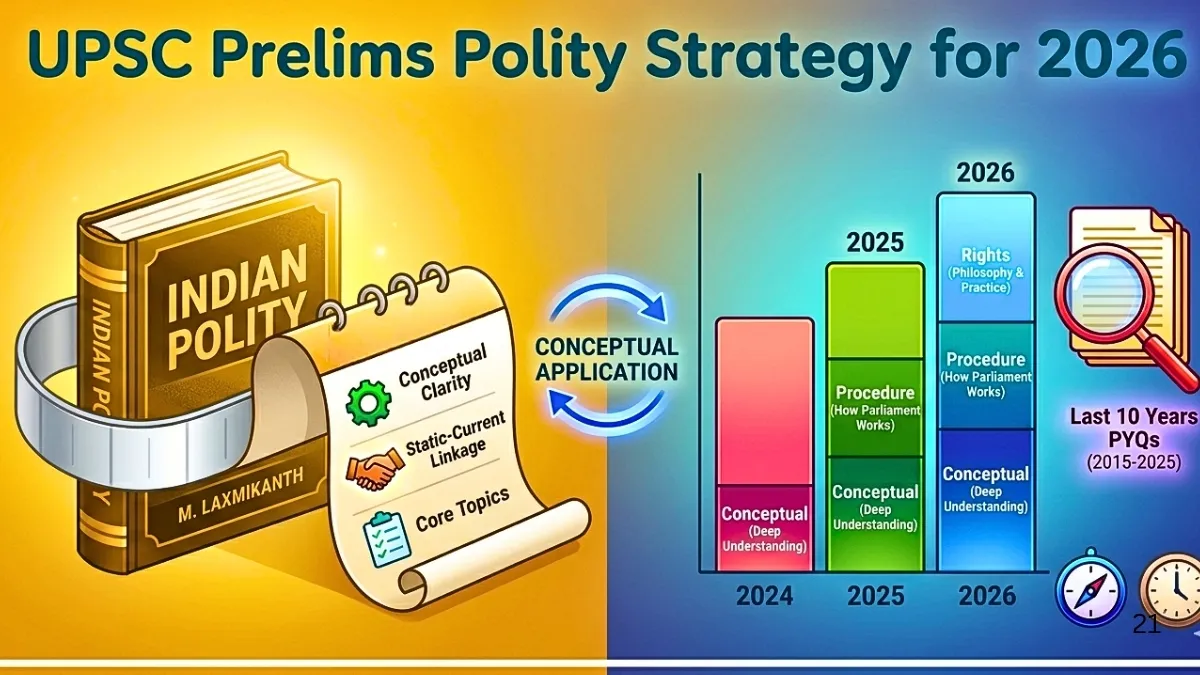
Indian Polity remains one of the most reliable and high-scoring sections of the UPSC Civil Services Preliminary Examination, genrally it contributes nearly 15–18 questions annually, making it a "make-or-break" subject for clearing the cutoff. However, the 2024 and 2025 Prelims signals a clear shift: UPSC is moving away from purely factual recall toward conceptual depth and applied governance.
To succeed in UPSC 2026, you cannot simply memorize articles; you must understand the "why" behind constitutional provisions. This 50-day guide is a result-oriented roadmap that synchronizes M. Laxmikanth with a deep dive into the last 10 years of Previous Year Questions (PYQs), ensuring you focus only on what truly matters for the exam.
UPSC Prelims 2026-Trend Analysis 'Core Areas' Of Polity
Based on the last decade (approx. 15 questions/year): where Even in worst year → 10 questions - Average → 13–17 questions
-
High Priority (60% of questions): Parliament, Fundamental Rights, DPSP, Judiciary, and Union Executive.
-
Medium Priority (25% of questions): Constitutional Bodies, Local Government, Federalism, and Basic Structure.
-
Low Priority (15% of questions): Historical Underpinnings, Citizenship, and Non-Constitutional Bodies.
UPSC Prelims Polity Questions in Last 5 Years:
| Year | No. of Questions | Nature |
| 2025 | 14 | Conceptual + Current linked |
| 2024 | 15 | Parliament-heavy + static core |
| 2023 | 15 | Balanced (static + analytical) |
| 2022 | 10 | Low weightage but tricky |
| 2021 | 14–16 | Conceptual + fundamental focus |
50-Day Core Polity Plan (PYQ-Based)
This plan prioritizes "High-Frequency Zones" identified from 2015–2025 trends.
Phase 1: The Constitutional Core (Days 1–20)
Goal: Secure 40% of your Polity marks by mastering the "Basic Structure" and Rights.
-
Days 1–4: Preamble & Philosophy. (PYQ Trend: Concepts of Liberty, Equality, and Justice).
-
Days 5–12: Fundamental Rights (Art 12–35). Focus on Art 14, 19, 21 and the Writ jurisdiction. Link with recent Privacy and Digital Rights cases.
-
Days 13–16: DPSP & Fundamental Duties. Understand the "Non-justiciable" nature and how they guide policy.
-
Days 17–20: Amendment Process & Basic Structure. Focus on the 42nd, 44th, and recent 100+ Amendments.
Phase 2: The Working of Democracy (Days 21–40)
Goal: Understand the machinery of the Union and States.
-
Days 21–30: The Parliament (Mega Topic). Focus on Sessions, Motions (No-confidence, Adjournment), the Budgetary process, and the Speaker’s role.
-
PYQ Tip: UPSC loves comparing the powers of Lok Sabha vs. Rajya Sabha.
-
Days 31–35: The Executive. President and Governor (Compare their pardoning and discretionary powers).
-
Days 36–40: The Judiciary. Supreme Court and High Court. Focus on the Appointment of Judges (Collegium) and Judicial Review.
Phase 3: Decentralization & Oversight (Days 41–50)
Goal: Factual accuracy for easy marks.
-
Days 41–45: Local Government. 73rd & 74th Amendments. Focus on Gram Sabha powers and the State Election Commission.
-
Days 46–50: Constitutional & Non-Constitutional Bodies. ECI, CAG, Finance Commission, and the Lokpal.
-
Days 51–55: Final PYQ Simulation. Solve the 2016–2025 papers in a timed environment.
How to Solve the Last 10 Years of Polity PYQs
Simply finding the right answer is not enough. Follow this Active Analysis Method:
-
Analyze the "Distractors": In a question about the CAG, if one option mentions the Attorney General, go to that chapter immediately and find the difference. UPSC often uses the "swapping technique" (putting AG's powers in a CAG question).
-
Verify the "Wording": Look for phrases like "The Constitution of India defines..." In many cases (like 'Basic Structure' or 'Office of Profit'), the Constitution mentions them but doesn't define them. These are classic UPSC traps.
-
Note the Trend Shift:2015–2019: Focus was on factual Articles and Powers.
-
2020–2025: Focus shifted to "Political Theory" (What is a Constitutional Government? What is the essence of Bureaucracy?).
-
Theme Mapping: Every year, UPSC asks one question on Anti-Defection (10th Schedule) or Panchayati Raj. Mark these as "Zero-Mistake Zones."
-
Identify "Trap Words": Note how UPSC uses terms like "The Constitution of India defines..." (usually false for specific details) or "Only the Parliament can...". In 2024 and 2025, UPSC increased these "word-play" questions.
Strategic Advice for 2026:
What you need to Avoid:
-
New sources
-
New notes
-
Reading multiple sources
Focus on Only Revise:
-
PYQs
-
practicing MCQs
-
No revision cycle
-
Fundamental Rights
-
Parliament
-
Amendments
-
Constitutional Bodies
-
Link with Current Affairs such as SC judgments and Bills & amendments
‘’Polity is not about remembering Articles, it is about understanding power’’
Don't wait until the end of your 50-day cycle to touch PYQs. Solve the relevant PYQs the same day you finish a chapter in Laxmikanth. This helps you see the book through the "eyes of the examiner."
Also Read: Last 50 Days UPSC Prelims Strategy: A Smart Plan for UPSC CSE 2026



Comments
All Comments (0)
Join the conversation