CBSE 12th Board Exam 2027: Two-Month Study Plan to Score High Marks
CBSE Class 12 Board Exam 2027: Check a 2-month study plan, daily timetable, revision strategy, subject-wise preparation tips and ways to score 90+ marks in 12th board exams.
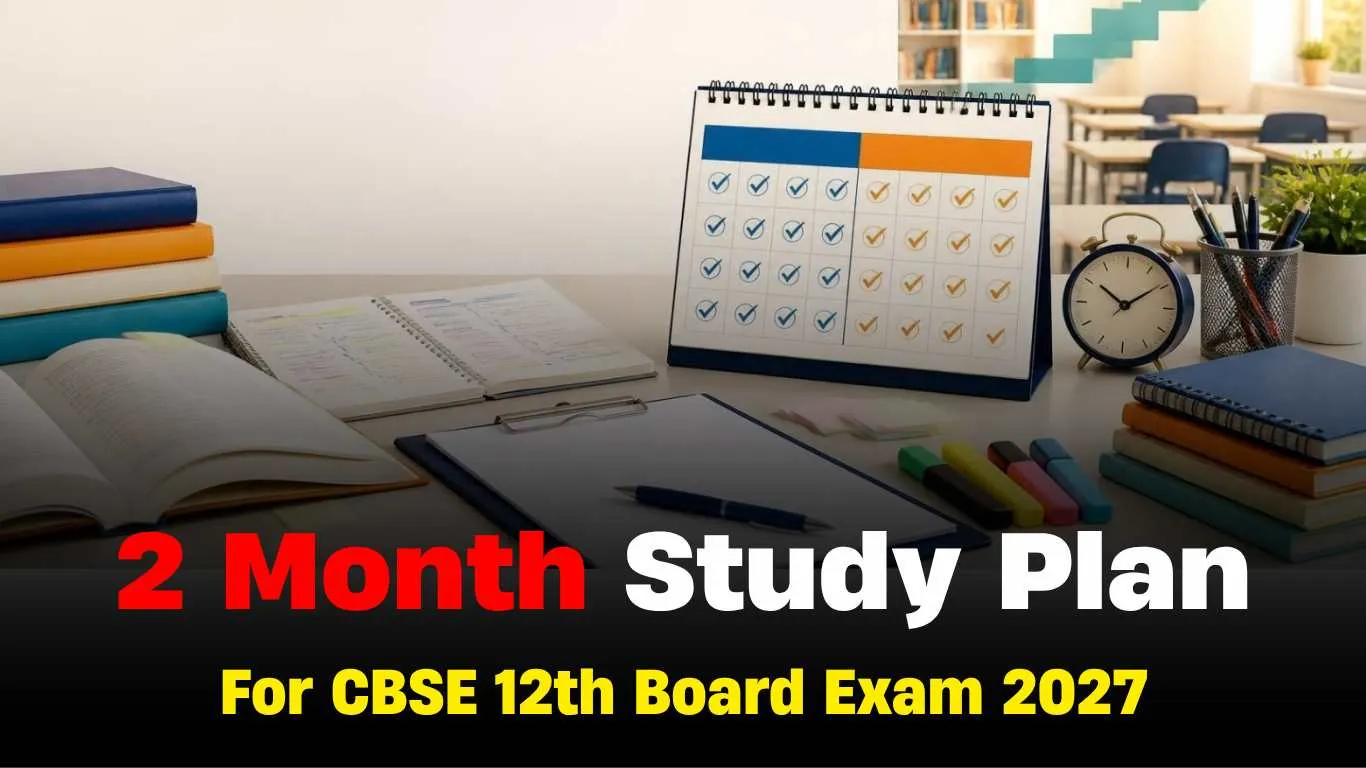
CBSE 12th Board Exam 2027: Scoring high marks in the CBSE Class 12 Board Exams requires a focused and balanced strategy, strict discipline, and smart time management. A well-planned two-month study strategy can help students to get a score of 90 per cent, 95 per cent or higher marks. With two months remaining before the final exams, the students' primary focus must shift from long-form reading to targeted revision, solving Previous Year Questions, PYQs, and perfection for CBSE answer presentations. Here we have made an effective two month study plan for students, which can be adopted for learning and score high marks in CBSE 12th board exam.
CBSE 12th Board Exam High-Level Strategy
- Primary Resource First: Complete NCERT textbooks, back-of-chapter exercises, and in-text questions before referring to secondary refresher books.
- Active Recall over Passive Reading: Instead of reading notes continuously, test yourself using flashcards, blank page active-recalls, and writing answers from memory.
- Master the Marking Scheme: Step-wise marking is followed by CBSE evaluators. Always write clear steps for numericals, draw neat diagrams, and use bulleted points to score marks on every step.
Month 1: Detailed Subject-Wise Revision & Concept Consolidation
The first 30 days are dedicated to completing remaining weak topics, revising high-weightage chapters, and practicing chapter-wise question banks.
Week 1 & 2: High-Weightage Chapter to Focus on
-
Science Stream:
| Subject | Focus Areas & Strategy |
| Physics | Focus on Electrostatics, Optics, and Current Electricity. Practice derivations, circuit diagrams, and numericals daily. |
| Chemistry | Divide study sessions into Physical (formulas and calculations), Organic (named reactions, mechanisms, and distinction tests), and Inorganic Chemistry (p-block, d & f block trends and coordination compounds). |
| Biology | Memorize NCERT diagrams, flowcharts, terminology, and key processes (Genetics, Biotechnology, Reproduction). |
-
Commerce Stream:
| Subject | Focus Areas & Strategy |
| Accountancy | Practice daily numericals on Partnership, Company Accounts, and Financial Statement Analysis. |
| Business Studies | Learn case study frameworks and memorize keywords/headings directly from NCERT. |
| Economics | Master Macroeconomics graphs, national income numericals, and Indian Economic Development facts. |
-
Humanities Stream:
| Subject | Focus Areas & Strategy |
| History/Political Science | Memorize timelines, bullet points, and key policy frameworks. Focus on map-based questions. |
| Psychology/Sociology | Practice application-based scenarios and theoretical definitions. |
Week 3 & 4: Chapter-Wise PYQs & Formula/Concept Maps
- Solve 5-year chapter-wise PYQs for each subject.
- Prepare a dedicated Mistake and Formula Notebook to log incorrect formulas, calculation errors, or missed keywords.
- Dedicate 1.5 hours daily to English Core and Optional Subjects (Physical Education, Computer Science, IP, Fine Arts) to secure top aggregate scores.
Month 2: Mock Tests, Time Management & Presentation Mastery
The final 30 days focus purely on exam real time situation, speed, and refining final presentation skills.
- Simulate Real Exam Conditions: Solve official CBSE Sample Papers strictly between 10:30 AM and 1:30 PM without interruptions to test your time management and how much is the preparation you have made for exam
- Analyze Mock Results: After every sample paper, spend 1 hour checking your answers against the official CBSE marking scheme to identify lost step-marks.
- Writing Speed & Word Limits: Make sure 3-mark and 5-mark answers are written concisely within word limits using appropriate headings, subheadings, and underlined key terms.
Daily Time-Table Structure (6-8 Hours Self-Study Routine)
| Time Slot | Focus Area | Activity |
| 06:00 AM – 08:30 AM | Heavy Theory / Core Subject | Complex concept revision and active recall |
| 09:30 AM – 11:30 AM | Numericals / Practice | Solving Physics/Maths/Accounts problems |
| 02:00 PM – 05:00 PM | Exam Simulation / PYQs | Solving sample papers under timed conditions |
| 06:30 PM – 08:00 PM | Secondary Subject / English | Language prose, poetry, or optional subjects |
| 09:00 PM – 10:00 PM | Revision & Mistake Logging | Reviewing formula notebook and mistake log |
Important Do's and Don'ts for Exam Preparations
- Do stick strictly to the official CBSE syllabus and avoid unprescribed topics.
- Do underline important keywords and highlight final numerical answers in a neat box.
- Don't start new reference books or heavy resource materials in the final 30 days.
- Don't compromise with sleep, diet, or physical well-being; keep stress manageable to avoid burnout.
Best of Luck for Exams!

Anisha Mishra is journalist with over 3 years of experience in covering the Indian education sector. She has worked extensively in the K12 domain, with focus on the state board as well as central board examinations, policy structure of seconday and higher secondary education as well as the entrance examinations like JEE, NEET, CLAT, etc. Her extensive experience in the domain has helped her provide students with concise accurate information in all aspectes of school life and education. Her key interest lies in decoding the changes in the curriculum, NEP implementation and changing education ecosystem in the country. Besides working, she enjoys traveling, exploring new places and cultures, and painting.