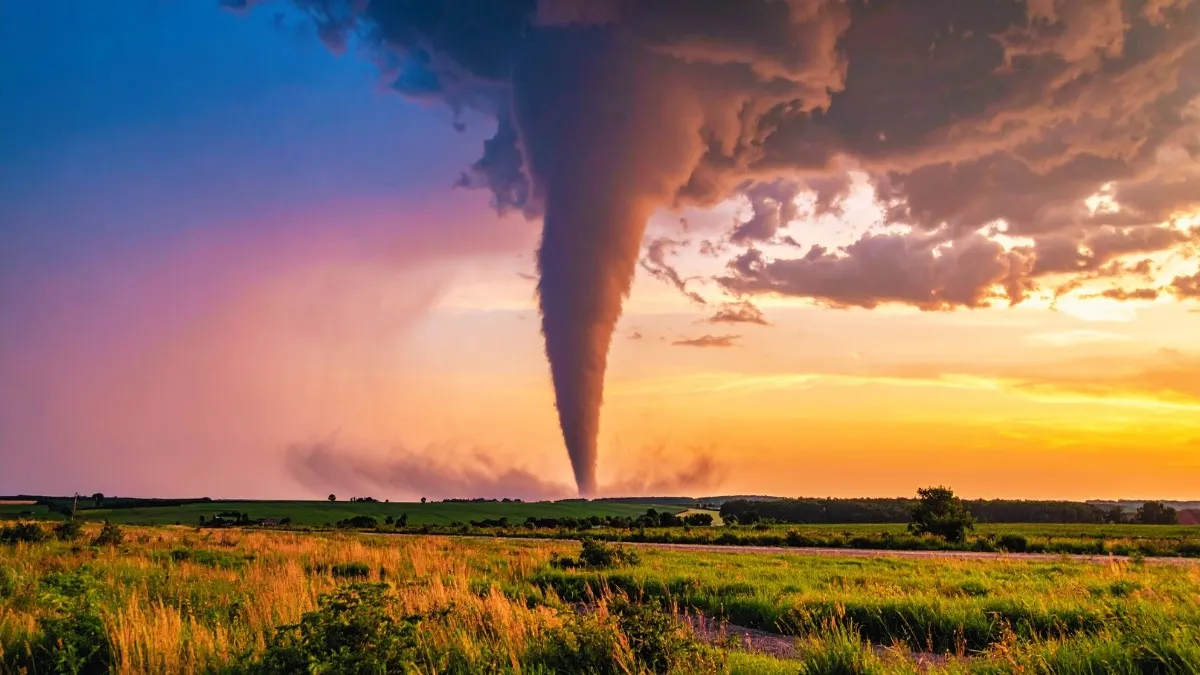
Tornadoes are common across the central United States, especially in "Tornado Alley." In the Tornado Alley, air masses collide from the Rocky Mountains and the Gulf Coast create an environment that is conducive to these violent winds.
The billions of dollars in damage caused each year by tornadoes pose a threat to life and property throughout the Plains.
According to the National Oceanic and Atmospheric Administration (NOAA), approximately 1,200 tornadoes occur annually in the United States, with nearly 1/4 of the strong tornadoes (EF2 or greater) occurring in Tornado Alley between 1950 and 2016.
Find out the states most affected, when tornadoes peak, and how often they strike. In this article, we’ll understand the science, stats, and history behind America's tornado hotspot.
What is Tornado Alley?
Tornado Alley refers to an area where tornadoes occur frequently and that's primarily due to the warm moist air that is coming from the Gulf of Mexico colliding with the cool dry air from north over flat Plains.
The term "Tornado Alley" originated from a 1952 study by the U.S. Air Force on severe storms in the states of Texas, Oklahoma, Kansas and other states in close proximity.
However, there are no established or defined geographical boundaries for the area but it centers on the Great Plains "tornado belt."
Stormchasers come to this area because of its high concentration of tornado activity.
This area has the perfect combination of geographical and meteorological factors that make the perfect conditions for twisters, including twisters that are rated EF5's.
Know here Which U.S. Mountain Range is Called the “Great Smokies”?
Where is Tornado Alley 2025?
In 2025, the core of Tornado Alley stretches from Northern Texas, through Oklahoma and Kansas to Nebraska has undergone no major boundary shifts even with climate changes. However, according to recent research, the majority of tornado activity appears to be shifting to the east and northeast (Missouri and Illinois).
The tornado activity is tracked by National Severe Storms Laboratory (NSSL) by looking at the number of tornadoes, rather than established political and geographical boundaries.
The relatively flat topography facilitates the formation of "supercell" thunderstorms that can draw in moist, warm air from the southern U.S., into the Central U.S.
Read about the U.S. City has the Highest Quality of Life.
Which states are in Tornado Alley?
Tornado Alley primarily includes Texas, Oklahoma, Kansas, Nebraska, and parts of South Dakota, Iowa, and Missouri.
Texas leads in sheer numbers due to size; Oklahoma sees intense ones like the 1999 Moore EF5. Kansas and Nebraska host peak spring outbreaks. Eastern edges like Illinois contribute via clustered events.
| State | Role in Tornado Alley | Example Hotspot |
| Texas | Most tornadoes overall | Dallas-Fort Worth |
| Oklahoma | Violent twisters (EF4+) | Oklahoma City |
| Kansas | Peak frequency | Wichita |
| Nebraska | Northern edge outbreaks | Omaha |
| Missouri | Eastern extension | Springfield |
(Source: NOAA)
When is Tornado Alley Most Active?
The peak of Tornado Alley is April through June, with the busiest time being in May, when significant outbreaks occur.
Spring thaw amplifies instability as warm air from the Gulf of Mexico pushes northward and meets the jet stream during this period. Activity is low in winter but spikes in localized areas in the fall.
-
April: Early season ramp-up.
-
May: Peak month, up to 300+ tornadoes nationwide.
-
June: Northern shift to Dakotas.
NOAA data shows 70% of Alley tornadoes hit March-June. Evening hours (4-9 PM) see most landfalls.
Which State in Tornado Alley has the Most Tornadoes?
Texas tops Tornado Alley with the highest tornado count, averaging 140+ yearly due to vast area and Gulf exposure.
Oklahoma follows closely for intensity per capita. Kansas clocks consistent numbers; Nebraska focuses on fewer but fierce ones.
-
Texas: 155 avg. (1991-2010); record holder.
-
Oklahoma: 68 avg.; strongest winds (316 mph, 1999).
-
Kansas: 87 avg.; central hotspot.
-
Nebraska: 45 avg.; northern peaks.
Texas's size amplifies totals, per NOAA stats.
Do you know Is Niagara Falls in the U.S. or Canada?
Conclusion
The region known as Tornado Alley consists of the central states of the U.S. that frequently experience destructive tornadoes due to the clash of air masses each spring. Tornadoes can be especially prevalent during the peak months of April through June; therefore, residents should pay particular attention to early warning systems, containing supplies for use during a potential tornado, and having access to safe places to seek refuge from tornadoes. Being aware of what Tornado Alley encompasses will help prepare people, both residents and travelers, to protect themselves and others from the destructive nature of tornadoes.




Comments
All Comments (0)
Join the conversation