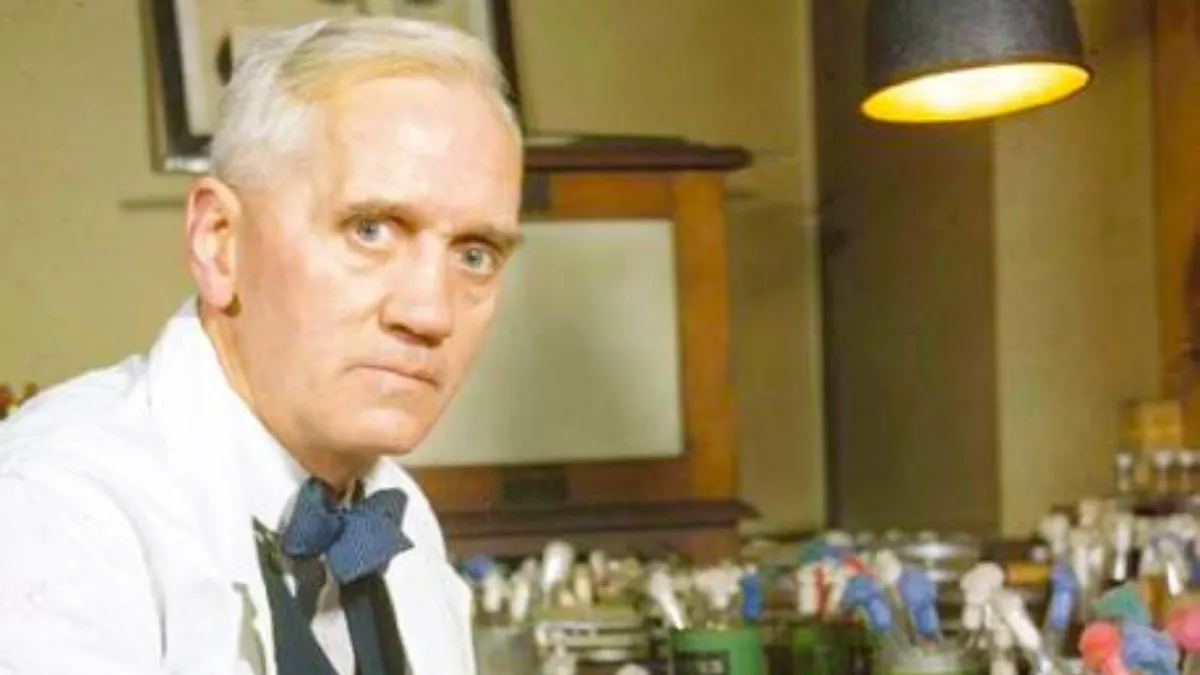
Penicillin was discovered accidentally by the Scottish bacteriologist Alexander Fleming on 3rd September, 1928 at St.Mary’s Hospital in London. Fleming was sorting through the petri dishes containing culture of Staphylococcus bacteria, when he noticed that in one of the dishes a specific portion a mold was growing and there were no colonies of bacteria near that area.
The mold later identified as Penicillium notatum gave the world the first antibiotic Penicillin which changed the course of medicine and healthcare. Initially it was known as the mold juice but later renamed to penicillin in 1929
Why the Discovery was Important?
To understand why this discovery mattered globally, one must look at the harsh realities of the early 20th century. Before 1928, the world was trapped in the pre-antibiotic era. A simple scratch from a rose thorn, a minor dental surgery, or a case of strep throat could easily become a death sentence.
During World War I, Fleming served as a captain in the Royal Army Medical Corps. Working in battlefield hospitals, he watched helplessly as soldiers survived their initial artillery injuries only to die days later from rampant sepsis.
The antiseptics of the time often did more harm than good, destroying the body's white blood cells faster than they killed the infection. Fleming returned to civilian life determined to find a natural chemical that could destroy harmful bacteria without devastating the patient’s immune system.
The magnitude of the discovery of Penicllin can be understood from the fact that there was no cure for bacterial infection prior to the discovery. Fleming, who served as a captain in the Royal Army Medical Corps in the World War I, observed soldiers dying of infected wounds.
Although he discovered the antibiotic, he couldn’t extract the purified form and discontinued his work.
It was not until 1939 that a team of researchers led by Australian pathologist Howard Florey, German biochemist Ernst Chain, and British biologist and biochemist Norman Heatley transformed the lab experiment into a life saving drug by extracting penicillin in their lab in Sir William Dunn School of Pathology at Oxford University.
By 1944, in collaboration with United States, mass scale production of penicillin was started which helped reduce mortality rates during the Second World War.
Interesting Facts About Penicillin
1. Mary Kay Hunt also known as Moldy Mary identified the mold from a cantaloupe in Peoria, Illinois
2. The 1945 Nobel Prize in Medicine was not awarded to Fleming alone; he shared it jointly with Florey and Chain for their vital work in clinical development.
3. Anne Miller was the first person to be successfully treated with Penicillin in 1942.
Who Invented the Television? Check History, Interesting Facts!



Comments
All Comments (0)
Join the conversation