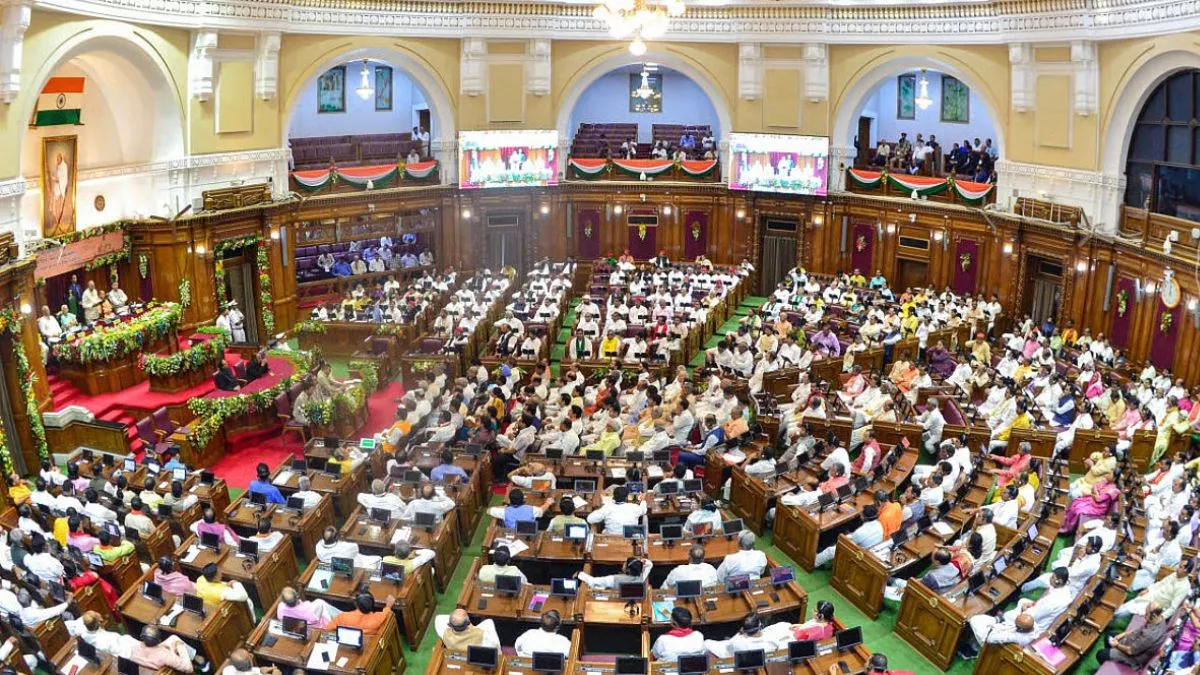
A unicameral legislature in India is a parliamentary system of the state level with only one house. This consists of a Legislative Assembly (Vidhan Sabha). Each state and some Union territories have a Vidhan Sabha (Legislative Assembly). The Vidhan Sabha is the lower chamber.
In our previous article, we learnt that bicameral legislature in India is a parliamentary system which has two houses at the state level. The Legislative Assembly (Vidhan Sabha) and the Legislative Council (Vidhan Parishad). As of 2026 only six states in India have a bicameral legislature which include Andhra Pradesh, Bihar, Karnataka, Maharashtra and Telangana.
In this article, we will learn which Indian states have a unicameral legislature.
Which Indian states have a unicameral legislature?
Every state has a Legislative Assembly. But only 22 out of 28 states and three union territories have a unicameral legislature. This means these states and UTs have only one house i.e. Legislative Assembly or Vidhan Sabha. They do not have a Legislative Council.
List of States with Unicameral Legislature (As of 2026)
1. Arunachal Pradesh
2. Assam
3. Chhattisgarh
4. Goa
5. Gujarat
6. Haryana
7. Himachal Pradesh
8. Jharkhand
9. Kerala
10. Madhya Pradesh
11. Manipur
12. Meghalaya
13. Mizoram
14. Nagaland
15. Odisha
16. Punjab
17. Rajasthan
18. Sikkim
19. Tamil Nadu
20. Tripura
21. Uttarakhand
22. West Bengal
List of Union Territories (UTs) with Unicameral Legislature (As of 2026)
1. Delhi
2. Puducherry
3. Jammu & Kashmir
Difference Between Unicameral and Bicameral Legislature
Below, we have shared the key differences between a Unicameral Legislature and Bicameral Legislature:
| Unicameral Legislature | Bicameral Legislature |
| A unicameral legislature in India is a parliamentary system with only one house at the state level, comprising a Legislative Assembly (Vidhan Sabha). | a bicameral legislature in India is a parliamentary system with two houses at the state level, comprising a Legislative Assembly (Vidhan Sabha) and a Legislative Council (Vidhan Parishad). |
| Bills are passed by one house. The legislative process is easier and quicker. | Bills must be passed by both houses to ensure debate and scrutiny. |
| It has a unitary system of government. | It has a federal system of government. |
| No possibility of deadlocks, leading to faster deicison-making. | Possibilities of deadlock between the two houses. |
| Members are directly elected by universal adult suffrage. | Members are directly elected in the Lower House and indirectly elected or appointed in the Upper House. |
| Most states have unicameral legislature (22 states and 3 UTs have a State Legislative Assmbly but no State Legislative Council). | Only 6 states have a bicameral legislature, meaning they have both a State Legislative Assmbly and a State Legislative Council. |