Which Country Has the Longest Written Constitution in the World? Hint: It is Not the USA
Which country has the longest written constitution? Hint: It’s not the USA. Learn the origin, key milestones, and facts behind India's longest written constitution in the world.
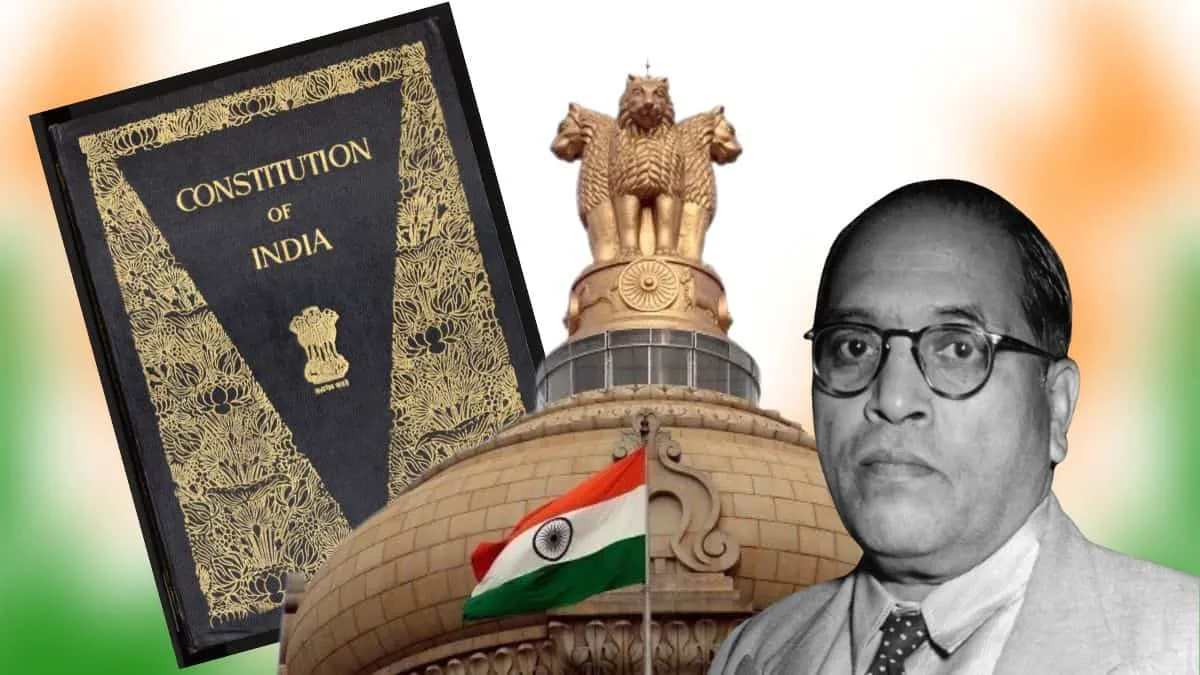
Many people are thinking that the USA is the strongest country in the world and that it must have the longest written constitution in the world.
But it is not correct; the Indian Constitution has the longest written constitution in the world. The Constitution of India has about 1,45,000 words in English, which is comprises of 448 articles, 25 parts and 12 schedules.
On the other hand, the USA has the shortest written constitution in the world, comprising 7 articles only.
Quick Facts: Indian Constitution at a Glance
-
Country: India
-
Adopted On: 26 November 1949
-
Came into Effect: 26 January 1950
-
Handwritten By: Prem Behari Narain Raizada
-
Decorated By: Artists from Shantiniketan led by Nandalal Bose
-
Father of Indian Constitution: Dr. B. R. Ambedkar
-
Time Taken to Draft: 2 years, 11 months, and 17 days
The Indian Constitution is the longest written Constitution in the world. It has a Preamble, 22 parts with 448 articles, 12 schedules, 5 appendices and 115 amendments.#SamvidhanDiwas @PIB_India @MIB_India @airnewsalerts @DDNewslive pic.twitter.com/JgnHb3LtFq
— Ministry of Panchayati Raj, Government of India (@mopr_goi) November 25, 2020
Why is the Indian Constitution the Longest Written Constitution in the World?
The Indian Constitution is the longest written constitution in the world due to the following reasons, given below:
1. Vast Diversity: India is home to a vast diversity of languages, multiple religions, and diverse cultures. So, the Indian Constitution was made keeping in mind these diverse groups so that each and every section of India gets equal rights and status.
2. Single Unified System: As in the US, where each state has its own power to separate, but here in India it is not the case.
India’s constitution was made to manage and govern both the central and the states, keeping the central above the states, and there is no right to secede from the territory of India.
3. Borrowed Feature of Indian Constitution: For making the Indian Constitution, the Constituent Assembly has borrowed many features from other countries, like Fundamental Rights from the USA, DPSP from Ireland, single citizenship from the British, and a quasi-federal form of government from Canada, and included many features.
With all these, for making the Indian Constitution, the federal rules from the Government of India Act 1935 are also taken.
| Did You Know: Who is Known as Father of Indian Constitution? Dr. Bhimrao Ramji Ambedkar is known as the father of the Indian Constitution. H |
Key Historical Milestones (1946–1952)
-
December 6, 1946: The Constituent Assembly was formed to represent India's diverse population.
-
December 9, 1946: The Assembly held its first session in Constitution Hall (now known as Samvidhan Sadan). Dr. Sachchidananda Sinha served as interim President.
-
December 11, 1946: Dr. Rajendra Prasad was elected as the permanent President of the Assembly.
-
August 29, 1947: The Drafting Committee was appointed with Dr. B. R. Ambedkar at the helm.
-
November 4, 1948: Dr. Ambedkar presented the first official draft constitution to the Assembly.
-
November 26, 1949: The final draft was officially adopted by the Constituent Assembly.
-
January 24, 1950: 284 members signed the final document, Jana Gana Mana was declared the National Anthem, and Dr. Rajendra Prasad became India's first President.
-
January 26, 1950: The Constitution came into force, transitioning India into an independent Republic.
-
1951–1952: India held its first general elections under the new constitutional system.
| Did You Know: Who was the first Speaker of the Lok Sabha after India turned into a Republic when Constitution came into force on Januray 26, 1950? The Constitution came into force on Januray 26, 1950, and the G.V. Mavlankar was the first Speaker of the LokSabha after India turned into a Republic. |
India vs USA Constitution: Comparison Table
| Point | India | USA |
|---|---|---|
| Length | World's longest written constitution | One of the shortest among big nations |
| Articles | Original: 395 articles Latest: 448 articles | 7 articles |
| Parts/Schedules | Original: 22 parts and 8 schedules Latest: 25 Parts & 12 schedules | Not divided into parts |
| Word count | About 90,000 words (handwritten version) | About 4,400 words |
| Adopted | 26 November 1949 | 1787 |
| Came into force | 26 January 1950 | 1789 |
| Time taken to draft | 2 years, 11 months, 17 days | About 4 months |
| Style | Very detailed, covers many subjects | Short, gives only broad rules |
| Original form | Handwritten and calligraphed | Handwritten on parchment |
The original document of the Indian Constitution was not printed or typed; it was completely handwritten in elegant calligraphy.
The original copies are preserved in special nitrogen-filled cases inside the Parliament Library in New Delhi. Every year, India celebrates 26 November as Constitution Day (Samvidhan Divas).

Prabhat Mishra is a Subject Matter Expert and digital journalist with an extensive background in the competitive exam landscape and over 4 years of experience in education, national and international news, and current affairs. Over his tenure with top knowledge platforms like Mentorship India, IAS BABA, IAS SARTHI, and now Jagran Josh, he has a deep understanding of government exams like UPSC and State PCS, including UP and Bihar, as he has already qualified for the UPPCS 2022 Mains and Bihar 68th Mains. With his core expertise in history, polity, geography & current affairs, he specialises in creating well-researched, aspirant-centric content and simplifying complex topics for competitive examinations.


-1786964195524_t.webp)
![[OUT] UGC NET Answer Key 2026: Download June Session Response Sheet PDF at ugcnet.nta.nic.in - Direct Link Here](https://img.jagranjosh.com/images/2026/August/1682026/NTA-UGC-NET-June-Answer-Key-2026.jpg)

![[लिंक एक्टिव] Rajasthan Computer Instructor Exam City 2026 LIVE: कंप्यूटर अनुदेशक सिटी स्लिप recruitment.rajasthan.gov.in पर जारी, तुरंत SSO ID से करें चेक](https://img.jagranjosh.com/images/2026/August/1482026/Rajasthan-Computer-Instructor-Exam-City-2026.jpg)