
India’s history goes back thousands of years, and during that time, many cities and regions have had different names. These earlier names often reveal the culture and rulers of those periods. For instance, Patna, formerly known as Pataliputra, was an important centre of power. These changes highlight how India has developed through the ages. Do you know what the land of the five rivers was once called? In this article, we will look at the rich history and original identity of this lively state.
What is the Old Name of Punjab?
The land of Punjab has a history that stretches back to the very beginning of civilisation. Here is a breakdown of its historical names and how its current identity was formed:
- Ancient Vedic Name: During the Vedic period (c. 1500–500 BCE), the region was known as Sapta Sindhu, meaning the "Land of Seven Rivers". This included the five rivers we know today, as well as the Indus and the Saraswati.
- The Greek Influence: When Alexander the Great invaded in 326 BCE, the Greeks referred to the region as Pentapotamia, meaning "five rivers" in Greek.
- The Origin of "Punjab": The name "Punjab" is of Persian origin, combining panj (five) and ab (water). It gained official prominence during the Mughal Empire in the 16th century, particularly under Emperor Akbar.
- The Modern Transition: After the Anglo-Sikh Wars, the British annexed the region in 1849 and maintained the name "Punjab Province".
- Following the partition of India in 1947, the region was divided, with the eastern part becoming the Indian state of Punjab.
7+ Lesser-known Facts About Ancient Punjab
- People in the Indus Valley were very smart. They practised "crop rotation" as early as 2500 BCE to keep the soil healthy and grow better food.
- Ancient Taxila was located in Punjab. Over 2,000 years ago, students from all over the world came there to study science, math, and medicine.
- Ancient builders used a special "interlocking" brick pattern. This clever design helped their buildings stay standing during earthquakes.
- The soil in Punjab is rich in minerals from the Himalayan mountains. This makes it some of the most fertile land on Earth for farming.
- A famous doctor named Sushruta lived in this region. He created surgical tools and techniques for plastic surgery that doctors still study today.
- Ancient cities like Ropar had amazing drainage systems. They used gravity to make water flow away, keeping the streets clean and dry.
- Science shows that people in Punjab have a very diverse DNA. This is because Punjab was the main gateway for travellers entering India for centuries.
- Many ancient buildings were perfectly aligned with the sun. This proves that the people of Punjab were experts at studying the stars and the seasons.
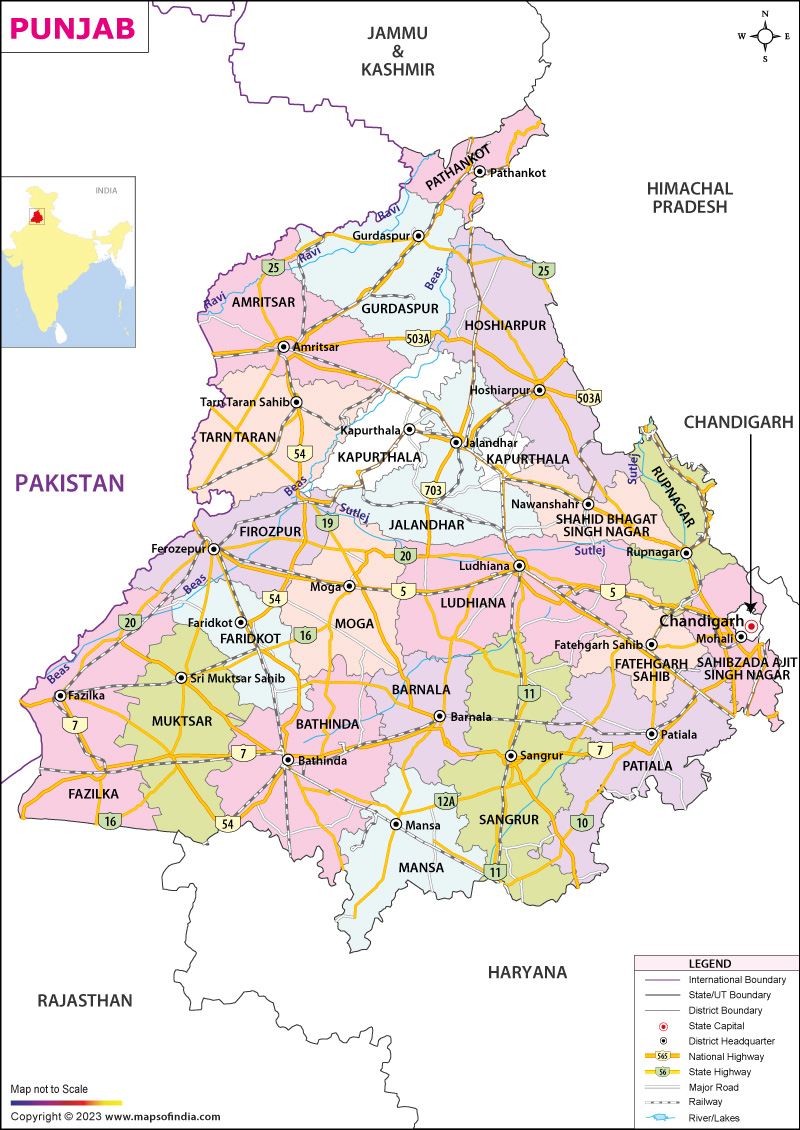
How Punjab Got Its Name? History & RoadMap
Source: India Map
The name "Punjab" is a combination of two Persian words: "Panj" (five) and "Ab" (water). This refers to the five major rivers that flow through the region: the Jhelum, Chenab, Ravi, Beas, and Sutlej.
Historical Roadmap of Punjab’s Name
The region has been known by various names over the years, depending on the era and the rulers in power.
| Era | Name of Region | Meaning / Significance |
| Vedic Period | Sapta Sindhu | The "Land of Seven Rivers" (including the Indus and Saraswati). |
| Greek Era | Pentapotamia | A Greek word meaning "The Land of Five Provinces/Rivers". |
| Mughal Era | Punjab | The Persian name became official during the reign of Emperor Akbar. |
| British Era | Punjab Province | The British kept the name after annexing the region in 1849. |
| Post-1947 | Punjab State | The region was split between India and Pakistan during the partition. |
History At a Glance
- Thousands of years ago, this region was the centre of the Indus Valley civilisation.
- Ancient Indian texts, like the Rig Veda, called it Sapta Sindhu, meaning "seven rivers", because seven rivers flowed through the area at the time.
- The word "Punjab" does not come from an Indian language. It has Persian roots. As many rulers and traders from the West spoke Persian, the name became widely used over time.
- Although the term was used earlier, it became the province's official name during the Mughal Empire in the 1500s. Emperor Akbar included this name in his records.
- The name 'Punjab' refers to the five rivers that supply water for farming, which made the land rich and fertile.
- Even after the British left in 1947, both India and Pakistan kept the name "Punjab" for their parts of the region because it is closely linked to the region's geography and culture.
In a Nutshell
- Language of Origin: Persian.
- Components: Panj (5) + Ab (Water).
- The Five Rivers: Jhelum, Chenab, Ravi, Beas, and Sutlej.
- Current Status: A state in North India and a province in Eastern Pakistan.



Comments
All Comments (0)
Join the conversation