Show Key Points
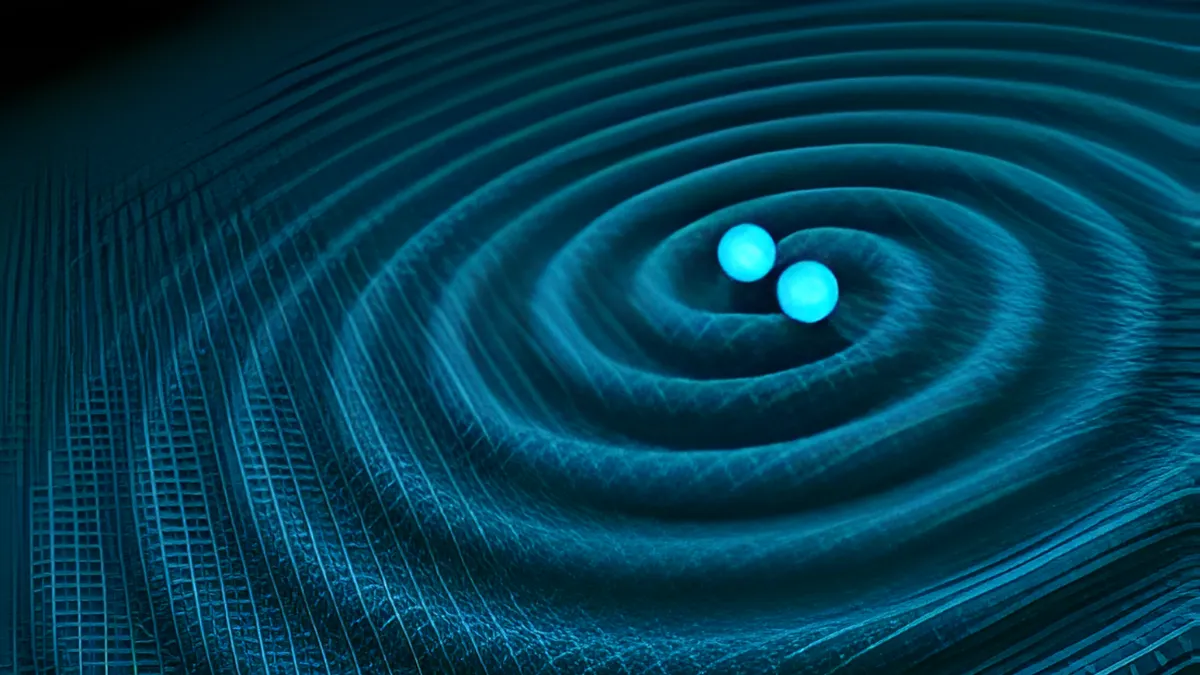
Think of spacetime as a rubber sheet, which is stretched when there are large objects such as stars and black holes. Gravitational waves are the waves on this cloth, which are produced when the masses move at an appalling pace, like when the black holes collide.
These waves were predicted by Albert Einstein in 1916 to travel at a speed of light throughout the universe with unseen truths of extreme physics. LIGO made the first direct observation in 2015, which revolutionized science and won the 2017 Nobel Prize and proved Einstein right after 100 years.
What is the History of Gravitational Waves?
In his 1916 paper on general relativity, Einstein theorized the existence of gravitational waves which he referred to as distortions of spacetime due to accelerating masses.
In 1974, indirect evidence was obtained through the Hulse-Taylor binary pulsar the orbit of which was found to decay exactly in accordance with the expectation, emitting energy as waves, and was recognized along with Russell Hulse and Joseph Taylor as the 1993 Nobel Prize.
Hundreds of years of development resulted in the launch of Advanced LIGO in 2015. On September 14, the same year, the ripples of two black holes (36 and 29 solar masses) colliding 1.3 billion light-years distant were detected by detectors and emitted enough energy to produce gravitational waves equivalent to three solar masses.
This led to more than 90 detections as at 2023 to Virgo and KAGRA collaborations.
How Do Gravitational Waves Form?
Gravitational waves are due to the asymmetric acceleration of massive objects, which results in a varying quadrupole moment in spacetime, as opposed to linear motion, which does not. Binary systems of compact objects, either black holes or neutron stars rotating around one another, spiraling toward the center, emitting energy are classified as primary sources.
It takes place in stages, inspirational (slow tightening of orbit), merger (collision), and ringdown (settling vibration).
Other bursts are due to non-spherically symmetrized explosions of supernovae or those neutron stars that are asymmetrical due to spins. Waves become weaker with distance, but lengthen/ shorten space across their direction, with strain.
What are the Detection Methods for these Waves?
Laser interferometry is used to measure minute strains of space time in detectors. Two locations in the U.S. by LIGO send 1-micrometer lasers down 4-km long vacuum arms perpendicular to the mirrors, bouncing the lasers off them; a wave passing changes the arm lengths by a width less than that of a proton, changing the interference patterns.
Other recent breakthroughs involve enormous mergers (such as the 150-solar-mass merger in 2020) that have been a challenge to the formation models and popcorn-like black hole rates implying a hierarchical merger. Continuous waves of pulsars have not been detected so far, but they are being searched.
Waves are measured by the path differences of the laser in the interferometer arms of LIGO.
What to Expect Next?
Enhanced instruments such as LIGO A+ and Voyager (2030s) will scale by 10x volumes; baselines may be further enhanced in LIGO-India (2025+). LISA is focused on the supermassive mergers, extreme mass-ratio inspirals and primordial waves. Cosmic Explorer and Einstein Telescope (2035s) look further.
Multi-messenger astronomy is the golden age of gravitational waves, which will break the secret of the violence of the universe. Since the vision by Einstein to the 200+ discoveries, they hold promises to uncover the black holes, relativity, and beginnings.



Comments
All Comments (0)
Join the conversation