Show Key Points
People have been dancing for as long as we can remember. Some evidence shows that dance began as a way to communicate and connect before language became complex.
Early humans probably used rhythmic movements to copy things in nature, celebrate a good hunt, or feel closer to spiritual forces.
Today, new dance styles like Electro Dance and TikTok shuffling keep appearing, showing that dance is always changing.
But out of all these styles, one is known as the very first. Do you know which dance is the oldest in the world? In this article, we’ll explore the history and culture behind this timeless art.
ALSO READ| List of Indian Classical Dances and Their States of Origin
Which is the Oldest Dance Form in the World?
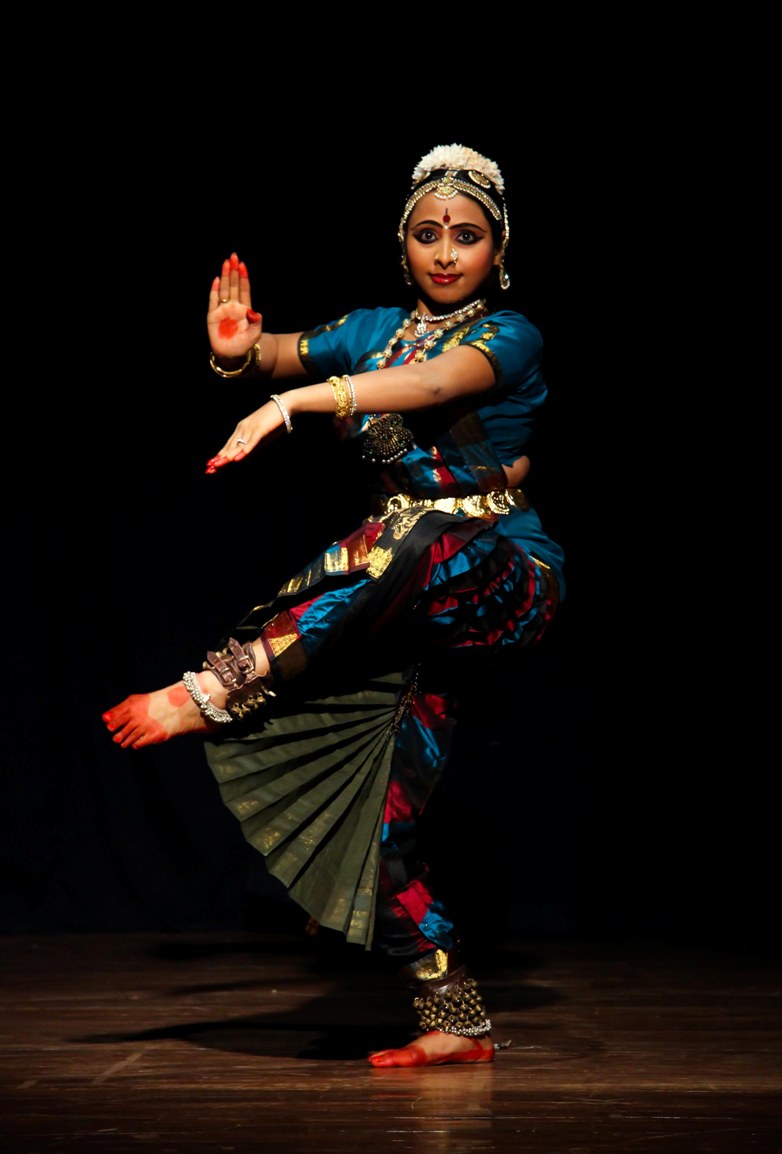
Bharatanatyam, a classical dance originating from Tamil Nadu, India, is widely recognised as the world's oldest dance form.
The foundations of Bharatanatyam are documented in the Natya Shastra, an ancient treatise on medicine and performing arts composed between 200 BCE and 200 CE.
Originally referred to as Sadir Attam, Bharatanatyam was traditionally performed by temple dancers known as Devadasis.
Archaeological evidence, such as stone carvings in the Chidambaram temple from the 10th century, illustrates 108 distinct poses (karanas) associated with Bharatanatyam. Currently, Bharatanatyam is practised by millions worldwide.
7+ Lesser-Known Facts About Bharatanatyam
- The dance utilises "Araimandi" (a half-squat), which science shows lowers the body's centre of gravity, significantly increasing balance and core muscle activation.
- The rhythm (Tala) is based on complex Carnatic music cycles; dancers often perform intricate subdivisions of beats, such as 5, 7, or 9 counts per cycle.
- There are 108 fundamental transitions carved into the Gopurams (gateways) of ancient Indian temples, serving as a visual "manual" for the dance.
- Using different "Mudras" (hand gestures) in each hand simultaneously stimulates both the left and right hemispheres of the brain, enhancing cognitive coordination.
- The dance is built on the concept of the "Mandala," in which movements create perfect triangles and circles that mirror sacred geometry found in nature.
- The dance almost went extinct due to colonial bans, but was formally renamed and revived in 1932 by activists like E. Krishna Iyer and Rukmini Devi Arundale.
- A professional Bharatanatyam dancer's foot strikes the floor with a force of up to 3 times their body weight, which requires specific training to prevent joint stress.
- There are 28 single-hand and 24 double-hand gestures, creating a vocabulary of 52 root signs that can express over 500 distinct meanings.
MUST READ| Which Language Is Known As The 'Italian Of The East'?
What is the History of Bharatnatyam?
Source: Medium
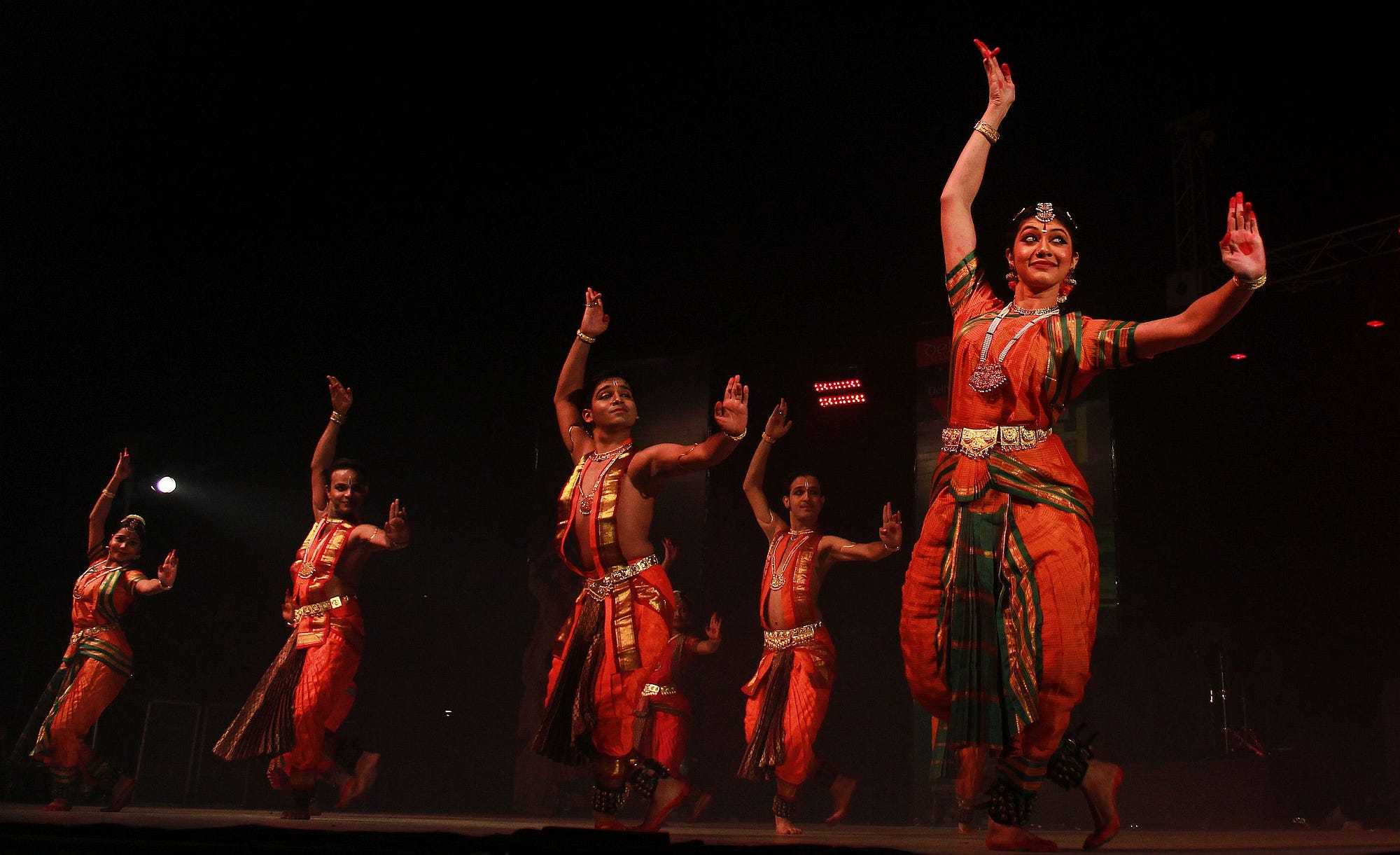
Bharatanatyam has a rich history that begins with sacred temple rituals and now reaches audiences around the world. Its story is one of devotion, survival, and a strong cultural revival.
1. Ancient Origins (200 BCE – 500 CE)
- The roots of the dance are found in the Natya Shastra, the world's oldest surviving text on performing arts.
- It was originally called Sadir Attam (or Dasi Attam).
- For centuries, it was performed by Devadasis, highly educated women dedicated to temple deities.
- These dancers were not just performers; they were scholars of music, Sanskrit, and mathematics.
2. The Golden Age (10th – 18th Century)
- During the Chola and Vijayanagara empires, dance flourished.
- The Brihadisvara Temple in Thanjavur (built around 1010 CE) housed over 400 dancers.
- In the early 19th century, four brothers (Ponnaiyah, Vadivelu, Sivanandam, and Chinnaiyah) codified the modern repertoire we see today, known as the Margam (the path).
3. The Dark Period and Colonial Ban (1800s – 1920s)
- During British rule, the social status of Devadasis declined due to poverty and a lack of royal patronage.
- In 1910, the British government officially banned temple dancing, labelling it "immoral".
- This nearly erased the art form from history.
4. The 20th Century Renaissance (1930s–1950s)
A few visionaries fought to save the dance by moving it from temples to the public stage:
- E. Krishna Iyer: A lawyer who performed in female attire to prove the dance's artistic merit.
- Rukmini Devi Arundale: In 1936, she founded Kalakshetra, an academy that refined the dance and introduced modern costumes.
- Name Change: To remove the social stigma associated with Sadir, the art form was renamed Bharatanatyam (Bha = Bhava/Emotion, Ra = Raga/Melody, Ta = Tala/Rhythm).
What Specific Costumes and Jewellery are used in Bharatanatyam?
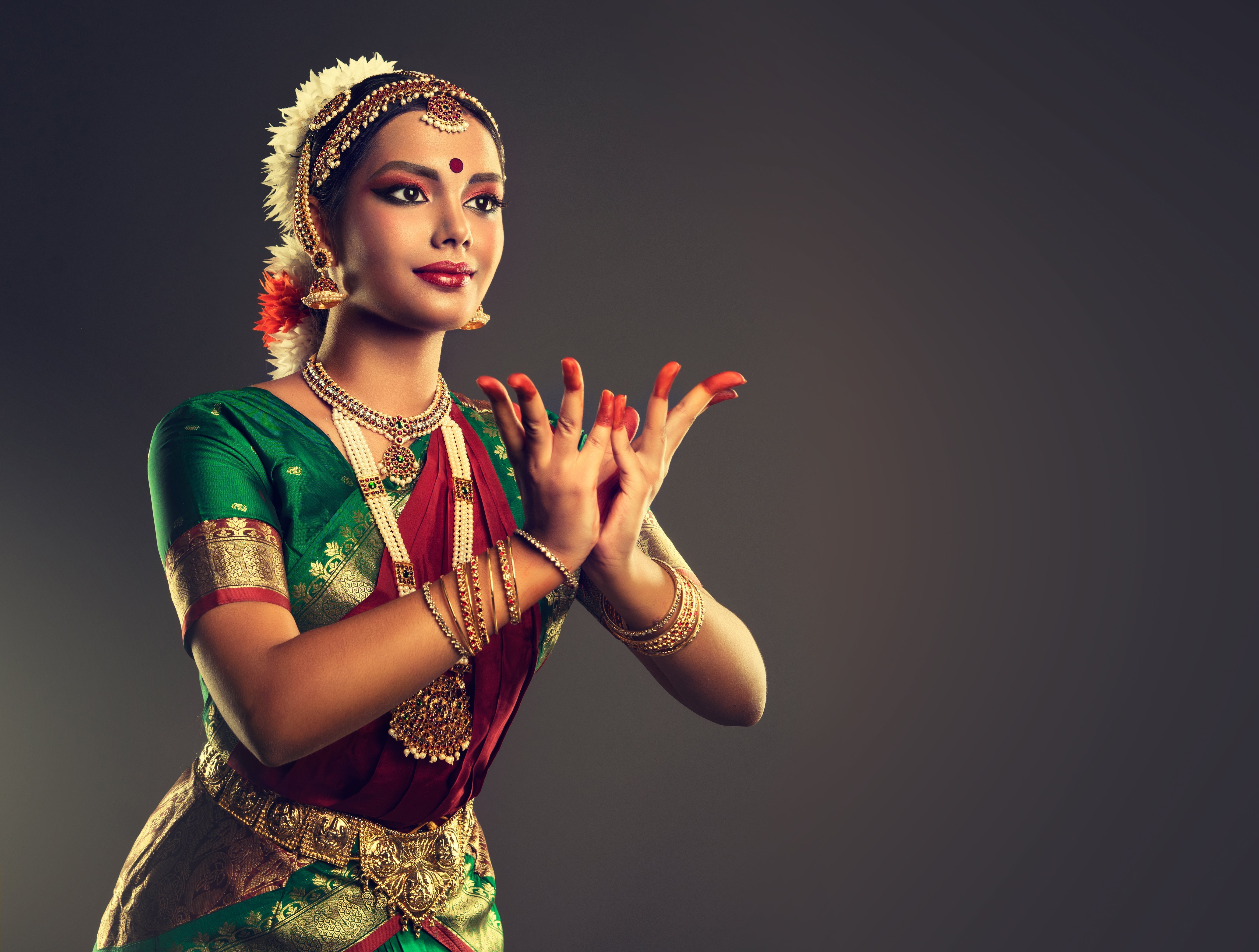
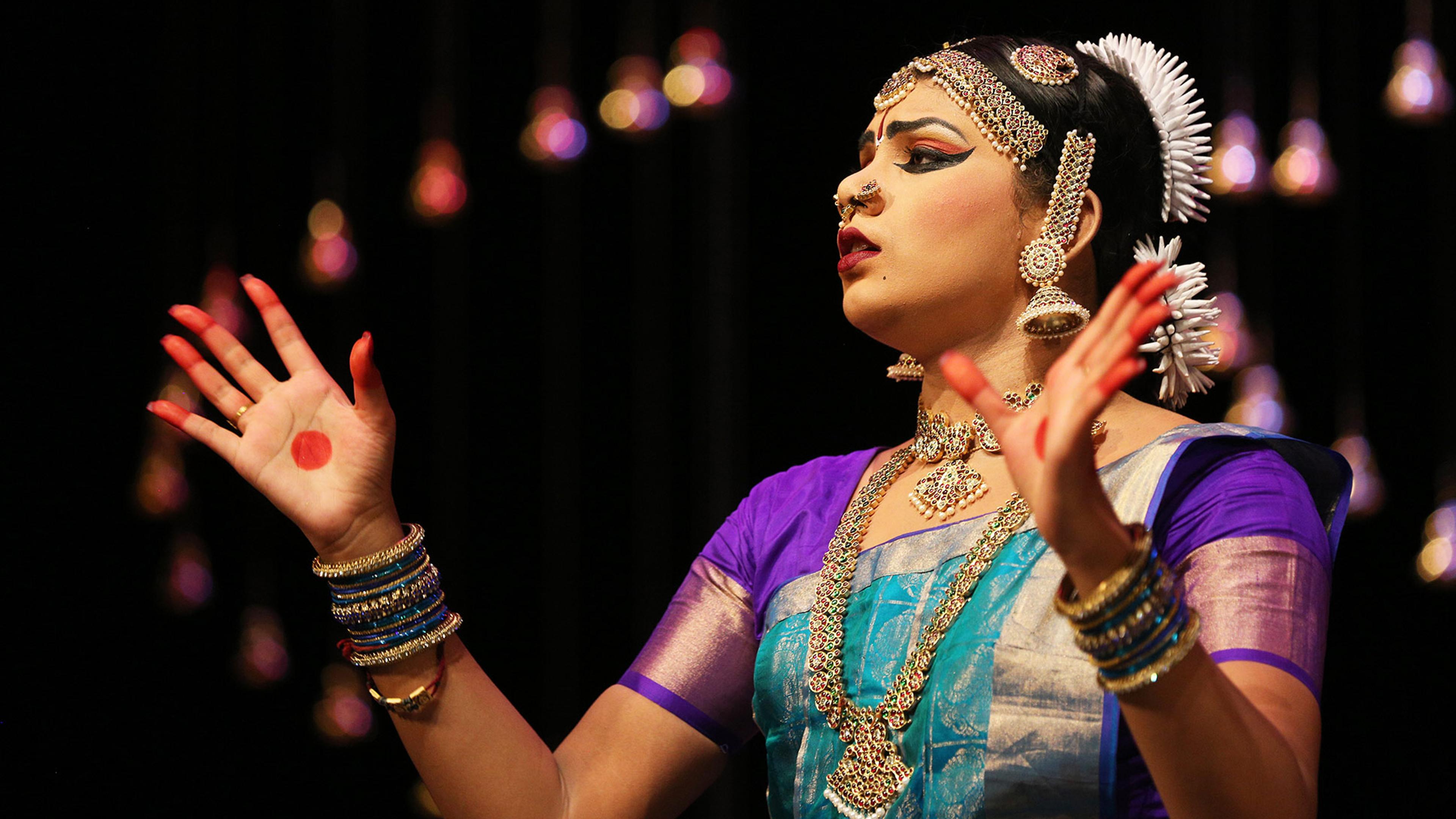
Bharatanatyam costumes are made not only to look beautiful but also to highlight the dancer’s movements and handle the physical demands of the dance.
i. The Costume
- Most modern Bharatanatyam costumes are made from Kanchipuram silk.
- The most recognisable part is the pleated fan at the front, also known as the Dhoti style.
- When the dancer does the Araimandi, or half-squat, the fan opens up in a striking way.
- It forms a perfect triangle, which is the basic geometric shape in Bharatanatyam.
- Pure silk is chosen because it lets the skin breathe and keeps its shape even when the dancer sweats a lot.
- The gold border, called Zari, adds weight so the fabric drapes well during quick spins.
ii. Temple Jewellery: The Science of "Temple Gold"
- This type of jewellery is called Kempu jewellery. It is usually made from silver coated with 24-carat gold and set with unpolished rubies and emeralds.
- For the headset, called Thalai Saman, dancers wear the Surya (Sun) on the right side and the Chandra (Moon) on the left side of their hair parting.
- This shows the balance of solar and lunar energies in the body.
- The belt, called Ottiyanam, is a heavy gold waist belt.
- It is worn not only for decoration but also to support the lower back and hold the silk costume in place during jumps.
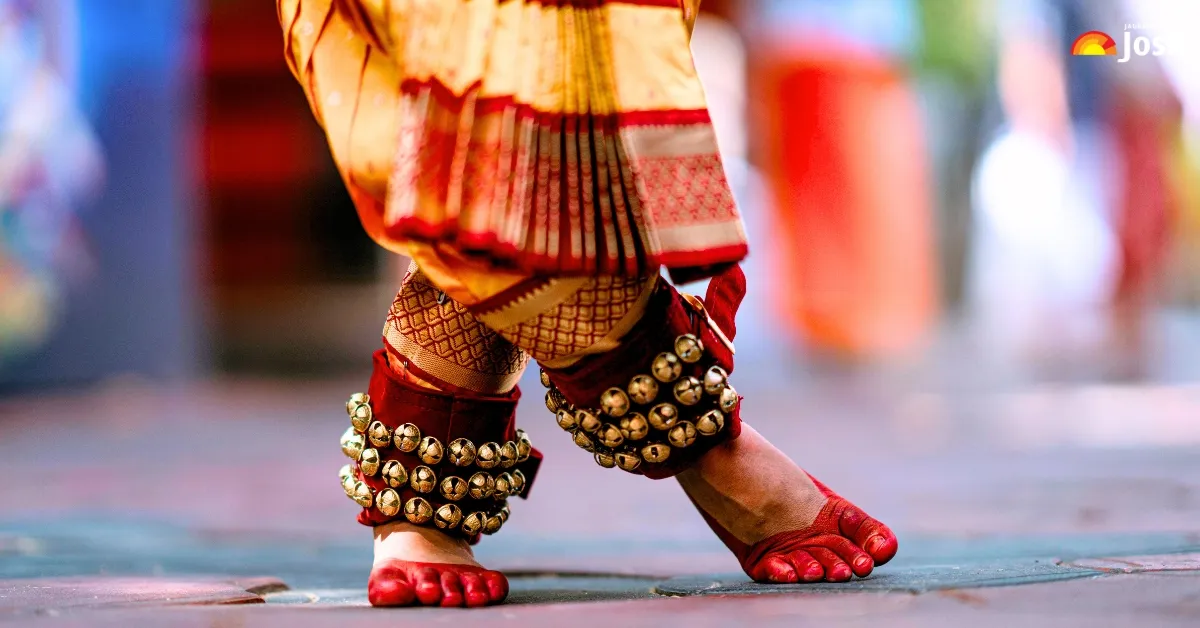
- Ghungroo, or bells, are worn by dancers with 50 to 200 copper bells on each ankle.
- These bells give sound feedback, which helps the dancer stay in sync with the complex Carnatic rhythms.
iii. Why the Makeup is Bold

Source: Pinterest
Bharatanatyam makeup is quite bold, especially around the eyes.
- Thick kohl, called Alta, is applied so that the audience, even those sitting far away, can see the dancer’s eye movements (Drishti Bheda) that help tell the story.
- The tips of the fingers and the edges of the feet are painted red with Alta. This makes the Mudras, or hand gestures, and the detailed footwork stand out clearly against the floor.
Conclusion: Comparing Ancient Indian Classical Dances
Source: Psyche
Bharatanatyam is the best-documented dance form thanks to the Natya Shastra, but many other styles also began during this time, each with its own unique regional and technical features.
| Feature | Bharatanatyam | Kathak | Odissi |
| Region of Origin | Tamil Nadu (South India) | Northern India | Odisha (East India) |
| Primary Posture | Araimandi (Half-squat, diamond shape) | Straight legs (Vertical alignment) | Tribhanga (Three-bend posture) |
| Movement Style | Linear, crisp, and geometric | Fluid, fast spins (Chakkars) | Sinuous, soft, and lyrical |
| Focus Area | Precision of footwork and mudras | Intricate rhythmic footwork | Torso movement and grace |
| Historical Root | Temple worship (Devadasis) | Travelling storytellers (Kathakas) | Temple rituals (Maharis) |
The movements in these dances are carefully designed. For example, the Tribhanga pose in Odissi is more than just beautiful; it shifts the body's weight across three axes: the head, chest, and hips. This creates a dynamic balance that is unique to Eastern Indian sculpture and dance.
Kathak, on the other hand, emphasises upright posture. Dancers often wear more than 100 bells, called Ghungroo, on each ankle. Their technique uses flat-footed steps to make clear percussive sounds while protecting their bones and joints.
WHAT'S NEXT| List of Top 7 Oldest Written Languages Still in Use



Comments
All Comments (0)
Join the conversation