List of Major iPhone Generations Launched Under Tim Cook From iPhone 4s to iPhone 17
List of major iPhone generations launched under Tim Cook from iPhone 4S to iPhone 17, with launch dates, key features and Cook’s Apple legacy.
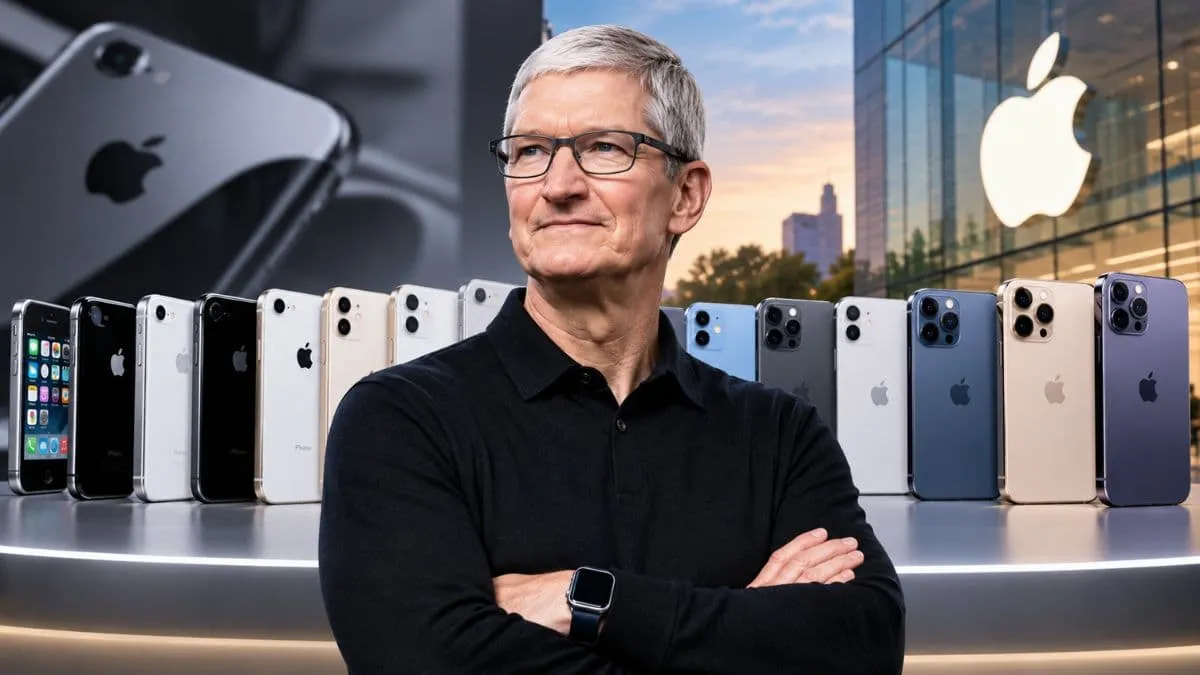
Tim Cook led Apple as CEO from 2011 to 2026, and during this period the iPhone went through some of its biggest changes. From the larger-screen iPhone 6 and Touch ID to Face ID, 5G, Dynamic Island, USB-C, Apple Intelligence and the iPhone 17, the iPhone changed a lot during his leadership.
This article gives a simple year-by-year list of the major iPhone generations launched during Tim Cook's time as Apple CEO, along with their launch dates and important features.
Who Is Tim Cook?
Tim Cook is an American business executive who joined Apple in 1998. Before becoming CEO, he worked as Apple's Chief Operating Officer (COO). His work included Apple's worldwide sales, operations, supply chain, service and support.
On August 24, 2011, Apple announced that Steve Jobs had resigned as CEO and Tim Cook would become the new CEO. Steve Jobs became Chairman of the Board.
Cook served as Apple's CEO from 2011 until September 1, 2026. He is now Apple's Executive Chairman.
Who Was Apple CEO Before Tim Cook?
Before Tim Cook, Steve Jobs was Apple's CEO. Steve Jobs was one of Apple's founders and played a major role in bringing products such as the iMac, iPod, iPhone and iPad to the market.
Jobs resigned as CEO on August 24, 2011, and Apple's Board named Tim Cook as his successor.
Who Is the Current CEO of Apple?
As of September 2026, John Ternus is the CEO of Apple. Apple announced the leadership change in April 2026. Tim Cook became Executive Chairman, while John Ternus became CEO effective September 1, 2026, and on september 9, 2026, under his leadership as CEO of Apple, iPhone 18 Pro & iPhone 18 Pro Max, and iPhone Duo has been launched.
John Ternus joined Apple in 2001 and later became Senior Vice President of Hardware Engineering. He has worked on many generations of iPhone, Mac, iPad and Apple Watch products.
Major iPhone Generations Under Tim Cook
| iPhone generation | Launch/availability date | Major feature or change |
| iPhone 4s | October 4, 2011 | Dual-Core A5 Chip, All New Camera, Full 1080p HD Video Recording & Introduces Siri |
| iPhone 5 | September 21, 2012 | 4-inch Retina display, LTE, Lightning connector |
| iPhone 5s | September 20, 2013 | Touch ID and first 64-bit A7 chip |
| iPhone 6 / 6 Plus | September 19, 2014 | Larger 4.7/5.5-inch displays and Apple Pay |
| iPhone 6s / 6s Plus | September 25, 2015 | 3D Touch and Live Photos |
| iPhone 7 / 7 Plus | September 16, 2016 | Water and dust resistance, dual camera on Plus |
| iPhone 8 / 8 Plus | September 22, 2017 | Glass back and wireless charging |
| iPhone X | November 3, 2017 | Face ID, OLED Super Retina display, edge-to-edge design |
| iPhone XS / XS Max | September 21, 2018 | A12 Bionic, larger 6.5-inch Max model, Dual SIM |
| iPhone XR | October 26, 2018 | Colourful design and Liquid Retina display |
| iPhone 11 series | September 20, 2019 | Ultra Wide camera and Night mode |
| iPhone 12 series | October 23, 2020 | 5G, MagSafe and Ceramic Shield |
| iPhone 13 series | September 24, 2021 | Cinematic mode and improved battery life |
| iPhone 14 series | September 16, 2022 | Crash Detection and Emergency SOS via satellite |
| iPhone 15 series | September 22, 2023 | USB-C on iPhone, Dynamic Island on standard models |
| iPhone 16 series | September 20, 2024 | Camera Control, Action button and Apple Intelligence support |
| September 19, 2025 | Center Stage front camera and ProMotion on iPhone 17 |
1. iPhone 4S — 2011
Announced: October 4, 2011
Available: October 14, 2011
The iPhone 4S was the first major iPhone launched after Tim Cook became Apple's CEO.
It kept the basic external design of the iPhone 4 but received important internal upgrades.
The biggest new feature was Siri, Apple's voice assistant. Users could ask questions, send messages, make calls, set reminders and perform other tasks using their voice.
Apple also introduced the dual-core A5 chip, an improved 8MP camera and 1080p HD video recording.
Main features
-
Siri
-
Dual-core A5 chip
-
8MP camera
-
1080p HD video recording
-
Improved camera optics
-
Improved antenna design
-
Up to 64GB storage
Apple said the iPhone 4S sold more than four million units in its first three days.
2. iPhone 5 — 2012
Availability: September 21, 2012
The iPhone 5 was the major numbered iPhone generation introduced during Tim Cook's CEO period.
It came with a 4-inch Retina display, an A6 chip and a thinner aluminium body. Apple also introduced LTE support, giving users much faster mobile internet on supported networks.
Another important change was the new Lightning connector, which replaced the older 30-pin connector.
Important new features:
-
4-inch Retina display
-
LTE connectivity
-
A6 chip
-
Thinner and lighter aluminium body
-
New Lightning connector
-
Panorama camera mode
The iPhone 5 went on sale on September 21, 2012.
3. iPhone 5s — 2013
Availability: September 20, 2013
The iPhone 5s brought one of Apple's most important security features to the iPhone — Touch ID.
Touch ID allowed users to unlock the phone with their fingerprint. It was also Apple's first smartphone with a 64-bit processor, the A7 chip.
Important new features:
-
Touch ID fingerprint sensor
-
A7 64-bit chip
-
True Tone flash
-
Improved camera
-
Slow-motion video recording
Apple also launched the colourful iPhone 5c alongside the 5s.
4. iPhone 6 and iPhone 6 Plus — 2014
Availability: September 19, 2014
The iPhone 6 generation brought a major change in screen size.
The iPhone 6 had a 4.7-inch display, while the iPhone 6 Plus introduced a much larger 5.5-inch display.
This generation also introduced Apple Pay, allowing users to make contactless payments using the iPhone.
Important new features:
-
4.7-inch iPhone 6
-
5.5-inch iPhone 6 Plus
-
Apple Pay
-
A8 chip
-
Focus Pixels
-
Optical image stabilisation on iPhone 6 Plus
For many users, the bigger-screen design was one of the biggest changes in the iPhone's history.
5. iPhone 6s and iPhone 6s Plus — 2015
Availability: September 25, 2015
The iPhone 6s introduced 3D Touch.
It could detect how strongly a user pressed the display and provide different actions based on the pressure. Apple also introduced Live Photos, which captured a short moving moment around a photo.
Important new features:
-
3D Touch
-
Live Photos
-
A9 chip
-
12MP rear camera
-
5MP front camera
-
Rose Gold colour
3D Touch was later removed from newer iPhone models, but it was an important part of the 6s generation.
6. iPhone 7 and iPhone 7 Plus — 2016
Availability: September 16, 2016
The iPhone 7 brought several noticeable changes.
It was the first iPhone with water and dust resistance. The iPhone 7 Plus also introduced a dual-camera system with a telephoto camera.
Apple also introduced stereo speakers and removed the traditional 3.5mm headphone jack.
Important new features:
-
Water and dust resistance
-
Dual cameras on iPhone 7 Plus
-
Optical zoom on the Plus model
-
Stereo speakers
-
A10 Fusion chip
-
New solid-state Home button
The iPhone 7 was also officially launched in India in October 2016.
7. iPhone 8 and iPhone 8 Plus — 2017
Availability: September 22, 2017
The iPhone 8 series moved from the aluminium back used by earlier models to a glass back.
This made wireless charging possible. Apple supported the widely used Qi wireless charging standard.
Important new features:
-
Glass back
-
Wireless charging
-
A11 Bionic chip
-
True Tone display
-
Portrait Lighting
-
Improved cameras
-
Better support for augmented reality
The iPhone 8 was launched alongside the much more radically redesigned iPhone X.
8. iPhone X — 2017
Availability: November 3, 2017
The iPhone X was one of the biggest changes in iPhone history.
Apple removed the traditional Home button and introduced an almost all-screen design. It also brought the Super Retina OLED display and Face ID.
Important new features:
-
Face ID
-
TrueDepth camera
-
5.8-inch OLED display
-
No physical Home button
-
Animoji
-
Wireless charging
Face ID replaced Touch ID for biometric unlocking on the iPhone X.
9. iPhone XS and XS Max — 2018
Availability: September 21, 2018
The iPhone XS continued the design introduced by the iPhone X.
The biggest technical upgrade was the A12 Bionic chip, Apple's first 7-nanometre smartphone chip at the time. Apple also introduced Dual SIM support on these models.
The XS Max brought a much larger 6.5-inch display.
Important new features:
-
A12 Bionic chip
-
6.5-inch XS Max
-
Dual SIM
-
Improved Face ID
-
Improved dual-camera system
-
Better water resistance
10. iPhone XR — 2018
Availability: October 26, 2018
The iPhone XR offered the iPhone X-style design at a lower starting price than the XS models.
It used a Liquid Retina LCD display instead of OLED and came in several bright colours.
The XR became one of the most popular iPhone models of its generation.
11. iPhone 11 Series — 2019
Availability: September 20, 2019
The iPhone 11 generation placed a strong focus on photography.
The standard iPhone 11 received a new Ultra Wide camera, giving users a much wider view. Apple also introduced Night mode, which helped capture brighter photos in low-light conditions.
Important new features:
-
Ultra Wide camera
-
Night mode
-
A13 Bionic chip
-
Improved water resistance
-
12MP front camera
-
4K video from the front camera
The iPhone 11 Pro and 11 Pro Max added a third telephoto camera.
12. iPhone 12 Series — 2020
Availability: October 23, 2020
The iPhone 12 generation introduced 5G connectivity to the iPhone.
Apple also brought back a flat-edge design and introduced MagSafe, a magnetic system for wireless charging and accessories.
Important new features:
-
5G
-
MagSafe
-
A14 Bionic chip
-
Super Retina XDR displays
-
Ceramic Shield front cover
-
Flat-edge design
-
iPhone 12 mini
This was also an important generation because MagSafe created a new accessory system around the iPhone.
13. iPhone 13 Series — 2021
Availability: September 24, 2021
The iPhone 13 series focused strongly on cameras and battery life.
One of the most noticeable new camera features was Cinematic mode, which automatically changes focus between people and subjects while recording video.
Important new features:
-
Cinematic mode
-
Photographic Styles
-
A15 Bionic chip
-
Improved battery life
-
Sensor-shift optical image stabilisation
-
128GB starting storage on iPhone 13
-
ProMotion on iPhone 13 Pro models
14. iPhone 14 Series — 2022
Availability: September 16, 2022
The iPhone 14 generation introduced important safety features.
Apple introduced Crash Detection, which can detect a serious car crash. It also introduced Emergency SOS via satellite in supported regions.
On the Pro models, Apple introduced Dynamic Island, replacing the traditional notch with a new interactive area.
The iPhone 14 Pro models also introduced a 48MP Main camera and Always-On display.
Important new features:
-
Crash Detection
-
Emergency SOS via satellite
-
Dynamic Island on Pro models
-
48MP Main camera on Pro models
-
Always-On display on Pro models
-
Photonic Engine
15. iPhone 15 Series — 2023
Availability: September 22, 2023
The iPhone 15 generation brought one of the most visible hardware changes in recent years: USB-C.
Apple moved away from the Lightning connector and introduced USB-C across the iPhone 15 lineup.
The standard iPhone 15 models also received Dynamic Island, which had previously been limited to the iPhone 14 Pro models.
The iPhone 15 Pro models introduced a lightweight titanium design and the A17 Pro chip.
Important new features:
-
USB-C connector
-
Dynamic Island on standard models
-
48MP Main camera
-
A16 Bionic on iPhone 15
-
Titanium design on Pro models
-
A17 Pro chip on Pro models
-
5x Telephoto camera on iPhone 15 Pro Max
16. iPhone 16 Series — 2024
Availability: September 20, 2024
The iPhone 16 generation was designed with Apple's new Apple Intelligence features in mind.
Apple also introduced Camera Control, giving users a dedicated control for accessing and adjusting camera functions.
The Action button, which had first appeared on the iPhone 15 Pro models, was also brought to the standard iPhone 16 models.
Important new features:
-
Camera Control
-
Apple Intelligence support
-
A18 chip
-
Action button
-
48MP Fusion camera
-
Improved Ultra Wide camera
-
Spatial photo and video capture
The iPhone 16 went on sale on September 20, 2024.
17. iPhone 17 Series — 2025
Availability: September 19, 2025
The iPhone 17 was the final major numbered iPhone generation introduced while Tim Cook was CEO.
Apple introduced a new Center Stage front camera, which can automatically keep people in the frame during photos and videos.
The standard iPhone 17 also received a 6.3-inch ProMotion display, a 48MP Dual Fusion camera system and the A19 chip.
Important new features:
-
Center Stage front camera
-
6.3-inch ProMotion display
-
A19 chip
-
48MP Fusion Main camera
-
48MP Fusion Ultra Wide camera
-
256GB starting storage
-
Ceramic Shield 2
The iPhone 17 became available on September 19, 2025.
What Did Tim Cook Do for Apple?
Tim Cook's time at Apple was not only about new iPhone models. He also changed the way Apple operated as a global company.
1. Expanded Apple's global business
Under Cook, Apple expanded its presence to more than 200 countries and territories and grew its active installed base to more than 2.5 billion devices.
2. Built Apple Services into a major business
Services became an important part of Apple's business during Cook's leadership.
Products and services such as iCloud, Apple Pay, Apple Music, Apple TV and other services became important parts of Apple's ecosystem. Apple says its Services business grew to more than $100 billion during Cook's tenure.
3. Introduced new product categories
Apple launched several important new product categories during Cook's leadership, including:
-
Apple Watch
-
AirPods
-
Apple Vision Pro
Apple credits Cook's leadership with helping build the company's wearables business.
4. Moved Apple toward its own chips
Another major change was Apple's move toward Apple-designed silicon.
The iPhone already used Apple's A-series chips, but under Cook the company expanded its own chip technology across more products, including Mac computers.
5. Focus on privacy and security
Privacy became an important part of Apple's product message under Cook.
Apple says Cook made privacy and security a major part of the company's product development and decision-making.
6. Focus on environment and sustainability
Apple also increased its focus on reducing its environmental impact during Cook's tenure.
According to Apple, the company's carbon footprint was reduced by more than 60 percent from 2015 levels, while revenue nearly doubled during the same period.
Tim Cook's Legacy at Apple
Tim Cook's Apple was different from Steve Jobs' Apple, but the iPhone remained at the centre of the company.
Jobs was closely associated with the creation and early development of the iPhone. Cook's period was more focused on expanding the product, improving technology year after year, growing Apple's services business and taking Apple to more markets around the world.
By the end of Cook's CEO tenure in 2026, Apple had introduced many new products and services while the iPhone had moved through generations from the iPhone 5 to the iPhone 17. Apple says its annual revenue grew from $108 billion in fiscal 2011 to more than $416 billion in fiscal 2025 during Cook's tenure.
On September 1, 2026, Tim Cook moved from CEO to Executive Chairman, ending a 15-year period as Apple's chief executive. John Ternus is now Apple's CEO.

Prabhat Mishra is a Subject Matter Expert and digital journalist with an extensive background in the competitive exam landscape and over 4 years of experience in education, national and international news, and current affairs. Over his tenure with top knowledge platforms like Mentorship India, IAS BABA, IAS SARTHI, and now Jagran Josh, he has a deep understanding of government exams like UPSC and State PCS, including UP and Bihar, as he has already qualified for the UPPCS 2022 Mains and Bihar 68th Mains. With his core expertise in history, polity, geography & current affairs, he specialises in creating well-researched, aspirant-centric content and simplifying complex topics for competitive examinations.