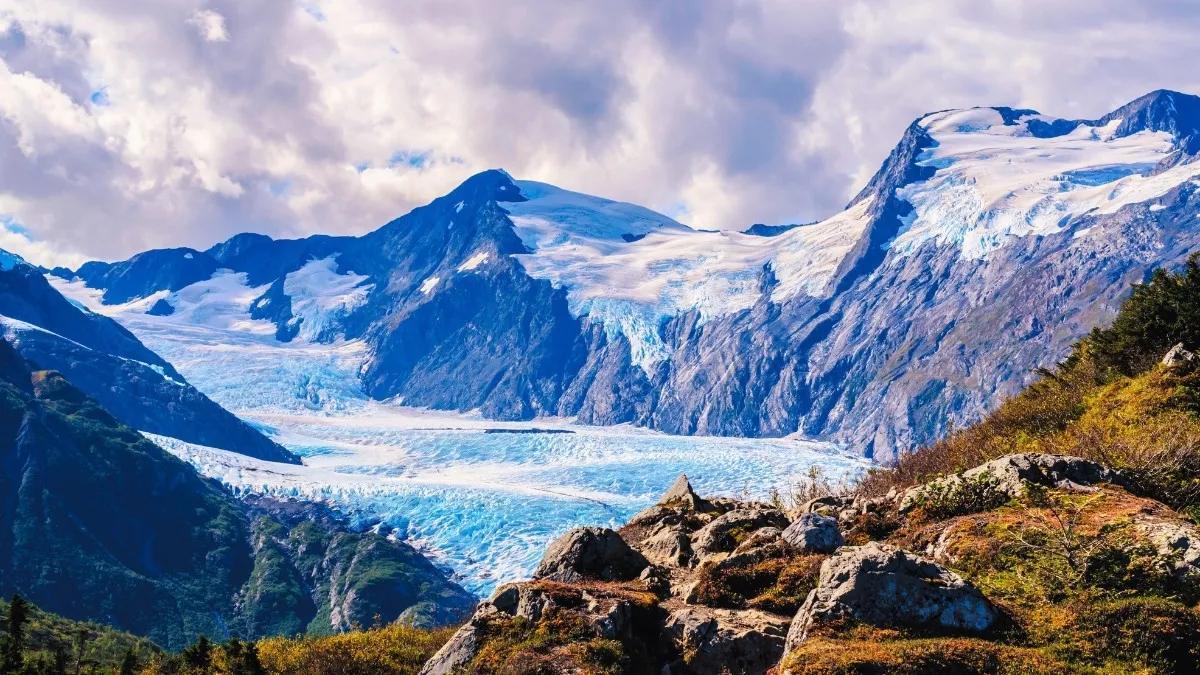
Alaska is this cold because it is located at a very high latitude, close to the Arctic Circle, where there are short days and long nights that lock in the cold.
Alaska is a very large state in the U.S., and it experiences very harsh freezes that affect travel, animals, and even life. But the residents have learned to cope with the cold by using heated clothing.
Alaska has the lowest temperature record in the U.S. of -80°F, which is much colder than the rest of the mainland, according to the National Weather Service at Prospect Creek in 1971.
Learn why is Alaska so cold, coldest spots, warm areas, 24-hour darkness and climate facts in this article.
Why is Alaska so Cold?
Alaska's cold climate is due to its location north of 60° latitude, which pulls Arctic air masses southward and prevents warm Pacific air from reaching there by ranges such as the Brooks Range.
The long nights in winter reduce the amount of sunlight, causing temperatures to drop below -50°F. Cold water currents, such as the Bering Sea flow, cause freezes.
Continental interiors, such as Fairbanks, average -40°F, while coastal areas are not as cold but are snowy. Snow has a high albedo, which reflects heat.
Check about the Capital of Alaska here.
Is Alaska the coldest place in the USA?
Yes, Alaska has the coldest state in the U.S., with the record lowest temperature of -80°F compared to -70°F in the continental states.
Interior valleys are where cold air pools get trapped, even colder than Antarctica’s stations. Fairbanks gets an average of -19°F in January; Utqiaġvik gets -20°F. There is no Lower 48 location comparable to the Arctic front.
Records:
-
Prospect Creek: -80°F (1971).
-
Fairbanks: -66°F low.
-
Big Delta: -60°F+ extremes.
Check Out What is a Glacier Outburst and is Alaska’s Juneau at risk?
Does it ever get warm in Alaska?
Alaska has warm summers above freezing, with Fairbanks reaching 90°F+ and Anchorage seeing 70°F averages in July. Coastal tempering prevents extremes, but interiors get a hot spell.
Long days, with as much as 24 hours of daylight, promote melting. Midnight sun hikes are in high season due to tourism.
Comparisons:
-
Coastal Juneau (One of the Largest Cities in Alaska): 60°F summers, rainy mild.
-
Interior: 80°F peaks, wildfire risks.
-
Arctic north: Stays 40-50°F max.
Is it ever dark for 24 hours in Alaska?
Yes, Northern Alaska above the Arctic Circle experiences polar night, with the sun below the horizon for 24 hours, from late November to mid-January, for 65+ days in Utqiaġvik.
Total darkness occurs in mid-December. The southern regions experience 4-6 hours of dim light. The residents fight SAD with lights and vitamin D.
Impacts:
-
Extreme cold worsens without solar heat.
-
Aurora viewing peaks in endless nights.
-
Midnight sun flips summers above Circle.
| Region | Avg Winter Low (°F) | Summer High (°F) | Polar Night Days |
| Interior (Fairbanks) | -19 | 75 | None |
| Arctic (Utqiaġvik) | -20 | 45 | 65 |
| Coastal (Anchorage) | 11 | 65 | None |
| Southeast (Juneau) | 23 | 64 | None |
(Source: NCEI)
Read here Why was Alaska’s Mt McKinley Renamed to Denali?
Alaska's extreme cold is a result of Arctic latitude, air currents, mountains, and darkness, creating a harsh yet beautiful environment. The above factors make one appreciate the power of nature, which in turn encourages respect for the people living in this sub-zero wonderland.



Comments
All Comments (0)
Join the conversation