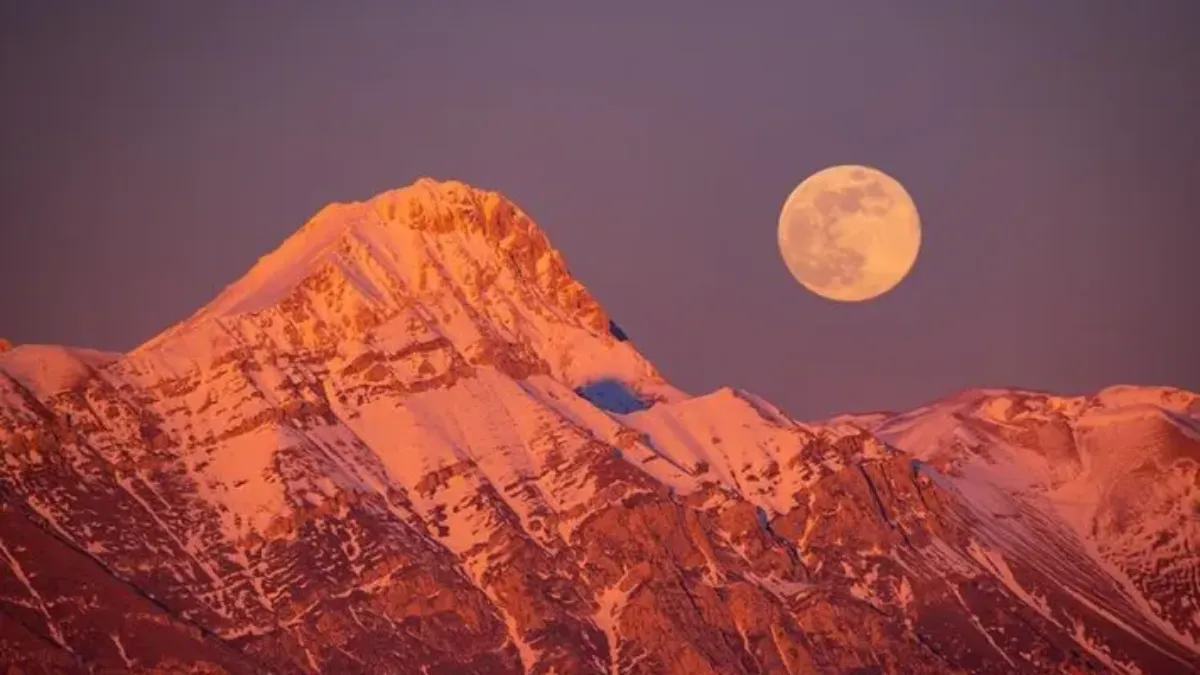
January 2026 will open with a bright Wolf Supermoon, the year's first full moon and one of its most photogenic sky events.
The Wolf Moon is the traditional name for January’s full moon in many North American and European sources, linked to wintertime wolf howls around villages and camps. In 2026 this full moon is also a supermoon, which means it occurs when the moon is near perigee, so it appears a little larger and brighter than an average full moon.
Astronomers generally define a supermoon as a full moon occurring within about 90% of the moon's closest distance to Earth in its orbit. This can make it appear up to roughly 14% larger and around 30% brighter than the smallest full moon of the year, though the difference is subtle to casual observers.
When is the January 2026 Wolf Supermoon?
The Wolf Supermoon will officially be full on Saturday, 3 January 2026, at about 10:03 GMT - which is 5:03 a.m. Eastern Time. That is the exact instant the moon is opposite the sun in the sky, but it should appear full to the naked eye for a couple of nights either side.
In practical terms, it means that skywatchers should consider the evenings of 2 and 3 January as the prime viewing window. On those dates the moon rises around local sunset and remains above the horizon for much of the night, allowing extended opportunities for viewing and photography.
Best time to See the Wolf Supermoon Rise
But for many of us, arguably the most memorable view will be moonrise on the evening of Saturday, 3 January 2026, as the Wolf Supermoon clears the eastern horizon. It can appear yellow or orange near the horizon because Earth's atmosphere scatters bluer light, and foreground silhouettes such as buildings or trees enhance an illusion of a huge moon.
Because moonrise times differ with every location, it is useful to try a planetarium app or local almanac for the exact moonrise for your city. As a general rule, look east shortly after sunset on 3 January, and if possible check the view on the previous evening too, for a comparison of the two nights.
How to view the Wolf Supermoon from your location?
It requires no special equipment to see the Wolf Supermoon besides a clear eastern horizon and relatively dark skies. For excellent views, observers in the Northern Hemisphere include North America, Europe, and much of Asia-the full phase conveniently occurs during nighttime or evening hours for many regions.
Viewed from cities, the perspective will be much better from an open vantage point such as a rooftop, balcony, waterfront or park that faces east. Rural observers can enjoy a much higher contrast sky, but even under urban light pollution this supermoon will remain a dominant striking feature of the night.
Recommended Reading:
List of 9 Fruits That Grow In the Desert
Why is January's full moon called the Wolf Moon?
The name "Wolf Moon" is most often attributed to traditional naming systems among certain Native American groups and later in colonial and European almanacs. The harsh winter conditions of January and reported howlings of wolves outside early settlements helped solidify the term in popular use.
Modern almanacs and astronomy guides today list “Wolf Moon” as the standard popular name applied to the January full moon each year. Other historic names might also be “Old Moon” or “Ice Moon,” but “Wolf Moon” is the most familiar in contemporary culture and media.
What makes the supermoon different?
A supermoon is a situation when a full moon coincides with the closest approach of the Moon to Earth, called perigee. In this case, the distance of the Moon can be as small as approximately 226,000 miles, or about 363,000 kilometers, which would make it somewhat bigger in angular size than an ordinary full moon.
This difference in size is modest, and casual observers might not even be aware of it except by comparing photographs of various full moons with the same equipment. However, put together increased apparent brightness and the psychological "moon illusion" near the horizon, and the supermoon feels particularly impressive.



Comments
All Comments (0)
Join the conversation