Show Key Points
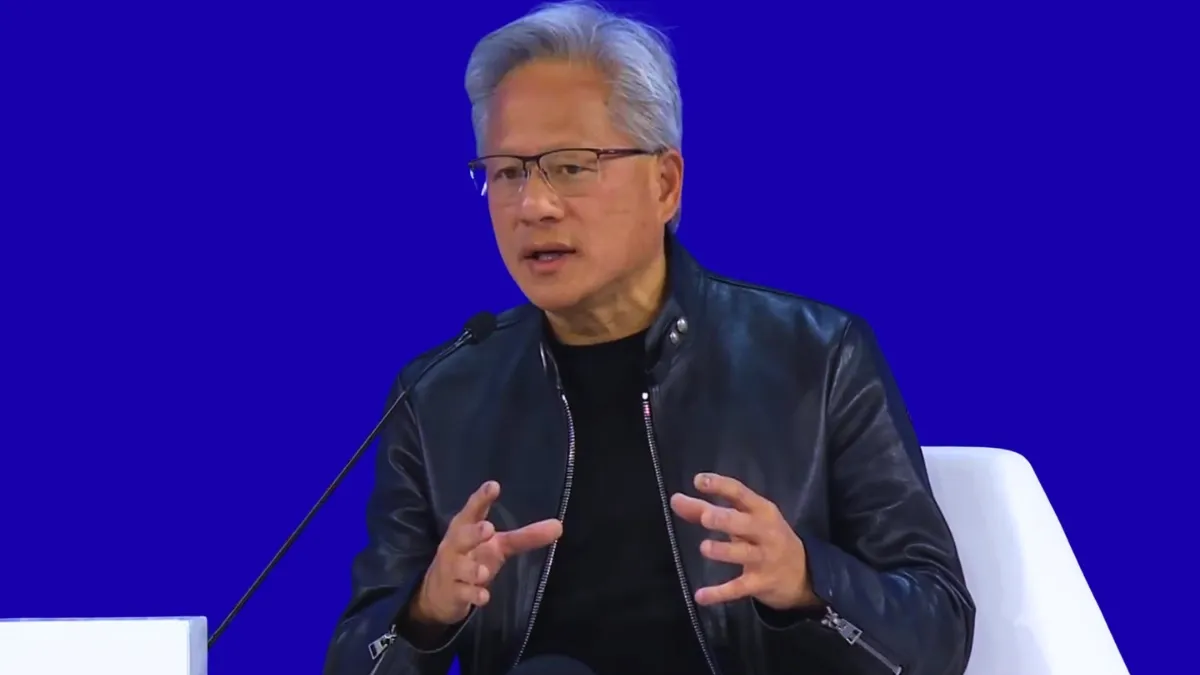
ensen Huang is the co-founder and CEO of Nvidia, a company that has redefined modern computing. Huang has transitioned from a chip designer to a global tech icon and becoming one of the world's wealthiest individuals. Huang's journey is a masterclass in persistence.
Jansen Huang's company Nvidia has become an engine room of the Artificial Intelligence (AI) Industrial Revolution. As of March 2026 Nvidia's market valuation rivaling the largest economies in the world.
Explores the man behind the machine, his early life, education, career, and his staggering net worth as of March 2026.
Who is Jensen Huang?
Jensen Huang is a Taiwanese-American billionaire who was born Jen-Hsun Huang on February 17, 1963, in Tainan, Taiwan. Jensen Huang holds a degree in electrical engineering, and is the visionary CEO of Nvidia Corporation.
Huang co-founded Nvidia in 1993 with a singular goal to bring 3D graphics to the gaming market.
Decades later, his bet-the-company moves into parallel computing and the CUDA platform have made Nvidia the primary provider of the GPUs (Graphics Processing Units) required for generative AI, autonomous vehicles, and quantum computing.
Life: From Tainan to the American Dream
Jensen Huang’s life is a story of resilience.Jen-Hsun Huang on February 17, 1963, in Tainan, Taiwan. His family moved to Thailand when he was five years old but due to regional instability in Thailand he and his brother were sent to the United States when he was nine.
In the United States Junsen and his brother were sent to Oneida Baptist Institute in Kentucky by his relatives due to some misunderstanding. The school then functioned as reformatory for troubled youth.
Junsen Huang spent his early years cleaning toilets and enduring bullying, an experience he claims taught him grit and the value of hard work. Huang worked as a dishwasher and waiter at a Denny’s in Portland, Oregon at the age of 15.It was at this same restaurant chain years later that he would sketch out the business plan for Nvidia on a napkin.
Family: Junsen Huang met his wife Lori Mills at Oregon State University where they were lab partners. Currently they have two children, Spencer and Madison.
Junsen Huang Education: Building a Technical Foundation
-
Oregon State University (1984): B.S. in Electrical Engineering.
-
Stanford University (1992):M.S. in Electrical Engineering (While working in the industry)
-
Jensen Huang was a gifted student who skipped two grades and graduated high school at 16.
Career: The Architect of AI
-
Early Career:Huang worked at AMD (Advanced Micro Devices) as a chip designer and later joined LSI Logic in a management role before Nvidia.
-
The Birth of Nvidia (1993): Alongside Chris Malachowsky and Curtis Priem, Huang launched Nvidia their first major success was the GeForce 256 in 1999, labeled the world’s first Graphics Processing Unit (GPU).
-
The AI Pivot: In 2006, Huang introduced CUDA, a programming model that allowed GPUs to solve complex mathematical problems outside of gaming and became the backbone of modern AI training.
-
2025-2026 Milestone: Nvidia became the first company to hit a $5 trillion market capitalization in late 2025.
-
In early 2026, he was awarded the IEEE Medal of Honor, the highest distinction in the field of technology.
Net Worth (March 2026)
Jensen Huang’s wealth is almost entirely tied to his ownership of Nvidia stock which is approximately 3.5%. Note: His net worth fluctuates daily based on the NASDAQ performance of NVDA shares.
| Metric | Details (Estimated March 2026) |
| Estimated Net Worth | $158 Billion – $176 Billion |
| Global Rank | Top 10 Richest People (currently #7 or #8) |
| Wealth Source | Nvidia (Semiconductors & AI Software) |
| Annual Growth | Over 100% increase since 2024 |
"The more you learn, the more you realize how little you know. I am a student for life." – Jensen Huang
Jensen Huang is just not a CEO, he is a pioneer who transformed a graphics company into the most critical infrastructure provider of the 21st century whether through the Blackwell chips or the new Vera Rubin architecture. Huang continues to push the boundaries of what is possible in computing.



Comments
All Comments (0)
Join the conversation