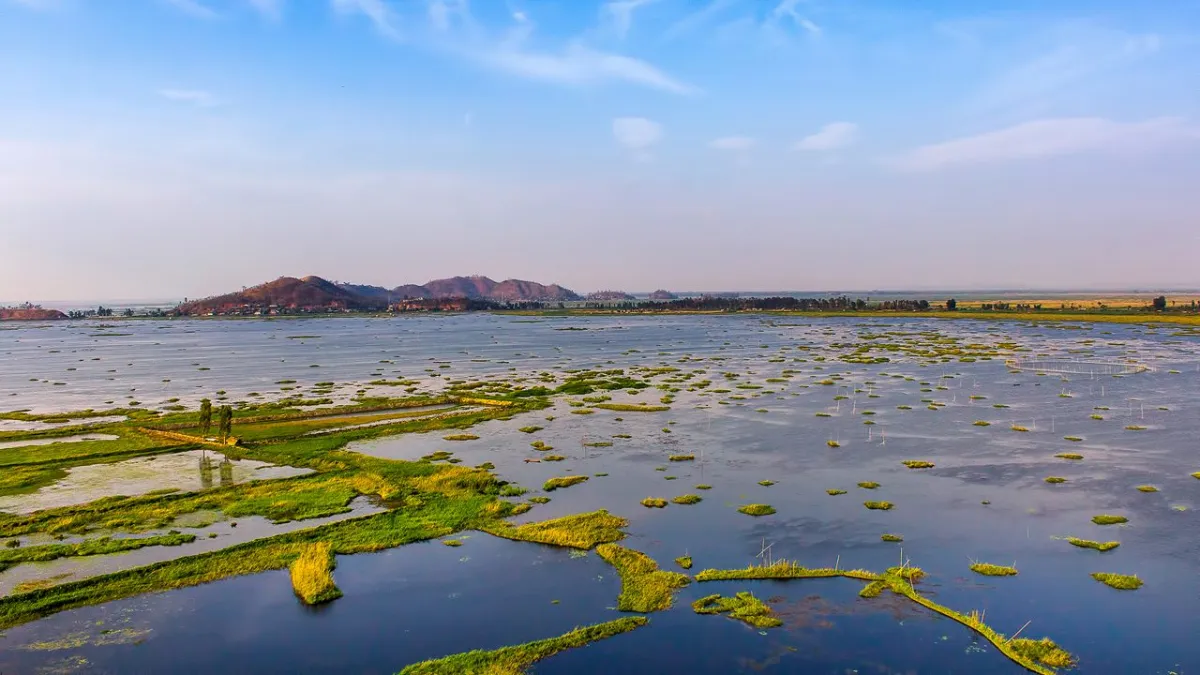
Imagine a floating park of the world Keibul Lamjao National Park in the ecologically distinct Loktak Lake, Bishnupor district, Manipur, is the only floating national park in the world built upon extraordinary phumdis.
It has floating beds of vegetation, soil and decaying organic matter which rise and fall with the water level during the seasons. It is the final natural habitat of the critically endangered Sangai deer (Rucervus eldii eldii), often called the dancing deer because of its unique hooves, designed to support the swampy terrain.
It has been a national park since 1977 (having previously become a wildlife sanctuary in 1966). The park is part of the largest freshwater lake in the whole of Northeast India (287 sq km), and it is a fascinating example of a vibrant wetland ecosystem that is recognized worldwide due to its biodiversity and geological rarity.
Such a surreal park on water appeals to eco-tourists, researchers and photographers who appreciate seeing a landscape that is literally floating around and changing with seasons and the wind.
What Are Phumdis? The Science of the Floating Park
The park is made up of phumdi, porous, heterogeneous rafts of dead vegetation (mostly Zizania latifolia reeds), soil particles and aquatic biomass, built up over centuries.
They are lightweight (0.3-0.6 g/cm3) and therefore can be lifted off by buoyancy, thus grasses, shrubs, and even trees can grow on them:
-
Seasonal Change: Increase 3-4 feet during monsoons; decrease in the dry months, leaving roots exposed.
-
Mobility: Islands move around with winds/currents; motion of boats is not allowed to maintain stability.
-
Uniqueness: There is no similar floating national park in the rest of the world - other phumdi scale/ecosystem complexes such as Uvs Nuur (Mongolia) are not as large.
-
Loktak is also maintaining 1,000+ phumdis; Keibul Lamjao is preserving the most dense one.
Park Stats:
| Metric | Details |
| Area | 40 sq km |
| Sangai Pop. | ~260 |
| Established | 1977 |
| Lake Size | 287 sq km |
| UNESCO Status | Tentative Heritage |
Why Does Keibul Lamjao Qualify as a Floating National Park?
The name is due to the fact that the whole landmass is floating on the Loktak Lake as opposed to the terrestrial parks or even other wetlands (e.g., Sundarbans mangroves). Tourists can feel like walking on water through a series of raised bamboo board walks and the surface is wavy.
It was founded to protect Sangai against extinction (the population dropped down to 14 by 1975) displaying the evolution of phumdi biome - tectonics, silt, and biomass accumulation over the course of millennia.
Also Read: Good Governance Day: Index, Top States & India's Efforts
Sangai Deer and Beyond: Biodiversity
Flagship Species:
-
Sangai Deer: 260 or so; wide hooves spread weight on phumdis; breeds in the months of October-December.
-
Others Mammals: Elds deer, hog deer, otters, fishing cats, jungle cats, civets, Indian python.
-
Avifauna: 200+ such as migratory Siberian cranes and spot-billed pelicans, herons, kingfishers, pheasant-tailed jacanas.
-
Flora: Water lilies (Nymphaea), lotus, wild rice, orchids, medicinal plants such as Euryale ferox.
Facing Ithai Barrage siltation and poaching; conservation through breeding centers.
History: Sanctuary to National Park
-
1966: Wildlife Sanctuary amid Sangai degradation.
-
1977: Elevated to National Park.
-
Ramsar Wetland was declared by Loktak in 1990.
-
2015: UNESCO Tentative List, Loktak Development Authority (LDA) established.
Keibul Lamjao National Park is a rare example of the resourcefulness of nature, as it is unique as it is floating on the phumdis of Loktak Lake and it is protecting the fragile lives of the Sangai deer in the colorful wetlands of Manipur. Since the park was formed back in 1977 to the present realization by UNESCO, it combines both the conservation of biodiversity with the Meitei culture and is thus attracting attention all over the world as the only floating national park on the planet.
Ithai Barrage Threats Suggest Emergency Wetland Restoration - Dredging by LDA and community patrols can give a beacon of hope to the 260 strong population of Sangai. Climate-adaptive phumdis makes it a template of resilient ecosystems in the world.
Also Read: Malayalam Language Bill, 2025: Key Provisions, Impact, and Other Issues




-1768398283970.jpg)
Comments
All Comments (0)
Join the conversation